



For Bitcoin holders across Southeast Asia, the Bitcoin quantum freeze proposal now under discussion has turned a distant cryptography risk into a live governance question: should older, quantum-vulnerable coins be pushed into new scripts, or eventually left unspendable if the network adopts a post-quantum migration path?
The BIP-361 draft, titled “Post Quantum Migration and Legacy Signature Sunset,” lists Jameson Lopp, Christian Papathanasiou, Ian Smith, Joe Ross, Steve Vaile, and Pierre-Luc Dallaire-Demers as authors. It reached the public bitcoin/bips repository in an April 14, 2026 commit at 14:36:41 UTC, moving the quantum debate from theory into a formal Bitcoin Improvement Proposal.
TLDR Keypoints
- Phase A would only allow legacy outputs to move into post-quantum scripts after 160,000 blocks, or about three years, from activation.
- Phase B would later reject ECDSA and Schnorr spending at a predetermined block height set two years after Phase A, freezing unmigrated legacy coins unless a later recovery path is adopted.
- The draft says over 34% of all bitcoin had already revealed a public key on-chain by March 1, 2026.
What the draft would actually change
This is a draft Bitcoin consensus proposal, not an activated network rule and not a regulatory action. In the BIP, “quantum-vulnerable” mainly means UTXOs whose public keys are already exposed on-chain, a category the authors said covered over 34% of all bitcoin as of March 1, 2026.
If the network adopted BIP-361, Phase A would begin after 160,000 blocks, or roughly three years, from activation. From that point, legacy outputs could still move, but only into new post-quantum script types described in the draft.
Phase B goes further: the proposal says transactions relying on ECDSA or Schnorr keys would be rejected at a predetermined block height set two years after Phase A activation. In practice, that would freeze spending from quantum-vulnerable legacy outputs rather than let them remain spendable indefinitely.
The document also sketches a Phase C, but the recovery mechanism is still to be determined. That missing detail is central because it decides whether frozen coins are permanently locked or later recoverable under some new process.
Why backers prefer a sunset to recovery
Why supporters think acting early matters
The argument for a freeze is rooted in the earlier BIP-360 draft, which said its Pay-to-Merkle-Root design only resists long-exposure attacks and that short-exposure attacks may still require post-quantum signatures. The later BIP-361 proposal is harsher because it tries to close that broader attack surface instead of protecting only coins that have been exposed for a long time.
That logic is easier to understand when set beside the draft’s over 34% estimate. If more than a third of bitcoin is already sitting in outputs with revealed public keys, supporters argue the network has a stronger case for forced migration than for waiting until a real attacker appears.
In a separate essay, Lopp argued against letting quantum attackers become de facto redistributors of old coins. His case is that recovery after theft would still dilute untouched holders because the market would have to absorb coins taken through broken cryptography.
“Quantum recovered coins only make everyone else’s coins worth less. Think of it as a theft from everyone.”
Jameson Lopp
The backdrop is not a law, but it is time-sensitive. BIP-360 cites CNSA 2.0 migration deadlines by 2030 and planned U.S. federal disallowance of elliptic-curve cryptography after 2035, which helps explain why the authors are discussing a sunset path before large-scale quantum hardware is available.
What holders and the market should watch next
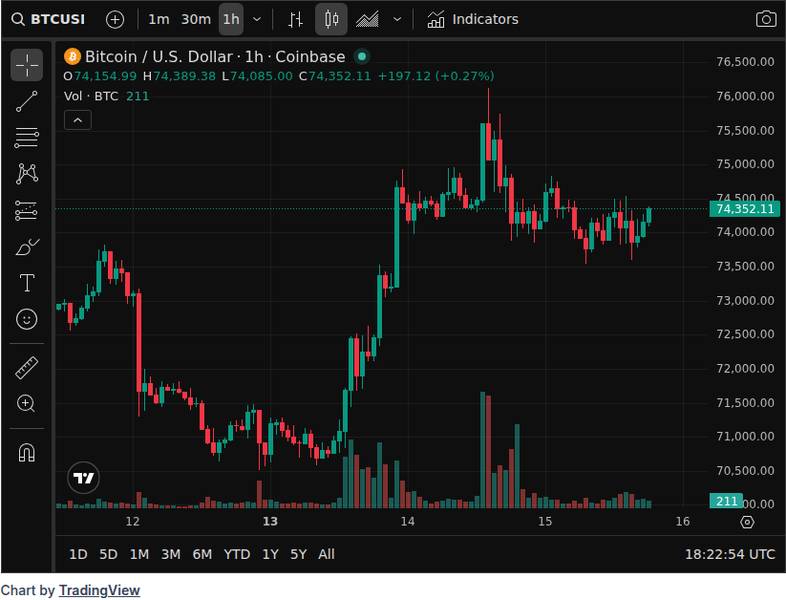
Bitcoin changed hands at $74,341, with a market cap near $1.49 trillion and 24-hour volume around $41.28 billion. The Fear and Greed Index at 23, or Extreme Fear, suggests the proposal is landing in a market that is already cautious about long-term security risk.
For holders of older addresses, the practical issue is simple. If Phase B ever takes effect, coins that still need legacy signatures would be frozen unless the network later adopts the still-undefined Phase C recovery path.
That tradeoff cuts directly into Bitcoin’s norms around ownership and self-custody. Because the draft ties its case to the share of bitcoin already exposed on-chain, the coming debate is likely to focus on whether network defense justifies freezing coins that have not yet been stolen.
For Southeast Asian users, the near-term implication is operational rather than dramatic. The same over 34% exposure estimate gives exchanges, custodians, and wallet providers a reason to audit how much old address risk still sits in customer balances and inherited holdings.
Because the draft pairs a 160,000-block migration window with a later signature sunset in Phase B, that matters for regional infrastructure builders following Atlas Launches on Rootstock With BTC, ETH and USDC Support, for traders tracking rotation signals in South Korea Crypto Trading Volume Signals Altcoin Tilt, and for crypto-linked equities reacting to headline risk in Online Casino Operator Stock Surges on Crypto.com Deal. A consensus fight over which bitcoin outputs remain valid would not stay confined to protocol mailing lists.
The next milestone is not activation but review. With the draft only entering the repository in the April 14, 2026 commit, readers should watch whether Bitcoin developers converge on a reference implementation, and whether Phase C becomes a burn mechanism, a recovery process, or a political non-starter.
Disclaimer: This article is for informational purposes only and does not constitute financial or investment advice. Cryptocurrency and digital asset markets carry significant risk. Always do your own research before making decisions.