



South Korea’s crypto trading volume continues to rank among the largest in the world, but viral claims that the country accounts for 30% of global volume with 85% in altcoins appear to blend separate datasets. Verified data from Kaiko paints a more nuanced picture of a retail-driven, altcoin-heavy market now facing questions about institutional access.
What Kaiko’s verified data says about South Korea’s crypto market share
A widely circulated headline claimed South Korea accounts for 30% of global crypto trading volume, with altcoins at 85% and Bitcoin near 9%. According to unconfirmed reports, those figures appear to combine multiple Kaiko publications covering different timeframes and methodologies.
The closest verified figure comes from Kaiko’s own research: KRW-denominated markets held a 35% global share of fiat-denominated crypto trading in Q1 2025, not 30%. That made KRW the second-largest fiat currency for crypto trading worldwide.
Full-year 2024 KRW-denominated trading volume exceeded $1.1 trillion, with Korea’s Big Four exchanges accounting for around 10% of global spot volume. These are substantial figures, but they measure different things than the headline implied.
The distinction matters. A 35% share of fiat-denominated volume is not the same as 30% of all global crypto trading, which includes stablecoin pairs and crypto-to-crypto markets. The headline likely compressed separate Kaiko findings into a single soundbite.
Why South Korea remains one of the most altcoin-heavy major crypto markets
The altcoin-dominance claim is directionally correct even if the exact 85% figure cannot be confirmed from a single dataset. Kaiko reported that altcoins represented around 80% of trading volume on Korea’s Big Four exchanges in 2024.
The gap between Korean and American exchange composition is stark. Bitcoin made up just 30% of the top 10 KRW trading pairs, versus roughly 70% on U.S. exchanges. That inversion reflects a fundamentally different retail appetite, one that has persisted for years, similar to how tokenized asset experiments in Korea signal broader interest in non-Bitcoin digital assets.
Upbit, the dominant Korean exchange, illustrates the extreme end of this tilt. In 2023, just 9% of Upbit’s volume came from BTC and 2% from ETH, leaving roughly 89% in altcoins. That concentration has no equivalent among major U.S. platforms.
By 2025, KRW-denominated crypto trading reached $663 billion, and domestic Korean platforms accounted for nearly 50% of altcoin trading volume compared with U.S. exchanges, but only 10% of Bitcoin volume. The altcoin skew is not just a quirk; it defines the market.
Why this market structure matters for Bitcoin liquidity and the next policy phase
South Korea’s altcoin tilt shapes its Bitcoin liquidity profile in ways that become visible during stress events. During the December 2024 martial-law crisis, Bitcoin demand spiked sharply on Korean platforms even as the broader market remained altcoin-heavy.
Average 1% BTC market depth on major Korean platforms reached about $1.3 million in Q1 2025, a figure that reflects the relatively thin Bitcoin order books in a market where most capital flows to smaller tokens. For context, recent volatility in ETH-heavy treasury positions has shown how concentrated exposure to non-Bitcoin assets can amplify losses.
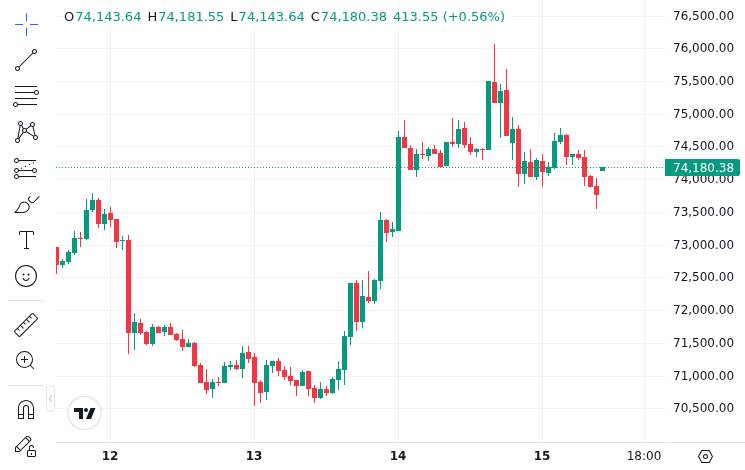
Bitcoin traded near $74,181 at press time, down roughly 0.8% over 24 hours, with the Fear & Greed Index sitting at 23, classified as Extreme Fear. That risk-off sentiment aligns with Kaiko’s description of weaker bullish demand and a 57% year-to-date drop in KRW trading volumes during South Korea’s political uncertainty.
Kaiko describes South Korea as a tightly regulated, retail-dominated market shaped by VASP registration rules, strict capital controls, and the absence of local crypto derivatives infrastructure. Those constraints help explain persistent pricing anomalies like the kimchi premium, as well as fragmented local pricing that new institutional platforms may eventually help normalize.
The debate over whether South Korea will approve spot Bitcoin ETFs or open institutional access to crypto derivatives hinges on this market structure. A market where 80% of volume flows through altcoins and Bitcoin depth remains thin presents different risks than one anchored by BTC-heavy institutional flows. Any regulatory opening would reshape not just Korean markets but the global altcoin liquidity landscape that depends on them.
Disclaimer: This article is for informational purposes only and does not constitute financial or investment advice. Cryptocurrency and digital asset markets carry significant risk. Always do your own research before making decisions.