


Atlas, a cross-chain bridging application, is now live on Rootstock with support for BTC, ETH, USDC, and additional digital assets, expanding the multi-asset toolkit available to users of the Bitcoin-linked smart contract network.
The launch was confirmed through the live product at atlas.rootstock.io, where the application’s frontend defines Rootstock, Ethereum, Bitcoin, BNB Smart Chain, and Lightning Network as supported networks.
TLDR KEY POINTS
- Atlas is live on Rootstock with routing that requires one side of every swap to be on the Rootstock network.
- Supported assets at launch include RBTC, ETH, USDC, USDT, WBTC, and BTC via both Bitcoin and Lightning Network.
- Rootstock context: the network claims over 20 bridged blockchains, more than 150 ecosystem partners, and 100% uptime since 2018.
What Atlas Going Live on Rootstock Means
Atlas is a bridging interface, not a standalone blockchain. Its routing logic filters provider-supported pairs so that either the source or destination network must be Rootstock, making it a Rootstock-first tool rather than a general-purpose cross-chain aggregator.
That design choice ties the product directly to the Rootstock ecosystem, which positions itself as an EVM-compatible smart contract layer secured by Bitcoin’s hashrate. Rootstock states it can bring assets from over 20 leading blockchains including Bitcoin, Ethereum, Arbitrum, and Base.
The network also claims more than 150 ecosystem partners and 100% uptime since its 2018 launch, a track record that provides infrastructure context for why a new bridging product would choose Rootstock as its anchor chain.
Supported Assets: BTC, ETH, USDC, USDT, WBTC, and RBTC
Atlas’s token configuration, visible in the live frontend bundle, lists a specific set of assets per network. On Ethereum, the supported tokens are ETH, USDC, USDT, and WBTC. On Bitcoin and Lightning Network, the exposed asset is BTC. On Rootstock itself, the native asset is RBTC.
The inclusion of both Bitcoin mainchain and Lightning Network as separate source networks is notable. It means users can route BTC to Rootstock through either layer, with Lightning offering faster settlement for smaller amounts, a pattern that may appeal to users already familiar with altcoin trading volume trends shifting toward faster execution paths.
USDC and USDT support gives Atlas stablecoin utility from day one. For users looking to move dollar-denominated value onto Rootstock without first converting to BTC, this is a practical on-ramp. The addition of WBTC rounds out the set by allowing wrapped Bitcoin holders on Ethereum to bridge directly.
Why This Launch Matters for Rootstock and Bitcoin DeFi
Rootstock’s value proposition has always centered on bringing programmability to Bitcoin without leaving Bitcoin’s security model. Atlas adds a concrete user-facing product to that pitch by letting users move assets onto the network from multiple chains in a single interface.
The broader Bitcoin DeFi sector has drawn increasing attention. According to unconfirmed reports from secondary coverage, BTCFi reached $4.7 billion in Q1 2026, though that figure was not independently verified from a primary dataset. If directionally accurate, it frames Atlas’s launch as entering a growing market rather than a stagnant one.
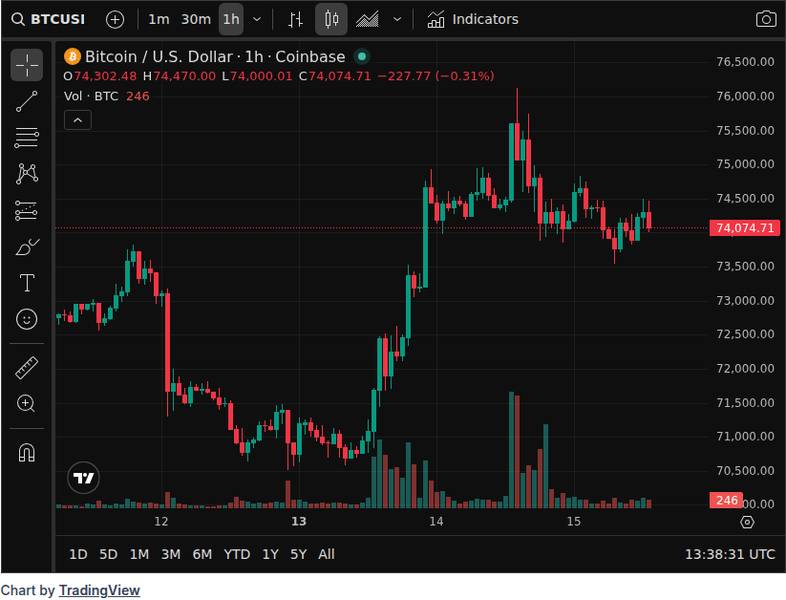
Bitcoin itself traded near $74,344 at the time of this writing, with a market capitalization of roughly $1.49 trillion and 24-hour trading volume above $52 billion.
The Fear and Greed Index sat at 23, in “Extreme Fear” territory. That sentiment backdrop is worth noting for context: Atlas is launching into a market where caution dominates, similar to the conditions seen when Bitmine reported significant losses tied to volatile treasury positions.
For Rootstock specifically, a working bridge product with multi-asset support is a concrete ecosystem addition. Projects like Paxos Labs building digital asset infrastructure for US platforms illustrate the broader industry trend of building connective tissue between chains and traditional finance, and Atlas fills a similar connector role within Rootstock’s ecosystem.
According to unconfirmed secondary coverage, Atlas plans Q2 2026 additions including Arbitrum and Polygon support, plus custody integrations with Cobo, Fireblocks, Fordefi, and Utila. That roadmap was not independently confirmed from official Atlas materials, but if executed, it would significantly expand the product’s reach beyond its current five-network footprint.
Disclaimer: This article is for informational purposes only and does not constitute financial or investment advice. Cryptocurrency and digital asset markets carry significant risk. Always do your own research before making decisions.