


Bitmine Immersion Technologies posted a net loss of $3.82 billion for the quarter ended February 28, 2026, driven almost entirely by unrealized losses on its massive Ethereum holdings. The filing, submitted to the SEC on April 14, 2026, underscores the volatility risk embedded in corporate crypto-treasury strategies even as Bitmine continued expanding its ETH position after quarter-end.
What Bitmine reported in its latest SEC filing
Bitmine Immersion Technologies filed a Form 10-Q with the SEC on April 14, 2026, covering the three months ended February 28, 2026. The filing reported a net loss of $3,818,413,000 for the quarter.
As of February 28, 2026, the company held ETH and BTC at fair values of $8.79 billion and $13.07 million respectively, with $879.58 million in cash on hand. The scale of those digital-asset holdings relative to cash illustrates how heavily Bitmine’s balance sheet is tilted toward crypto.
The 10-Q is a formal SEC disclosure, not a secondary news report. All dollar amounts in the filing are presented in thousands, meaning the line item “(3,818,413)” maps to the $3.82 billion net loss figure now circulating in headlines.
Why the loss was mostly an unrealized ETH markdown
Of the $3.82 billion quarterly loss, $3.78 billion came from unrealized changes in the fair value of Bitmine’s digital-asset holdings. This was not a cash operating loss or the result of selling ETH at a discount.
The accounting treatment traces to FASB ASU 2023-08, which requires companies holding eligible digital assets to mark them to fair value each reporting period, with changes flowing directly into net income. When ETH prices fell during the quarter, Bitmine’s income statement absorbed the full paper loss.
This distinction matters for readers evaluating the headline figure. The company did not burn $3.82 billion in operations or liquidate positions at a loss. The remaining $43 million gap between the unrealized digital-asset loss and total net loss reflects other operating costs, but the ETH markdown dominated the quarter’s result. For context on how institutional digital-asset platforms are evolving, Paxos recently raised $12 million to build new infrastructure for U.S. platforms.
How the filing changes the market read on Bitmine’s ETH strategy
Despite the paper loss, Bitmine kept buying. A separate SEC-filed press release dated April 13, 2026 disclosed that as of April 12, the company held 4,874,858 ETH, equal to 4.04% of the 120.7 million ETH supply. Total crypto, cash, and what Bitmine calls “moonshots” holdings stood at $11.8 billion.
That post-quarter expansion suggests the treasury strategy remains intact regardless of short-term price swings. Bitmine describes itself as the largest Ethereum treasury company, though that claim comes from the company’s own disclosure and has not been independently verified against a comprehensive peer ranking.
Tom Lee, referenced in Bitmine’s SEC-filed press release, noted that the company has staked more ETH than other entities in the world. The staking component adds yield but does not insulate the balance sheet from fair-value swings under current accounting rules.
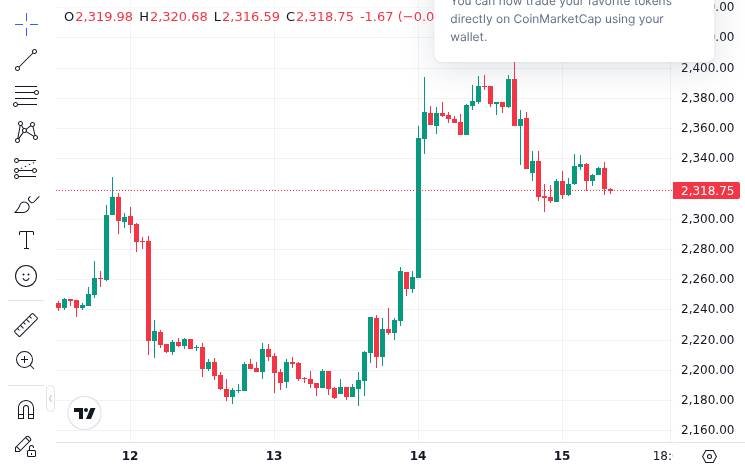
ETH traded at $2,320.57 on April 15, 2026, down 1.9% over 24 hours. The Fear and Greed Index sat at 23, labeled Extreme Fear, reflecting broad risk-off sentiment across crypto markets.
For investors tracking how tokenized asset experiments and corporate crypto strategies are playing out across the industry, Bitmine’s filing offers a concrete case study in what FASB fair-value accounting means for ETH-heavy balance sheets. The 10-Q also warns that evolving U.S. and foreign digital-asset regulation could further affect the business.
Bitmine’s next quarterly filing will reveal whether the post-quarter ETH accumulation paid off or deepened the paper losses, a question that hinges entirely on where ETH prices land by the end of May 2026. As platforms like X roll out new cashtag features for tracking crypto tickers, retail visibility into stories like Bitmine’s treasury risk is only increasing.
Disclaimer: This article is for informational purposes only and does not constitute financial or investment advice. Cryptocurrency and digital asset markets carry significant risk. Always do your own research before making decisions.