



Key Points:
- Zama token sale CoinList represents a true public price discovery event, starting from a $55M FDV floor, a sharp contrast to the project’s ~$1B private valuation.
- The combination of a sealed-bid Dutch auction and 100% unlock at TGE means post-TGE price action will be driven by market behavior, not vesting mechanics.
- ZAMA’s TGE should not be viewed through traditional bull, base, or bear price targets, but through how the market assigns the token’s role: distribution token, early infrastructure bet, or strategic infrastructure asset.
With only a few hours remaining, Zama’s public token auction is set to go live today, marking the execution phase of a token sale that was disclosed earlier. While CoinList was previously announced as a distribution partner, today’s event represents the moment when ZAMA officially enters real-time public price discovery.

Registration for the auction is already open, allowing participants to complete verification and familiarize themselves with the bidding interface ahead of time. The auction itself is conducted on-chain using a sealed-bid Dutch auction mechanism powered by Zama’s Fully Homomorphic Encryption (FHE) stack.
What makes this public auction notable is not its timing, but its structure. With a $55 million FDV floor, 100 percent unlock at TGE, and encrypted bid submission, the Zama public auction creates a rare setup where pricing is determined almost entirely by market perception, rather than vesting schedules or artificial supply constraints.
Zama Overview and the Context Behind the Token Sale
Zama is an open-source cryptography company focused on Fully Homomorphic Encryption (FHE), a technology that allows computation on encrypted data without ever decrypting it.
Before launching its public token sale, Zama raised over $130 million across private funding rounds, with its most recent valuation landing around $1 billion. These valuations were established before any public token trading, reflecting long-term private market expectations rather than real-time supply-demand dynamics.
The public auction marks the first moment ZAMA is priced by the open market, making today’s event a structural shift rather than a new announcement.
How the Zama Token Sale on CoinList Works
Zama’s public sale uses a sealed-bid Dutch auction, a structure rarely applied at this scale. All tokens purchased are fully unlocked and become usable at TGE (February 2, 2026).
Key parameters
- Floor price: $0.005 per ZAMA
- Floor FDV: $55 million
- Total supply: 11 billion ZAMA
- Tokens sold: 12% total supply
- 2%: community sale (OG NFT holders)
- 8%: main auction via CoinList
- 2%: post-auction sale at clearing price
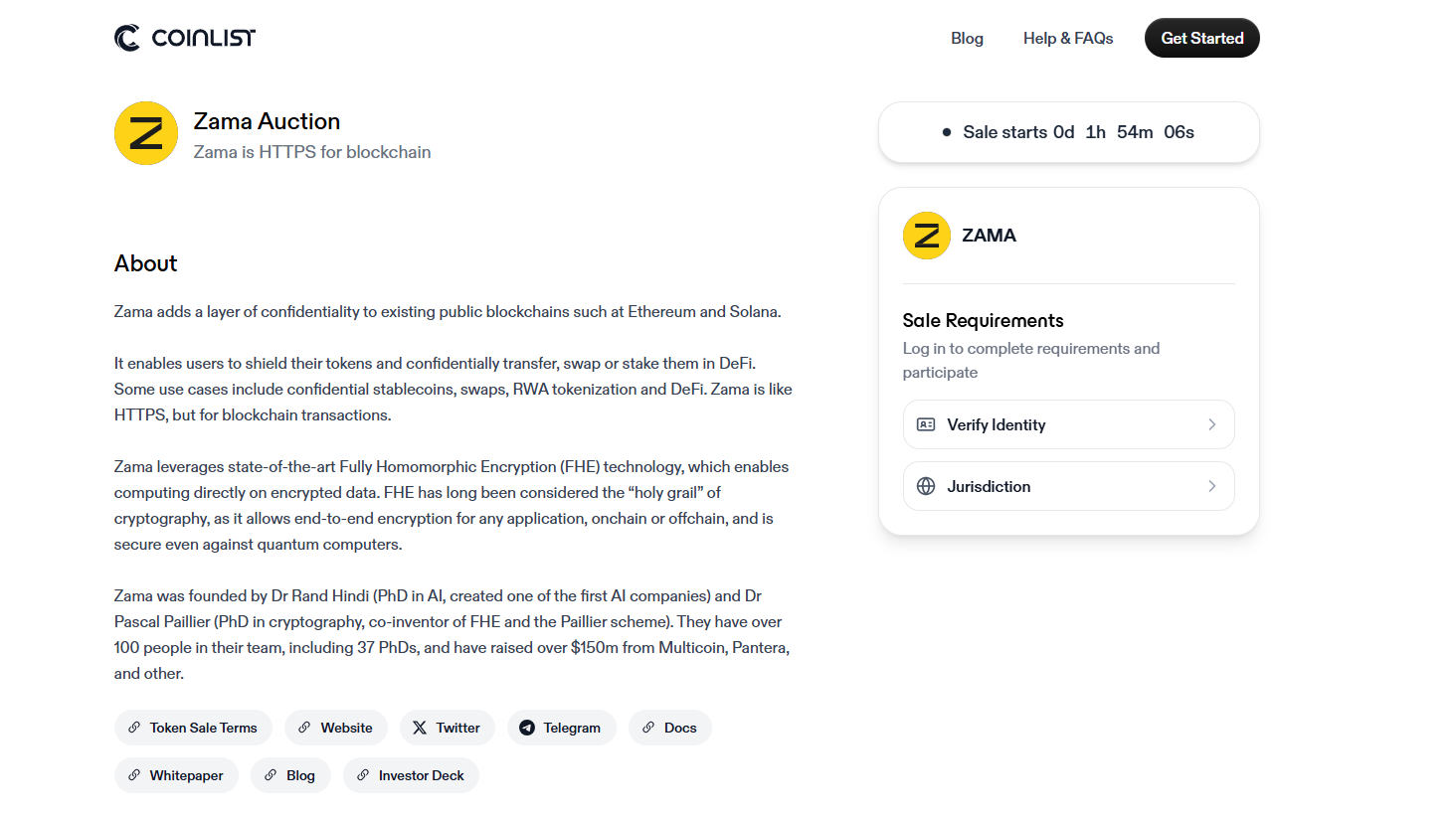
A closed-bid Dutch auction eliminates many irregularities commonly seen in open sales. Participants submit their maximum desired quantity anonymously, with bid values kept encrypted throughout the process.
After the auction closes, a single clearing price is determined, and all successful bidders receive tokens at that same price. This format helps curb front-running, gas wars, and FOMO-driven behavior.
As a result, the auction is designed to surface true willingness to pay, producing a cleaner signal of market demand rather than a race driven by speed or hype.
Why Is the Public Sale FDV Only $55M?
At first glance, launching a public token sale at a valuation nearly 20 times lower than prior private rounds may look like a down-round. In reality, the $55M FDV should be understood as a starting point for public price discovery, not a reassessment of Zama’s long-term value.
Private valuations were set in an environment with no public liquidity and no immediate token utility pressure. The public auction introduces open market dynamics where price is shaped by real demand, risk appetite, and short-term behavior, rather than venture-style long-term assumptions.
Zama has structured this offering not as a fundraising event, but as a token distribution mechanism aimed at seeding adoption among users, validators, and operators. In this context, the low FDV floor functions as an anchor, not a ceiling, allowing the market to determine value organically from day one.
How to Read ZAMA’s TGE: A Market-Behavior Framework
| Market State | How ZAMA Is Priced | Auction Behavior | Post-TGE Behavior | FDV Range | What It Really Means |
|---|---|---|---|---|---|
| Distribution Phase | Pure auction distribution token | Bids cluster near floor | Early profit-taking, rotation | ~$100M – $300M | Neutral price discovery, not a failure |
| Early Infra Bet | Early-stage FHE infrastructure | Clearing price well above floor | Selective holding, limited sell pressure | ~$400M – $800M | Fair public-market valuation |
| Strategic Infra Re-rating | Long-term strategic infrastructure | Aggressive competitive bidding | Long-term holding behavior | > $1B | Narrative-driven re-rating, higher risk |
Who the Zama Token Sale Is and Isn’t For
The Zama token sale is not designed for participants seeking predictable short-term gains or tightly managed post-TGE price behavior. With 100 percent of tokens unlocked at TGE, volatility should be expected.
Investors who rely on vesting schedules or supply constraints to manage downside risk may find this structure less attractive, particularly given the absence of proven token demand today.
The sale is better suited for participants who understand public market price discovery risk and view Zama as a long-term infrastructure thesis, rather than a short-term trading opportunity.
| Disclaimer: This website provides information only and is not financial advice. Cryptocurrency investments are risky. We do not guarantee accuracy and are not liable for losses. Conduct your own research before investing. |