



TLDR KEY POINTS
- White House crypto advisor Patrick Witt argues GENIUS Act-compliant stablecoins will channel global capital into US banks, not drain deposits.
- Banks counter with a Treasury study warning that up to $6.6 trillion in deposits could migrate to yield-bearing stablecoins.
- Southeast Asian regulators face a dilemma: USD stablecoin dominance risks accelerating dollarization across ASEAN economies.
White House crypto advisor Patrick Witt said stablecoins compliant with the GENIUS Act will funnel global deposits into the US banking system, directly countering fears from major banks that stablecoin yields could trigger a $6.6 trillion deposit exodus. The argument carries significant weight for Southeast Asia, where approximately 99% of stablecoin usage is denominated in US dollars.
Witt, the executive director of the President’s Council of Advisors for Digital Assets, posted on X on March 11 that foreign demand for dollar-backed stablecoins effectively creates net new capital for American banks. “Global demand for USD is massive. Foreigners exchange local currency for stablecoins from a US-based issuer,” Witt wrote. “That is net new capital entering the American banking system.”
His logic is straightforward: when a user in Jakarta or Manila converts local currency into USDC or USDT, the issuer deposits those reserves in a US bank. The GENIUS Act, signed into law in July 2025, mandates that stablecoin issuers fully back tokens with cash or cash-equivalent assets and prohibits lending or rehypothecating those reserves.
Witt framed the bank opposition as misleading in an earlier X post, calling it “deceit” to argue that paying yield alone requires bank-level regulation.
The deceit here is that it is not the paying of yield on a balance per se that necessitates bank-like regulations, but rather the lending out or rehypothecation of the dollars that make up the underlying balance. The GENIUS Act explicitly forbids stablecoin issuers from doing the… https://t.co/il0dihdbwM
— Patrick Witt (@patrickjwitt) March 4, 2026
Source: @patrickjwitt on X
Banks Warn of $6.6 Trillion Deposit Flight
The banking industry sees it differently. A Treasury advisory council study identified $6.6 trillion in US transactional deposits as “at risk” from stablecoin competition. JPMorgan CEO Jamie Dimon has argued that paying yield on held balances makes stablecoins functionally identical to bank deposits.
“Rewards are the same as interest. If you are going to be holding balances and paying interest, that’s the bank. You should be regulated by a bank,” Dimon stated. American Bankers Association President Rob Nichols echoed this, warning against “an uneven playing field” where crypto firms offer bank-like products without equivalent regulatory standards.
President Trump has pushed back sharply. He stated that banks are holding the broader CLARITY Act “hostage” and called the obstruction “unacceptable.” The White House has held at least three rounds of talks between banks and crypto firms to broker a compromise on stablecoin yield provisions.
Stablecoin Market Hits $314 Billion Amid Extreme Fear
The global stablecoin market grew 0.9% over the past week to surpass $314 billion, even as broader crypto sentiment remains deeply negative. The Crypto Fear & Greed Index sat at 18 on March 12, marking its fourth consecutive week in “Extreme Fear” territory.
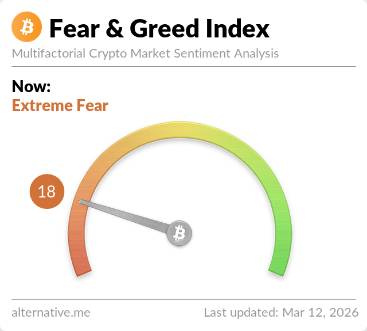
The divergence is notable. Stablecoin supply continues expanding while risk assets contract, suggesting institutional and cross-border demand for dollar-pegged tokens persists regardless of speculative sentiment. The GENIUS Act framework has given issuers regulatory clarity that is accelerating this growth.
What Witt’s Argument Means for Southeast Asian Banking
Witt’s deposit-inflow thesis has a flip side that directly affects ASEAN economies. If stablecoins channel global capital into US banks, that capital flows from somewhere, and Southeast Asia is one of the largest sources of USD stablecoin demand outside of the United States.
The ASEAN+3 Macroeconomic Research Office (AMRO) has flagged that approximately 99% of the stablecoin market is USD-denominated, creating what regional policymakers call “unintended dollarization risk.” When Indonesian or Filipino users convert rupiah or pesos into USDC, those funds effectively leave the domestic banking system and enter American financial infrastructure.
The region is responding with a patchwork of regulatory approaches. Singapore’s Monetary Authority (MAS) has licensed six to eight stablecoin operators under its Major Payment Institution framework, including Circle, Paxos, and StraitsX. Indonesia’s financial supervisor OJK took over crypto oversight from commodities regulator Bappebti in a move toward treating digital assets as financial products. Thailand’s SEC expanded its approved cryptocurrency list to include USDC and USDT in March 2025.
The ASEAN digital assets market is projected to reach $11.6 billion in revenue by 2026, with cross-border payments and remittances driving much of that growth. Stablecoins have become everyday infrastructure in Vietnam for remittances and savings, while the Philippines’ corridor economy relies heavily on dollar-denominated transfers.
For regional exchanges like Indodax, Tokocrypto, and Coins.ph, Witt’s vision of regulated stablecoins as a deposit magnet creates both opportunity and risk. Greater stablecoin adoption could increase trading volumes, but the accompanying capital outflows could pressure local banking systems and weaken central bank control over monetary policy.
CLARITY Act Stalemate and What Comes Next
The broader stablecoin yield debate remains unresolved. While the GENIUS Act established the regulatory framework for stablecoin reserves and issuance, the question of whether issuers can pay yield on held balances is being negotiated as part of the CLARITY Act, the comprehensive crypto market structure bill currently stalled in the Senate.
Senators on the Banking Committee are working on compromise language, with a potential markup hearing dependent on resolving the yield question. The GENIUS Act’s implementing regulations are due by July 18, 2026, one year after enactment, which sets a hard deadline for operational clarity.
For Southeast Asian regulators, the outcome will shape how aggressively they need to develop local alternatives. Multiple ASEAN nations are exploring central bank digital currencies (CBDCs) and local-currency stablecoins to counterbalance USD dominance. A multi-currency stablecoin corridor across Northeast and Southeast Asia is emerging as a 2026 priority.
Disclaimer: This article is for informational purposes only and does not constitute financial advice. Cryptocurrency investments carry significant risk. Always conduct your own research before making investment decisions.