


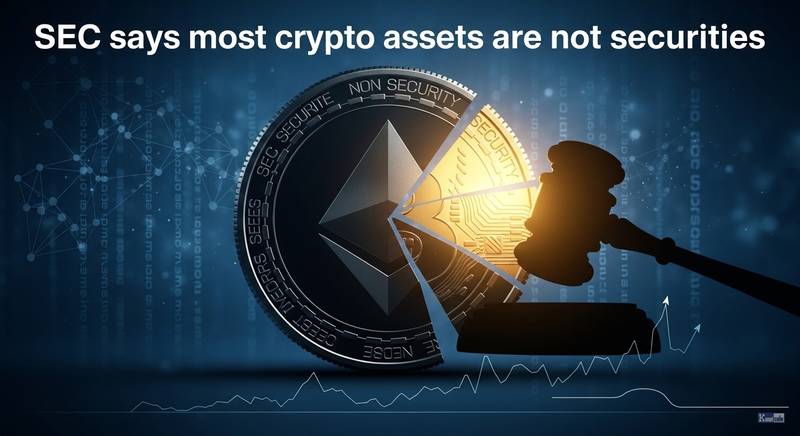
The claim that the SEC says most crypto assets are not securities is directionally tied to a softer 2025 U.S. policy stance, but the official record is narrower. The clearest verified actions are SEC staff statements on certain Bitcoin mining and certain protocol staking activities, while broader language on “most crypto assets” and some airdrops came from Commissioner Hester Peirce’s remarks rather than a binding Commission vote or rule.
That distinction matters for Southeast Asian readers because U.S. securities guidance often shapes listing, compliance, and token distribution decisions across exchanges and startups in Jakarta, Manila, Singapore, and Bangkok. It may improve sentiment, but it does not rewrite local rules for platforms such as Indodax, Tokocrypto, or Coins.ph overnight.
What the SEC has actually clarified so far
On March 20, 2025, the SEC’s Division of Corporation Finance said that certain proof-of-work mining activities do not involve the offer and sale of securities. That gave the market an official staff view on Bitcoin-style mining, but it was not a Commission rulemaking.
Then on May 29, 2025, the same division said certain protocol staking activities also do not involve the offer and sale of securities. The statement covered some ancillary services, including slashing coverage, early unbonding, alternate reward payment schedules, and stake aggregation, when those functions remain administrative or ministerial.
What is included, and what is still unresolved
The SEC staff statement on staking is explicitly limited. It says it has no legal force or effect, and it does not address all staking models, including liquid staking, restaking, or liquid restaking.
The broader “most crypto assets” framing comes from Peirce’s May 19 remarks, where she argued that many tokens trading on secondary markets today are not themselves securities, even if earlier fundraising may have involved investment contracts. In the same speech, she discussed a possible exemption framework for some airdrops, but that was a policy direction, not an adopted SEC-wide declaration.
Why the shift still matters for the crypto industry
Even with those caveats, the tone shift is real. Staff guidance on mining and certain staking narrows one part of the legal risk map for exchanges, token projects, validators, and infrastructure providers that serve U.S. users or depend on U.S. capital.
That has practical relevance in Southeast Asia, where many projects build globally first and sort out U.S. exposure later. A friendlier SEC interpretation can influence token listing committees, staking product design, and fundraising conversations across the region, even if ASEAN regulators still apply their own licensing and disclosure standards.
Industry reaction in the U.S. was broadly positive on staking clarity. CoinDesk described the May 29 statement as another step in a series of staff clarifications, and quoted Proof of Stake Alliance executive director Alison Mangiero calling it an “incremental but important update”.
Who benefits most immediately
Bitcoin miners benefit from the cleanest language because the March staff statement is specific to proof-of-work activity. Staking providers also gain some clarity, but only for certain protocol staking structures and related support services.
Token issuers hoping for a blanket answer on airdrops or secondary-market trading get less certainty. Peirce’s remarks are influential, but they do not settle enforcement risk the way a Commission rule, order, or formal vote would.
What markets and policymakers will watch next
The next question is whether the SEC turns this narrower staff guidance into broader Commission action. That includes whether any formal exemption framework for airdrops is proposed, and whether the agency expands or narrows its treatment of staking models beyond the current statement.
There is also internal disagreement. Cointelegraph reported support from Peirce and dissent from Commissioner Caroline Crenshaw, who argued the staff approach fails to provide a reliable roadmap for market participants.
For kanalcoin readers, the better takeaway is not that the SEC has fully declared most crypto assets outside securities law. It is that Washington has moved from broad, enforcement-first pressure toward more targeted clarifications, a trend that regional exchanges and policymakers will read alongside other regulatory disputes, including Arizona’s case against Kalshi and market risk stories such as crypto’s reaction to geopolitical tensions around Iran.
That matters in Southeast Asia because local regulators rarely mirror the SEC line by line, but they do track its direction. If the U.S. keeps separating mining, certain staking, and token trading into more precise categories, ASEAN markets could see more confident product launches, but not a free pass on licensing, custody, consumer protection, or token sale rules.
Disclaimer: This article is for informational purposes only and does not constitute legal, tax, investment, or financial advice.
Disclaimer: This article is for informational purposes only and does not constitute financial or investment advice. Cryptocurrency and digital asset markets carry significant risk. Always do your own research before making decisions.