


The U.S. Securities and Exchange Commission has approved the listing of Bitcoin index options on Nasdaq, granting accelerated approval for European-style, cash-settled options that track Bitcoin’s price directly, in the latest step toward full institutional crypto derivatives access on regulated American exchanges.
The SEC issued Release No. 34-105549 on May 22, 2026, approving the proposal filed by Nasdaq PHLX under reference SR-Phlx-2025-50. The options will trade under the ticker QBTC and are benchmarked to the CME CF Bitcoin Real Time Index (BRTI), with settlement determined by the CME CF Cryptocurrency Reference Rate, New York Variant (BRRNY).
The formal proposal was submitted to the SEC on September 23, 2025, meaning the regulator deliberated for approximately eight months before granting accelerated approval. Nasdaq had originally filed preliminary documentation for Bitcoin index options as early as August 2024.
SEC Greenlights Bitcoin Index Options on Nasdaq
QBTC options are distinct from the spot Bitcoin ETF options the SEC approved in September 2024, such as those tied to BlackRock’s IBIT fund. Index options reference Bitcoin’s price directly without the fund-level tracking error that arises from premiums, discounts, and management fees inherent in ETF structures.
Position and exercise limits are set at 24,000 contracts, representing approximately 0.12% of Bitcoin’s outstanding supply. That limit is less than half the notional value of the existing CBTX product, reflecting the SEC’s cautious approach to market manipulation risk.
Trading cannot begin immediately. Nasdaq PHLX must first obtain exemptive relief from the Commodity Futures Trading Commission, and the Options Clearing Corporation must receive approval to update its Options Disclosure Document. No public timeline for either step has been disclosed.
Why This Approval Is a Regulatory Milestone for Bitcoin
The approval completes a regulatory arc that began with the January 2024 spot Bitcoin ETF approvals. Institutions now have access to the full suite of Bitcoin derivatives on regulated U.S. exchanges: spot ETFs for direct exposure, ETF options for hedging fund positions, and now index options for pure price-based strategies without custody risk.
Index options allow portfolio managers and institutional desks to hedge or gain Bitcoin exposure within traditional finance infrastructure. Because QBTC options are cash-settled, participants never take delivery of Bitcoin, eliminating the custody complexities that have historically deterred large allocators. According to unconfirmed analyst commentary, the approval represents “the final missing piece of institutional Bitcoin infrastructure.”
The decision arrives at a time when the broader regulatory environment for crypto in the U.S. continues to evolve. The SEC’s willingness to grant accelerated approval, rather than letting the standard review period run its course, signals confidence in the product structure and Nasdaq’s surveillance framework. This follows a pattern similar to the progression that led to the Strategic Bitcoin Reserve Bill advancing through Congress, reflecting Washington’s gradual normalization of Bitcoin within existing financial frameworks.
Market and Industry Implications to Watch
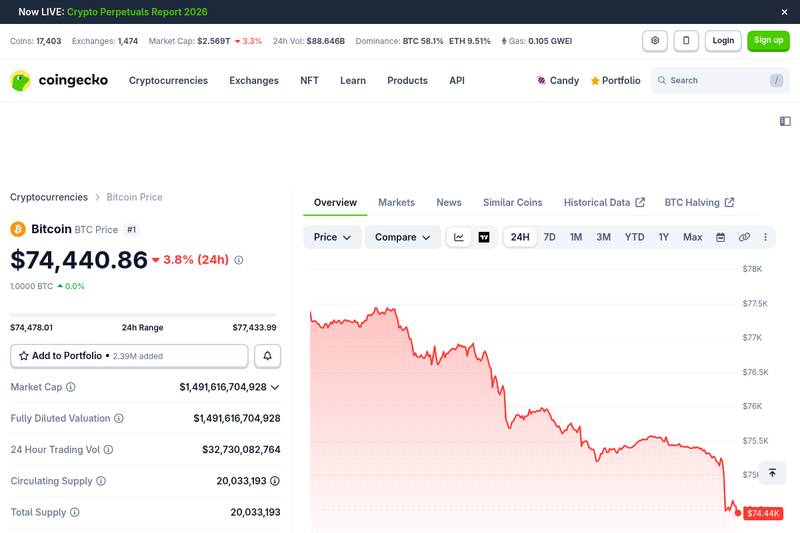
Bitcoin was trading at $74,563 at the time of the approval, down 3.67% over 24 hours and 5.14% over the past week. The price sits roughly 40.86% below its all-time high of $126,080, reached on October 6, 2025.
The Crypto Fear & Greed Index stood at 28 out of 100, firmly in “Fear” territory despite the regulatory milestone. The gap between bearish market sentiment and a structurally bullish regulatory development creates an unusual setup: institutions gaining new hedging tools precisely when prices are depressed relative to recent highs.
Bitcoin’s market cap stood at approximately $1.494 trillion, with circulating supply at 20,033,193 BTC, or 95.4% of the 21 million maximum. Daily trading volume reached $33.13 billion.
The approval could set a precedent for future crypto index products on regulated exchanges. No Ethereum or basket index options were included in this filing, but the regulatory framework established by QBTC’s approval may streamline future applications. Institutions that have already navigated significant Bitcoin transfers and built treasury positions now have another tool for managing that exposure.
The key near-term catalyst is the CFTC exemptive relief. Until that is granted and the OCC updates its disclosure document, no QBTC contracts can trade. Any delay from the CFTC, whether due to political headwinds or procedural backlog, could leave the product in regulatory limbo. The SEC’s approval, meanwhile, comes as European regulators take a more cautious approach to crypto product expansion, highlighting the diverging transatlantic regulatory paths.
The approval applies exclusively to Bitcoin. Whether the SEC extends similar treatment to other digital asset index products will depend on market surveillance agreements, liquidity thresholds, and the political appetite for further crypto integration within traditional finance infrastructure.
Disclaimer: This article is for informational purposes only and does not constitute financial or investment advice. Cryptocurrency and digital asset markets carry significant risk. Always do your own research before making decisions.