


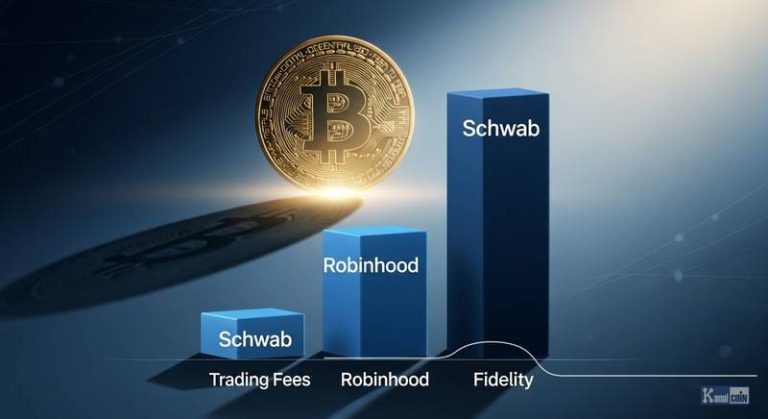
Charles Schwab said on April 16, 2026 that it will begin a phased rollout of spot bitcoin and ether trading for retail clients in the coming weeks, pricing Schwab bitcoin trading fees at 75 basis points per trade. The launch puts the brokerage giant directly between Robinhood’s tiered crypto pricing and Fidelity’s 1% transaction fee.
TLDR KEYPOINTS
- Schwab Crypto launches with direct bitcoin and ether access at a 0.75% trade fee.
- Paxos will handle sub-custody and trade execution for the new service.
- Schwab’s fee sits below Fidelity’s 1% charge but above Robinhood’s best smart-routing tier of 0.03%.
Schwab Prepares Spot Bitcoin and Ether Trading Rollout
Schwab’s announcement confirms that Schwab Crypto will give retail clients direct access to bitcoin and ethereum through a phased launch, according to the company’s press release. The firm described pricing as 75 basis points on the dollar value of each trade.
Paxos, an OCC-regulated blockchain infrastructure provider, will deliver sub-custody and trade execution for the offering. That arrangement lets Schwab extend crypto services without directly running wallet or matching infrastructure.
Bitcoin traded near $75,049 on launch day, while broader sentiment stayed cautious with the Fear & Greed Index at 23, a reading labeled “Extreme Fear.” The mood contrasts with Schwab’s timing as it expands direct bitcoin access. Market watchers tracking key price levels may see the rollout as another structural tailwind even if short-term positioning remains defensive.
How Schwab’s 0.75% Fee Compares With Robinhood and Fidelity
Schwab’s 75 basis point charge lands in the middle of the two most-cited competitor benchmarks. Robinhood’s own support documentation states that crypto orders placed with smart exchange routing qualify for fee tiers ranging from 0.03% to 0.85%, depending on volume and order characteristics.
Fidelity’s disclosure, by contrast, states a flat 1% fee on buy and sell transactions through Fidelity Digital Assets. That puts Schwab clearly below Fidelity on headline pricing while leaving Robinhood’s top tier the cheapest disclosed option for qualifying orders.
The comparison is not uniform across user profiles. Robinhood’s lowest tier beats Schwab only for orders that meet its routing criteria, while its ceiling at 0.85% sits above Schwab’s flat rate. No single platform is universally cheapest, but Schwab’s pricing is competitive for users who want a traditional brokerage experience without Fidelity’s higher flat charge. Similar questions around disclosure shaped recent debate over how crypto intermediaries publish their economics.
What Investors Should Watch as Schwab Expands Crypto Access
The rollout is phased rather than immediate, so retail access will expand gradually rather than switching on for all Schwab clients at once. Schwab’s disclosure also says the crypto account is available in all US states except New York and Louisiana, a caveat that rules out two large populations at launch.
Schwab plans transfer capabilities only over time, which is a meaningful gap against Fidelity, whose product page confirms users can trade, transfer, and manage crypto directly in the same portfolio used for stocks and ETFs. For self-custody-minded users, that difference can outweigh a headline fee gap.
The broader significance is that a mainstream wirehouse with tens of millions of brokerage accounts is opening a direct on-ramp to bitcoin and ether. That matters for retail adoption because Schwab’s distribution scale brings crypto into the same login and tax documents as conventional holdings, alongside ongoing conversations about bitcoin’s long-term infrastructure upgrades.
Disclaimer: This article is for informational purposes only and does not constitute financial or investment advice. Cryptocurrency and digital asset markets carry significant risk. Always do your own research before making decisions.