


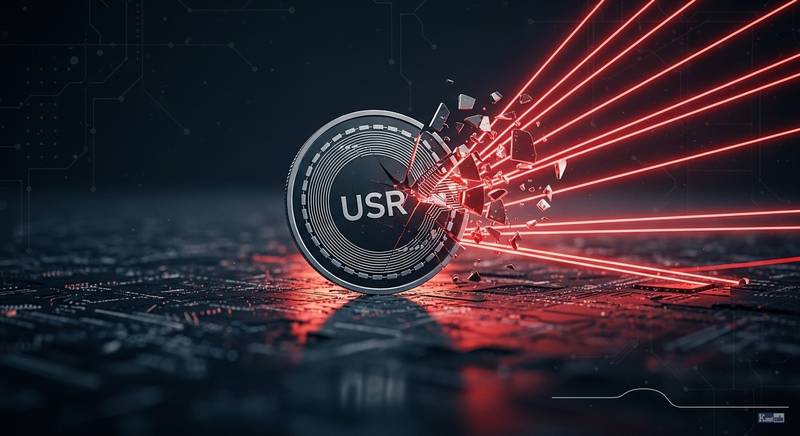
ResolvLabs’ USR stablecoin appears to have suffered a suspected exploit after an on-chain address reportedly minted approximately 50 million USR tokens in what security monitors flagged as an anomalous transaction. The incident, first circulated via crypto alert channels, has raised immediate questions about the protocol’s minting controls and the safety of funds held in USR-integrated DeFi positions across multiple chains.
The alert was initially shared through the Bitcoin Magazine Telegram channel, which flagged the minting event as suspicious. At the time of writing, the full scope of the incident remains unconfirmed, and ResolvLabs has not issued a detailed public statement clarifying whether the mint was authorized or the result of a vulnerability.
50 Million USR Minted: What the On-Chain Data Shows
The core allegation centers on an address that minted roughly 50 million USR tokens. USR is the yield-bearing stablecoin issued by Resolv Labs, a protocol that uses delta-neutral strategies backed by ETH collateral to maintain its dollar peg. The minting event was flagged as unauthorized or anomalous by on-chain monitoring services.
At this stage, critical details remain unconfirmed. The specific transaction hash, the block number, and the exact timestamp of the mint have not been independently verified in the available reporting. Whether the address that executed the mint is a known protocol contract, an externally owned account, or connected to the Resolv deployer infrastructure has not been publicly clarified.
ResolvLabs maintains an official presence on X (formerly Twitter), but as of press time, the team has not posted a confirmed statement addressing the suspected exploit. This silence is notable; in previous DeFi exploit scenarios, protocol teams that delay public communication often face sharper sell-offs as users preemptively exit positions.
For Southeast Asian DeFi users who may hold USR positions through aggregators or cross-chain bridges, the lack of an official response creates particular uncertainty. Regional platforms that list or integrate USR-denominated pools should be monitoring the situation closely.
USR Price and Protocol Impact as Markets React
The immediate market impact of a 50-million-token unauthorized mint on a stablecoin protocol can be severe. If the minted tokens were dumped into liquidity pools, USR could face downward pressure on its dollar peg. Traders tracking the USR price on CoinMarketCap should watch for any deviation from the $1.00 peg as a signal of realized damage.
The broader DeFi security landscape in 2026 has already been marked by significant losses. Over $2.1 billion has been stolen in crypto hacks this year, making this suspected exploit part of a troubling trend. Stablecoin protocols, which hold concentrated liquidity, remain high-value targets for attackers. The USPD hack in December 2025 demonstrated how quickly a stablecoin exploit can cascade through integrated DeFi protocols.
If USR is integrated into Curve pools, lending markets, or yield aggregators, downstream exposure could extend well beyond direct USR holders. Liquidity providers in paired pools face potential impermanent loss if USR depegs, while lending protocols using USR as collateral could face bad debt if the token’s value drops below liquidation thresholds.
For users in Southeast Asia, where DeFi participation has grown significantly through platforms accessible in Indonesia, the Philippines, and Thailand, any USR exposure through multi-asset vaults or stablecoin baskets warrants immediate review. While major regional exchanges like Indodax and Tokocrypto primarily list larger stablecoins, DeFi-native users bridging assets cross-chain may have indirect exposure.
What to Watch as ResolvLabs Responds
The next 24 to 48 hours are critical. Readers should monitor ResolvLabs’ official X account and Discord for any post-mortem, protocol pause announcement, or recovery plan. Key signals to watch include whether the team pauses minting and redemption contracts, whether a security firm is engaged for an audit, and whether a governance proposal or emergency multisig action is initiated.
Whether the exploit vector, if confirmed, has been identified and patched remains the most important open question. An unpatched vulnerability means additional mints could follow, compounding the damage. If ResolvLabs confirms the exploit and announces a compensation plan or white-hat recovery bounty, that would signal an organized response.
This incident is a reminder that stablecoin security extends beyond peg mechanics. Even delta-neutral designs with ETH collateral backing are only as secure as their smart contract access controls. As institutional players continue accumulating crypto assets and traditional finance pushes deeper into digital asset products, the security infrastructure protecting on-chain protocols remains a critical gap. For newer DeFi tokens seeking institutional credibility through ETF products, incidents like this suspected USR exploit underscore why security audits and transparent incident response are non-negotiable.
Southeast Asian regulators, already cautious about DeFi protocols, may point to events like this as justification for stricter oversight. Indonesia’s Bappebti and Singapore’s MAS have both signaled interest in stablecoin-specific frameworks. A confirmed exploit on a yield-bearing stablecoin would accelerate those conversations across the region.
Disclaimer: This article is for informational purposes only and does not constitute financial or investment advice. Cryptocurrency and digital asset markets carry significant risk. Always do your own research before making decisions.