



Ondo Finance has submitted a no-action letter request to the U.S. Securities and Exchange Commission seeking regulatory clearance for its tokenized equities model on Ethereum, a move that could set a precedent for compliant onchain stock exposure.
The company disclosed the filing in an April 13, 2026 blog post, describing the request as narrow in scope. Ondo said it is not asking the SEC to rewrite securities law but rather seeking comfort around its Ondo Global Markets platform.
A no-action letter, if granted, would signal that SEC staff does not intend to recommend enforcement against a specific business practice. For Ondo, that practice involves offering wrapped, tokenized versions of publicly traded U.S. securities on public blockchains through a registered broker-dealer and a registered transfer agent.
What Ondo is asking the SEC to bless
The request builds on groundwork laid over the past year. An SEC Crypto Task Force meeting memo dated April 24, 2025 documented a discussion between Ondo Finance, its counsel Davis Polk & Wardwell, and SEC staff about a proposal to enable tokenized public securities for qualified purchasers on public blockchains.
By September 2025, Ondo Global Markets had already launched more than 100 tokenized U.S. stocks and ETFs across six public blockchains, including Ethereum. The platform provides near-instant settlement for these instruments, according to an Ondo blog post from April 9, 2026.
The SEC’s Division of Corporation Finance issued a staff statement on January 28, 2026 clarifying that market participants offering or trading tokenized securities must evaluate and comply with existing federal securities-law requirements. Ondo’s no-action request appears designed to fit within that framework rather than challenge it.
Why Ethereum sits at the center of the model
Ethereum serves as a core settlement layer for Ondo Global Markets. Unlike traditional brokerage rails, where settlement can take one to two business days, an onchain model allows token transfers to finalize within minutes on Ethereum’s network.
The distinction matters for institutional participants. Tokenized equities on Ethereum are not direct stock ownership claims but wrapped representations, with the underlying shares held by a registered transfer agent. The blockchain layer handles issuance, transfer, and settlement while the traditional custody structure remains intact underneath.
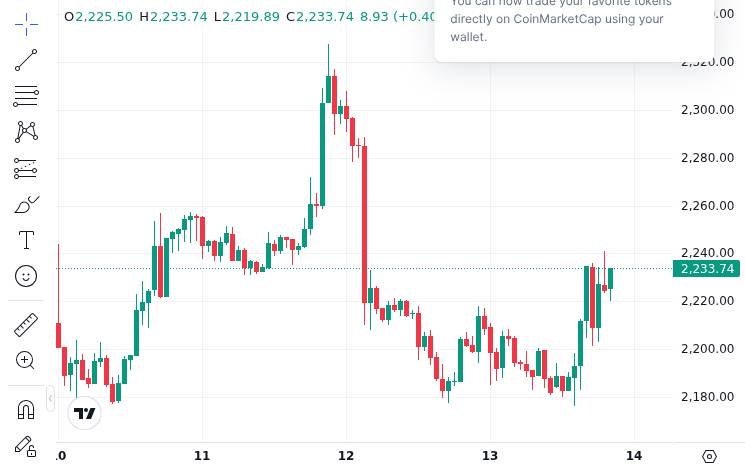
Ethereum traded at $2,227.24 at press time, with a market capitalization of roughly $268.4 billion. The network’s deep liquidity and broad institutional tooling make it a natural fit for securities-grade applications, which partly explains why Ondo included it among the six chains supporting its tokenized equities catalogue.
The broader concentration of Ethereum holdings across major entities underscores the network’s growing role as infrastructure for real-world asset tokenization beyond its native DeFi ecosystem.
What this could mean for tokenized equities adoption
Bryan Pellegrino, quoted in Blockworks’ coverage of the Ondo Global Markets launch, put it bluntly.
“The stock market and securities are coming onchain. It’s only a matter of time.”
— Bryan Pellegrino
Jason Rosenthal of a16z crypto framed the shift in even broader terms, writing on March 25, 2026 that what is happening now represents “the largest infrastructure upgrade in capital markets since the shift to electronic trading thirty years ago.”
If the SEC grants the no-action letter, other tokenized real-world asset issuers would likely pursue similar relief. The precedent would establish a compliance pathway that does not require new legislation, only staff-level comfort with existing rules applied to blockchain-based settlement.
The timing coincides with a period of caution in crypto markets. The Crypto Fear & Greed Index registered at 12 on April 13, reading “Extreme Fear,” suggesting that the tokenized-equities infrastructure push is advancing independently of short-term market sentiment. Similar institutional developments, like Circle’s stablecoin settlement platform for institutions, reflect a pattern of infrastructure building during risk-off periods.
However, a no-action request is not an approval. The SEC may decline to issue the letter, issue it with conditions, or take no action at all for an extended period. Ondo’s model is already live, but broader institutional crypto flows suggest the market is still waiting for clearer regulatory signals before committing at scale.
What Ondo has done is force a concrete regulatory question: can tokenized versions of registered securities trade on public blockchains within existing law? The SEC’s response, or silence, will shape the next chapter of onchain equities.
Disclaimer: This article is for informational purposes only and does not constitute financial or investment advice. Cryptocurrency and digital asset markets carry significant risk. Always do your own research before making decisions.