


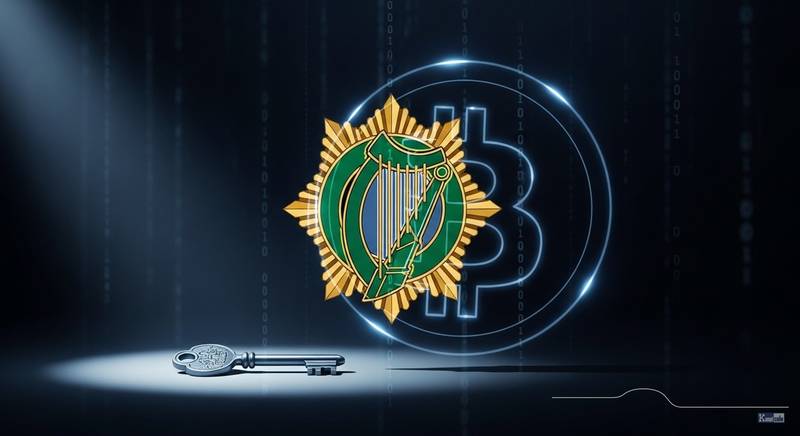
Ireland’s Criminal Assets Bureau has successfully accessed a Bitcoin wallet containing approximately 500 BTC, roughly a decade after the private keys were believed to be permanently lost. The breakthrough, supported by Europol, marks the first time authorities have cracked open a wallet tied to one of the country’s largest cryptocurrency seizure cases, valued at an estimated $378 million in total.
Irish Police Access Long-Locked Bitcoin Wallet
The Criminal Assets Bureau (CAB), Ireland’s dedicated agency for seizing proceeds of crime, confirmed it had gained access to the wallet as part of an ongoing operation with Europol support. The seized Bitcoin is currently valued at approximately $40 million, though that figure fluctuates with market prices.
Key Figure
~500 BTC
Recovered by Ireland’s Criminal Assets Bureau after the wallet’s private keys were considered lost for roughly a decade
The wallet had been in law enforcement custody for years but remained functionally inaccessible. Irish authorities had been unable to move or liquidate the funds without the private keys, leaving the Bitcoin sitting dormant on-chain while its value appreciated dramatically.
CAB described the access as a first breakthrough in the broader $378 million Bitcoin seizure case. The method used to recover the keys has not been publicly disclosed, though Europol’s involvement suggests cross-border forensic and technical resources played a role.
The Drug Trafficking Case Behind the Seized Bitcoin
The wallet is linked to a convicted drug trafficker whose Bitcoin holdings were seized as part of a criminal investigation roughly ten years ago. Under Irish law, CAB has the authority to seize assets it can demonstrate are proceeds of criminal activity, including cryptocurrency.
The private keys were considered lost after the suspect either refused to disclose them or they were stored on a device that was no longer accessible. This left CAB in an unusual position: legal ownership of a Bitcoin wallet it could not open. Ireland does not currently have a law that compels suspects to hand over encryption keys, unlike the United Kingdom’s Regulation of Investigatory Powers Act.
Timeline
~10 Years
Duration the Bitcoin wallet private keys were considered lost before Irish police successfully gained access
The case is part of a larger investigation that has identified $378 million in Bitcoin connected to criminal enterprises in Ireland. The 500 BTC wallet represents just a portion of those total holdings, but its recovery is the first concrete result after years of technical dead ends.
Growing Law Enforcement Capability in Crypto Recovery
The Irish case adds to a growing list of instances where law enforcement has recovered cryptocurrency once considered permanently out of reach. The U.S. Department of Justice recovered billions in Bitcoin tied to the 2016 Bitfinex hack, and multiple Silk Road-related wallets have been seized and liquidated years after the marketplace was shut down.
Chainalysis has estimated that roughly 20% of all Bitcoin in circulation, approximately 3.7 million BTC, is considered lost or dormant. While much of that total involves wallets with no known owner, the Irish case demonstrates that “lost keys” attached to a known suspect do not necessarily mean permanently inaccessible funds.
The successful wallet crack could influence how other EU member states approach cryptocurrency seizures. As regulators across Europe implement the Markets in Crypto-Assets (MiCA) framework, the question of how law enforcement handles inaccessible digital assets is becoming more urgent. The CFTC recently launched an innovation task force with crypto at its center, signaling that both U.S. and European authorities are investing more heavily in crypto-specific enforcement capabilities.
For Bitcoin holders, the practical takeaway is straightforward: the assumption that lost private keys create a permanent barrier to access is increasingly being challenged. Law enforcement agencies, particularly when pooling resources across borders through entities like Europol, now have forensic tools and technical expertise that did not exist a decade ago. Bitcoin’s price remains sensitive to macro pressures, but the expanding reach of authorities into dormant wallets adds another layer of risk for illicit holders.
Ireland’s CAB has not indicated whether additional wallets from the $378 million case are expected to be recovered. The remaining Bitcoin tied to the investigation, worth hundreds of millions of dollars at current prices, remains locked. Meanwhile, institutional interest in crypto continues to grow, with moves like Ark Invest’s recent $16 million purchase of Circle shares highlighting the widening overlap between traditional finance and digital assets.
The Europol-backed operation sets a precedent that other agencies are likely watching closely. Whether the forensic methods can scale to larger wallets or different blockchain architectures remains an open question, but for now, Ireland has demonstrated that patience and international cooperation can eventually unlock what once seemed permanently sealed.
Disclaimer: This article is for informational purposes only and does not constitute financial or investment advice. Cryptocurrency and digital asset markets carry significant risk. Always do your own research before making decisions.