


TLDR KEY POINTS
- Iran’s IRGC warns of $200 per barrel oil prices and vows to block all Strait of Hormuz traffic after three more ships are attacked in the Persian Gulf
- The IEA responds with a record 400 million barrel emergency reserve release, temporarily pulling oil back from $114 highs
- Bitcoin clings to $70K under “Extreme Fear” sentiment while Southeast Asian nations face severe energy and currency pressure from the Hormuz blockade
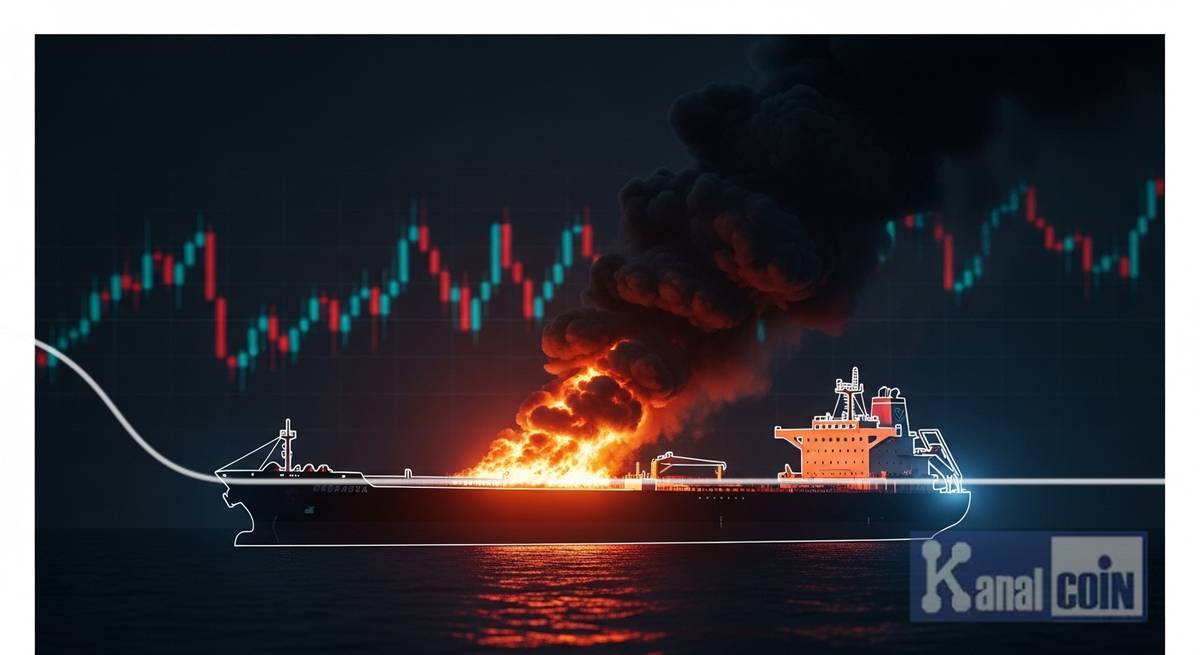
Iran’s Islamic Revolutionary Guard Corps has warned the world to prepare for $200 per barrel oil prices as three more foreign vessels were attacked in the Persian Gulf overnight, deepening a crisis that threatens Southeast Asia’s energy lifeline and keeps crypto markets pinned under extreme fear.
A container ship was struck by an unknown projectile roughly 35 nautical miles north of Jebel Ali near Dubai, causing a fire onboard with all crew reported safe. Two oil tankers were left ablaze in Iraqi waters near the port of Umm Qasr, killing at least one person while 38 crew members were rescued.
A Thai-flagged cargo vessel recovered 23 crew members from the water after a separate strike roughly 11 nautical miles north of Oman. The incidents bring the total to at least 12 confirmed attacks on vessels in and around the Strait of Hormuz since the U.S.-Israel military campaign against Iran began on February 28.
IRGC Threatens Full Hormuz Blockade, Tells World to “Expect $200 Oil”
A spokesperson for the IRGC’s Khatam al-Anbiya Headquarters declared on Wednesday that Iran will not allow “a litre of oil” through the Strait of Hormuz. Any vessel linked to the United States, Israel, or their allies “will be considered a legitimate target,” the spokesperson said.
“You will not be able to artificially lower the price of oil. Expect oil at $200 per barrel,” the IRGC warned, adding that “the price of oil depends on regional security, and you are the main source of insecurity in the region.”
Shipping traffic through the Strait has virtually ground to a halt, with export volumes currently at less than 10% of pre-conflict levels. An average of 20 million barrels per day of crude and refined products transited the waterway in 2025, roughly 25% of the world’s seaborne oil trade.
IEA Deploys Record 400 Million Barrel Reserve Release
The International Energy Agency on Wednesday announced its largest-ever emergency stock release of 400 million barrels. The coordinated intervention dwarfs the previous record of 182 million barrels released during the Russia-Ukraine war in 2022.
The announcement temporarily capped the oil spike. Brent crude, which had surged past $114 per barrel earlier in the week, pulled back below $85 on the news. IEA Executive Director Fatih Birol stressed that stable oil flows could not fully return unless tanker traffic resumed through the Strait.
The math, however, is sobering. At 20 million barrels per day of normal Hormuz throughput, 400 million barrels covers roughly 20 days of disrupted flow. If the blockade persists, the reserves offer a short buffer, not a solution. Rapidan Energy Group and Wood Mackenzie have both described the Hormuz closure as the largest oil supply disruption ever recorded.
Bitcoin Clings to $70K as Fear Index Drops to 18
Bitcoin traded at $69,850 at press time, up a modest 0.38% over 24 hours but down 3.06% on the week. The 24-hour range of $69,034 to $71,230 reflects the market’s indecision, a far cry from the October 2025 all-time high of $126,080.
The Crypto Fear & Greed Index sits at 18, deep in “Extreme Fear” territory. This is the lowest reading since the early days of the conflict, signaling broad risk aversion across digital assets.
U.S. spot Bitcoin ETFs have logged net inflows of $533 million over the past three trading sessions ($167M on March 9, $250.92M on March 10, $115.17M on March 11), suggesting institutional buyers are accumulating even as retail sentiment collapses. Ethereum held at $2,045, up 1.34%.
Bitcoin has not acted as a safe haven during the crisis. Unlike gold, which has rallied on geopolitical risk, BTC has tracked risk-on assets. Higher oil prices fuel inflation concerns, which suppress rate-cut expectations and pressure speculative assets, a pattern that has played out since the first strikes on February 28.
Southeast Asia’s Persian Gulf Dependency Amplifies the Pain
The Hormuz blockade is not an abstract risk for Southeast Asia. The Philippines sources 96% of its oil from the Persian Gulf region. Vietnam depends on the Gulf for 87% of supply, and Thailand for 74%.
The impact is already visible. The Philippine peso has dropped to 59.5 per U.S. dollar, and diesel prices in the country have surged 38.6% since the conflict began. Long lines at filling stations have become common across the region.
In Indonesia, the rupiah weakened to Rp16,990 per dollar, prompting Bank Indonesia to intervene in both spot and non-deliverable forward markets. Every $10 increase in Brent crude adds approximately 0.4 percentage points to Indonesia’s headline CPI. If oil sustains near $100 per barrel, headline inflation could climb toward 4.5%.
Filipino seafarers remain stranded in the Strait of Hormuz amid warlike conditions, with the Department of Migrant Workers coordinating their protection. The Thai-flagged vessel involved in Wednesday’s rescue underscores how deeply ASEAN nationals are exposed to the conflict zone.
For crypto traders across the region, the crisis creates a double squeeze. Portfolios are under pressure from the broader risk-off environment, while daily living costs are rising sharply due to fuel inflation. Higher energy costs also weigh on mining operations, particularly in Vietnam and Thailand where small-scale operations depend on affordable electricity.
What Comes Next for ASEAN Crypto Markets
The IEA’s 400 million barrel release buys roughly three weeks of breathing room. If the Hormuz blockade extends beyond that, the IRGC’s $200 per barrel warning may prove less hyperbole than forecast.
Several concrete catalysts lie ahead. U.S. CPI data, due this week, will reflect the first full impact of the oil shock on consumer prices. Bank Indonesia’s next rate decision will signal whether the central bank prioritizes currency defense or growth support.
Currency devaluation across ASEAN could push some users toward stablecoins and Bitcoin as hedges against depreciating local currencies, a pattern already visible in Iran where the rial’s collapse has driven Bitcoin adoption. But unlike Iran’s subsidized $1,320-per-coin mining costs, Southeast Asian miners face full market energy rates that are climbing fast.
Bitcoin’s $533 million in ETF inflows over three days suggests institutional conviction that the sell-off is overdone. Whether that signal proves correct depends on how long the Strait of Hormuz stays closed.
Disclaimer: This article is for informational purposes only and does not constitute financial advice. Cryptocurrency investments carry significant risk. Always conduct your own research before making investment decisions.