



Key Points
- Gold breaks $5,000 because global capital is fleeing geopolitical risk, falling real yields, and accelerating central bank gold accumulation.
- Bitcoin remains stuck near $87,000 due to heavy supply from older holders and a derivatives driven market that lacks strong spot demand.
- The 2026 macro crypto split shows gold acting as a true safe haven while bitcoin trades like a risk asset under yield and dollar pressure.
Gold tops $5,000 while Bitcoin is stuck near $87,000 because global capital has shifted into safety as real yields fall, geopolitical risk rises, and crypto markets face internal supply pressure.
This divergence marks a 2026 macro regime in which gold is being repriced as a monetary hedge, while bitcoin behaves like a risk asset constrained by seller overhang, ETF outflows, and weak spot demand.
Why gold tops $5,000: safe-haven flows, central-bank gold buying, real-yield dynamics
Gold is above $5,000 because geopolitical turmoil, central-bank reserve diversification, and falling real yields have created structural demand for non-yielding hard assets.
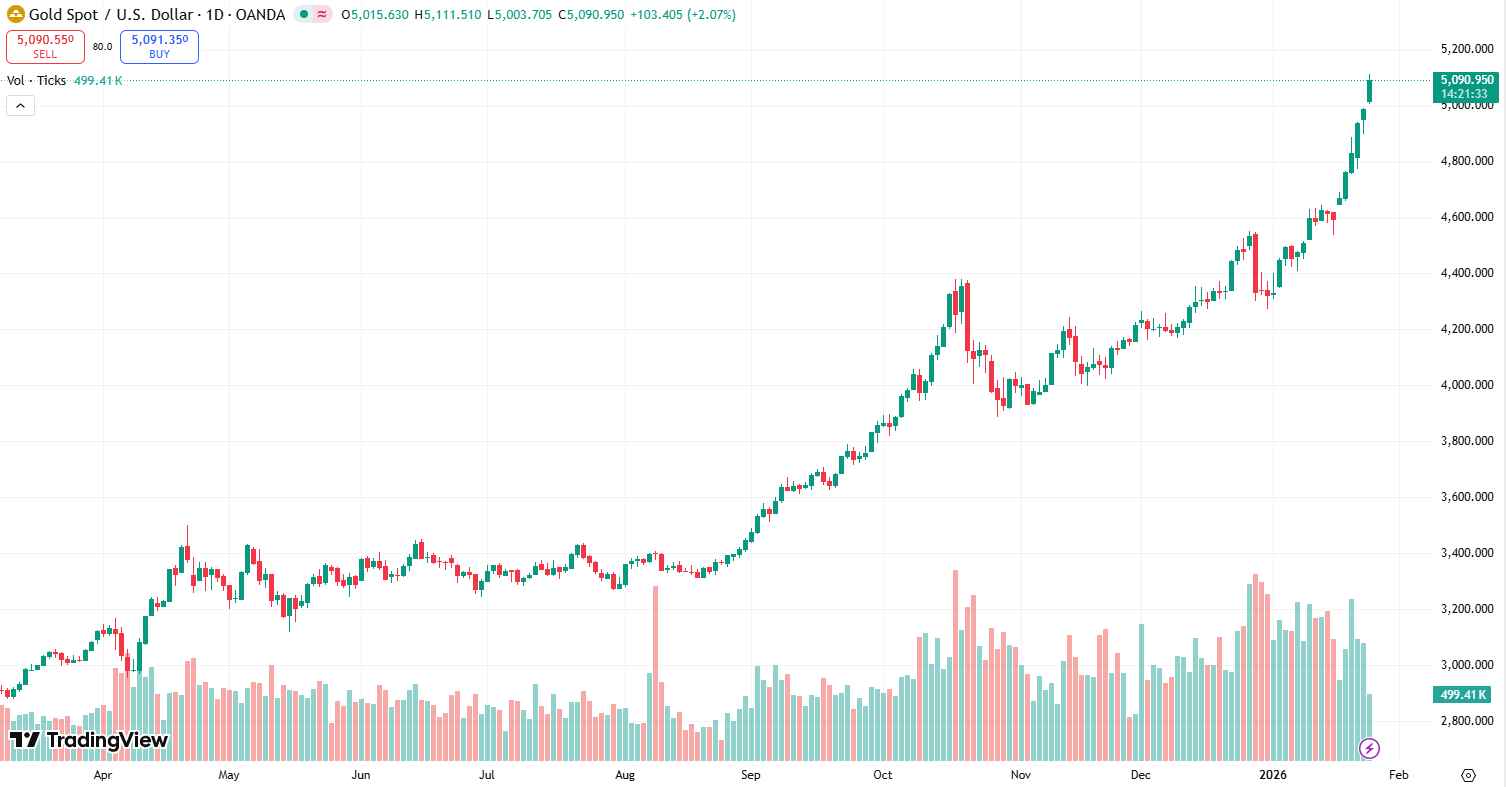
On January 26, 2026, gold reached a record $5,092.71/oz, extending a rally that followed a 60% gain in 2025. Three forces explain the move:
- Safe-haven flows: Escalating trade disputes (U.S.–Europe over Greenland), Middle East conflict, and U.S. political uncertainty (tariff threats and investigations tied to the Federal Reserve) have pushed investors out of U.S. assets and into gold. Elevated equity valuations and market volatility reinforce gold’s role as capital preservation.
- Central-bank gold buying: Emerging market central banks, especially China and India, are aggressively diversifying reserves away from the US dollar. Purchases now average about 60 tonnes per month, far above pre 2022 norms, creating persistent upward price pressure.
- Real yield dynamics: Gold becomes more attractive when real interest rates fall. Expectations that the Federal Reserve will cut rates are reducing bond yields, while persistent inflation concerns increase demand for purchasing power hedges.
BTC near $87,000: breakout context, key support resistance, and volatility implications
Bitcoin is stuck near $87,000 because supply from older holders and capital rotation into gold are capping rallies below the $98,000 to $100,000 resistance zone.
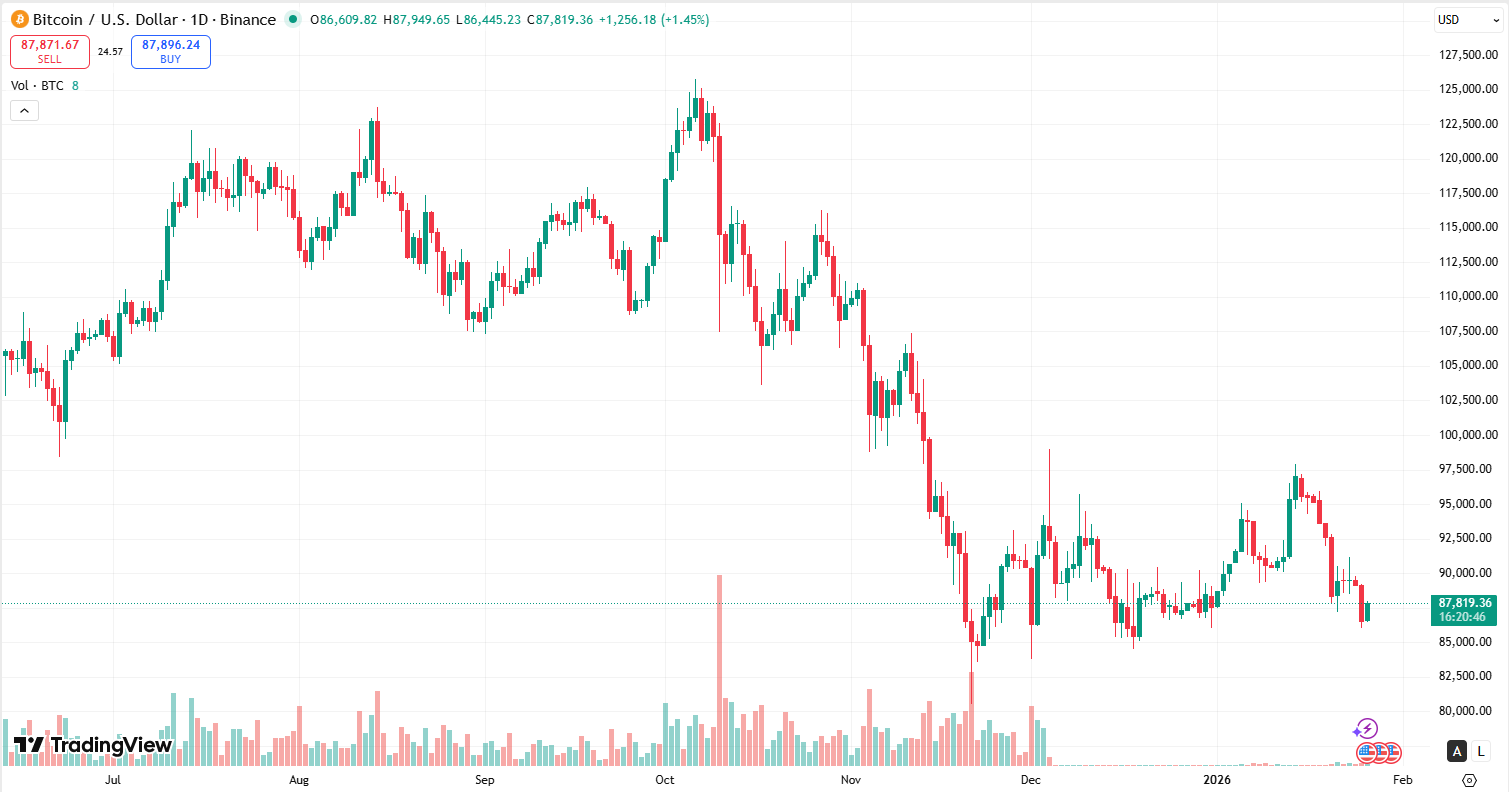
Bitcoin trades around $87,600 in a low conviction consolidation after falling from its October 2025 all time high near $126,000.
Breakout context
A previous technical breakout failed as selling pressure appeared at higher prices and macro headwinds drew liquidity toward gold
Key price levels
| Level | Price range | Meaning |
|---|---|---|
| Major support | 86,000 to 87,000 | Buyers have defended this zone. A breakdown risks a move toward 80,000 |
| Immediate resistance | 88,000 to 88,500 | A break is needed to attempt higher prices |
| Major resistance | 98,000 to 100,000 | Heavy supply overhang and psychological barrier |
Volatility
Low conviction markets are prone to sharp swings. Bitcoin regularly experiences moves exceeding 20 percent, making disciplined risk management essential
Macro crypto split: DXY, US Treasury yields, Fed path, inflation, risk
The macro crypto split exists because a firm US dollar and attractive bond yields pull capital into cash and Treasuries while risk off sentiment sends safety flows into gold.
As of January 26, 2026:
- BTC ≈ $87,600
- DXY ≈ 97.16 (softening short-term but supported)
- U.S. 10Y ≈ 4.217%
- U.S. CPI YoY ≈ 2.7%
- Fed Funds ≈ 3.50%–3.75%
How the levers work
- DXY ↑ → Crypto ↓ (cash safety drains liquidity from BTC)
- Real yields ↑ → Crypto ↓ (bonds compete with non-yielding assets)
- Fed hawkish → Crypto ↓; Fed dovish → Crypto ↑
- Risk-off → Gold ↑; Crypto ↓
- Today’s uncertainty keeps gold bid and bitcoin capped.
On-chain supply and participation: funding rates, open interest, spot vs derivatives
Leverage versus conviction: funding and OI signals around $87K
Funding rates are slightly positive, showing mild bullishness without excessive leverage. Binance and major exchanges show small positive funding rates, while total Bitcoin futures open interest is about $28.4 billion. Institutional activity on CME has declined while offshore exchanges remain active, indicating retail driven leverage.
Spot demand versus derivatives driven trading
The market is dominated by derivatives rather than spot buying. Recent data shows Bitcoin spot volume near $7.17 billion compared with futures volume around $69.39 billion, meaning price action is driven by speculation rather than long term accumulation.
Asia session playbook: Tokyo, Hong Kong, Singapore microstructure
Liquidity around opens and regional dynamics
Asian trading hours have thinner liquidity and set the tone without creating strong trends. Tokyo’s institutional growth, Hong Kong’s regulatory sensitivity, and Singapore’s compliance focused market shape price behavior during Asia hours.
Weekly watchlist and key levels
Bitcoin consolidating near 88,000 with cautious momentum. With ETF outflows and thin liquidity, traders should watch whether Bitcoin breaks above 88,500 or loses the 86,000 to 87,000 support zone. Gold holding above 5,000 would confirm the risk off regime.
| Disclaimer: This website provides information only and is not financial advice. Cryptocurrency investments are risky. We do not guarantee accuracy and are not liable for losses. Conduct your own research before investing. |