


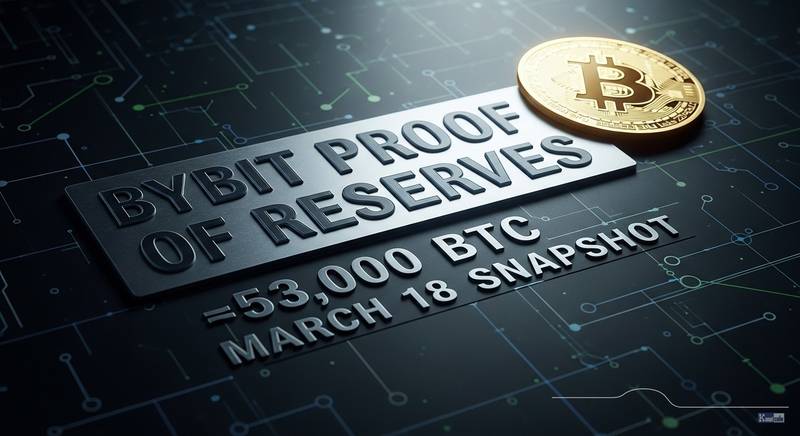
Bybit has published its 30th consecutive Proof of Reserves report, with a March 18, 2026 snapshot showing user Bitcoin holdings of approximately 53,000 BTC. The milestone marks roughly two and a half years of uninterrupted monthly reserve disclosures from the exchange.
Bybit’s 30th PoR: BTC Holdings and March 18 Snapshot Figures
The 30th report, based on a snapshot taken on March 18, 2026, puts total user BTC holdings at approximately 53,000 BTC. Bybit published the data through its official Proof of Reserves announcement, continuing a cadence that has not been broken since the program launched.
Bybit 30th Proof of Reserves · Snapshot: 18 March 2026
~53,000 BTC
Total user Bitcoin holdings verified on-chain
This is the 30th consecutive monthly report, a streak that few centralized exchanges have maintained without interruption. The consistency itself is notable in an industry where several competitors launched similar programs only to quietly reduce their frequency or stop publishing altogether.
What the Reserve Data Shows About User Fund Backing
Proof of Reserves reports are only meaningful if they demonstrate that user deposits are fully backed by exchange-held assets. Bybit’s PoR program uses a Merkle tree verification method, which allows individual users to confirm that their balances were included in the snapshot without revealing other users’ data.
Users can verify their own inclusion through Bybit’s dedicated PoR verification page, which provides tools to check individual account balances against the published Merkle root. The process is designed to let traders independently confirm that their funds are accounted for in the reserve totals.
The report covers BTC alongside other major assets held on the platform. For context on how major exchanges handle digital asset custody and transparency, a recent case involving Irish police recovering access to a Bitcoin wallet years after keys were presumed lost illustrates just how critical verifiable custody practices remain across the industry.
Whether the 30th report was independently audited by a third party, as opposed to being self-attested, is a key distinction. Bybit has previously worked with auditing partners including Hacken, a blockchain security firm that has published case studies on Bybit’s reserve verification process.
30 Reports In: Why Consistency Matters More Than Any Single Snapshot
Bybit began publishing Proof of Reserves in the wake of FTX’s collapse in November 2022. The implosion of what was then one of the largest crypto exchanges, which turned out to have been misusing billions in customer funds, triggered an industry-wide push for on-chain transparency. Multiple major exchanges launched PoR programs in the weeks that followed.
Thirty monthly reports represents approximately two and a half years of continuous publication. While many exchanges adopted PoR programs during the initial post-FTX urgency, maintaining that cadence over years is a separate challenge. Some competitors have shifted to quarterly reports or stopped updating entirely.
The broader push for exchange transparency has also intersected with regulatory developments. The CFTC’s recent launch of an innovation task force with crypto at the center of its regulatory agenda suggests that voluntary transparency measures like PoR may eventually be supplemented, or replaced, by formal reporting requirements.
Meanwhile, institutional interest in Bitcoin-related financial products continues to evolve. Firms like Ark Invest have been actively positioning in crypto-adjacent equities, reflecting broader institutional engagement with the digital asset ecosystem that makes exchange transparency increasingly important to a wider audience of stakeholders.
Bybit has not publicly indicated changes to its PoR methodology or reporting schedule. The 31st report, based on the pattern of monthly snapshots, would be expected in April 2026.
Disclaimer: This article is for informational purposes only and does not constitute financial or investment advice. Cryptocurrency and digital asset markets carry significant risk. Always do your own research before making decisions.