

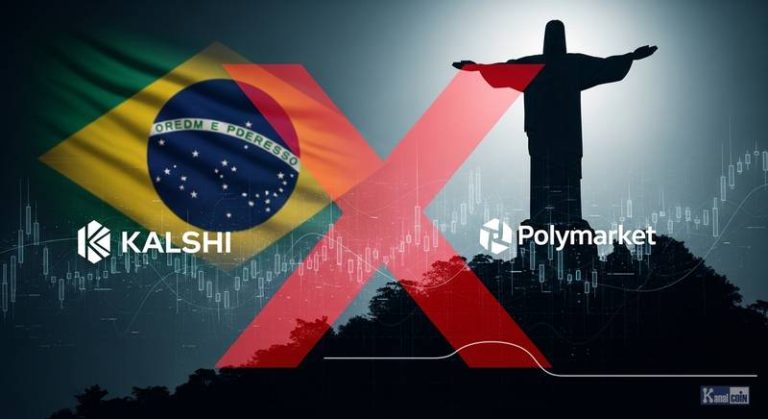
Brazilian authorities have moved to block access to Kalshi and Polymarket as part of a broader enforcement action targeting prediction platforms operating without proper licensing in the country.
What Brazil Announced About Kalshi and Polymarket
TLDR KEYPOINTS
- Brazil’s government announced an official block on prediction platforms, including Kalshi and Polymarket.
- The action is part of a regulatory push to curb unlicensed betting-like products in the country.
- No verified market data or token-price impact has been tied to the enforcement move.
The Official Announcement
The Brazilian government published an announcement confirming the block of prediction platforms operating in the country. The move is an enforcement action initiated by authorities, not a voluntary withdrawal by the platforms themselves.
Named Platforms
Kalshi and Polymarket are among the prediction platforms affected by the block. Both platforms have attracted significant attention in the crypto and prediction market space, with Polymarket gaining prominence during recent election cycles and Kalshi operating as a U.S.-regulated exchange.
Secondary reporting confirmed that Kalshi and Polymarket were among 27 prediction platforms banned under the enforcement action. The scope of the block extends well beyond these two names.
Scope of the Action
The enforcement push is not limited to crypto-native platforms. Brazilian regulators appear to be treating prediction markets as falling under the same regulatory umbrella as betting products, which triggered the broad crackdown. This mirrors a pattern seen in other jurisdictions, including how CFTC legal action has reportedly involved major crypto exchanges in the United States.
Why Authorities Say Prediction Platforms Must Be Blocked
The Legal Basis
Brazil’s Secretariat of Prizes and Bets, housed under the Ministry of Finance, issued a technical note outlining the regulatory framework for the enforcement. The document addresses how prediction platforms fall within the scope of Brazil’s fixed-odds betting legislation.
Consumer Protection Concerns
Brazil’s National Consumer Secretariat (Senacon) issued a separate notice warning consumers about the risks of illegal betting. The consumer-protection angle reinforces that authorities view prediction markets as posing direct risks to retail participants.
Financial Regulation Context
The Brazilian Central Bank has also been involved in the broader regulatory tightening. A CMN resolution from the central bank addresses financial stability concerns related to betting-like products. The multi-agency approach, spanning the communications secretariat, finance ministry, consumer protection body, and central bank, signals a coordinated government effort.
The regulatory logic frames prediction platforms as unlicensed betting operations. By classifying them this way, authorities bypass the question of whether these platforms are financial instruments or crypto products, instead applying existing gambling enforcement frameworks.
What the Block Means for Users and What to Watch Next
Immediate Impact
Brazilian users face an official block on accessing Kalshi, Polymarket, and the other affected platforms. The enforcement action means ISP-level restrictions could be applied, though the research does not specify the technical implementation of the block.
No reliable token-price, trading volume, or on-chain impact has been established in connection with this development. Regulatory actions in major markets can sometimes ripple through the broader crypto ecosystem, as seen when American Bitcoin recently expanded operations amid shifting regulatory conditions, but no such link is confirmed here.
What to Watch
Whether Kalshi or Polymarket issue public responses to the Brazilian block will clarify if the platforms intend to challenge the action or comply. Enforcement follow-through, specifically whether Brazilian ISPs actually implement the blocks, will determine the practical effect on users.
Clarification from Brazilian regulators on whether crypto-adjacent prediction markets will be treated differently from traditional betting platforms could set a precedent for other Latin American jurisdictions. In the broader crypto landscape, where projects like TREE DOR have launched new staking programs, regulatory clarity remains a key variable for platform operators worldwide.
Disclaimer: This article is for informational purposes only and does not constitute financial or investment advice. Cryptocurrency and digital asset markets carry significant risk. Always do your own research before making decisions.


