


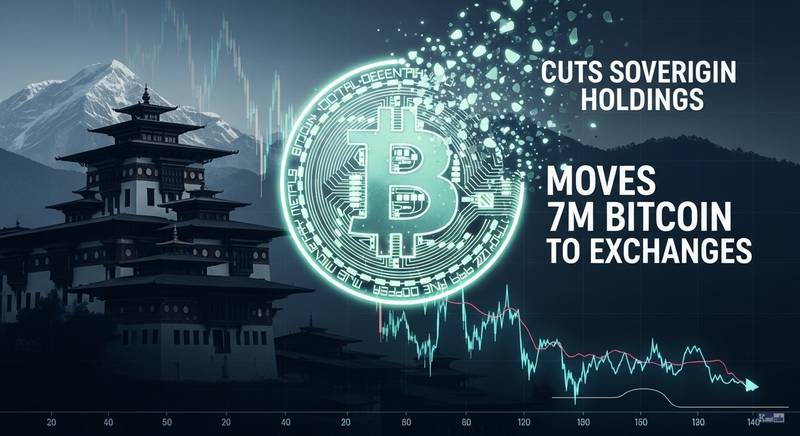
Bhutan has transferred another $37 million worth of Bitcoin to cryptocurrency exchanges, reducing its sovereign BTC holdings by roughly two-thirds and marking the latest in a series of moves that have drawn down one of the world’s most unusual national crypto reserves.
The transfer, flagged by on-chain tracking services, adds to a pattern of periodic liquidations by the Himalayan kingdom, which built its Bitcoin position not through open-market purchases but through state-sponsored mining powered by hydroelectric energy.
Sovereign BTC Moved to Exchanges
$37M
Bhutan’s latest Bitcoin transfer reduced its sovereign holdings by roughly two-thirds, signalling a significant shift in the kingdom’s crypto reserve posture.
Bhutan Sends $37M in Bitcoin to Exchanges in Latest Transfer
On-chain data shows the Bhutanese government wallet moved approximately 519 BTC to exchange addresses, valued at roughly $37 million at the time of the transfer. The move follows a broader pattern of outflows from wallets linked to Bhutan’s state investment arm.
After this latest batch, Bhutan’s remaining Bitcoin treasury has fallen to an estimated 4,452 BTC, a fraction of the kingdom’s former peak holdings. The cumulative sell-down now represents approximately two-thirds of Bhutan’s sovereign Bitcoin reserves.
The transfers were directed to major exchanges, a step that typically precedes liquidation. While moving coins to an exchange does not guarantee an immediate sale, the repeated pattern suggests a deliberate drawdown rather than a one-off rebalancing.
How Bhutan Built a Sovereign Bitcoin Reserve Through Hydropower Mining
Unlike El Salvador, which adopted Bitcoin as legal tender and purchased BTC with public funds, Bhutan took a fundamentally different path. The kingdom’s state investment vehicle, Druk Holding & Investments (DHI), has been mining Bitcoin since at least 2019 using the country’s abundant hydroelectric power.
At its peak, Bhutan’s BTC position was estimated between $750 million and over $1 billion, making it one of the largest sovereign crypto holders relative to GDP. Bhutan’s GDP sits at roughly $2.5 to $3 billion, meaning its Bitcoin reserves at one point equaled a significant share of national economic output.
That distinction matters for how markets interpret the selling. Bhutan is liquidating mined assets acquired at near-zero marginal cost, not dumping coins bought with taxpayer money. The decision reflects a government choosing to take profit on an energy arbitrage, not abandoning a Bitcoin policy experiment.
Other nations hold Bitcoin for different reasons. The United States holds seized BTC through the Department of Justice and Treasury, while countries exploring new crypto regulatory frameworks are still defining how sovereign digital asset holdings should be treated.
What the Exchange Transfers Signal for Bitcoin Supply Pressure
Exchange inflows from large holders are a closely watched on-chain metric. When significant quantities of Bitcoin move from cold storage or sovereign wallets to exchange hot wallets, it increases the available sell-side supply, even if the coins are not dumped immediately.
At current prices, the $37 million transfer represents a manageable volume for liquid markets, but Bhutan’s cumulative 2026 outflows tell a larger story. CoinDesk reported that Bhutan’s stack dropped below 5,400 BTC earlier in March after $42.5 million in transfers this year alone.
With roughly one-third of its original reserves remaining, Bhutan’s future selling capacity is limited. The overhang from this particular sovereign seller is shrinking, which may ease concerns among traders watching for continued supply pressure.
Holdings Reduction (Cumulative)
~67%
Bhutan has now liquidated approximately two-thirds of its sovereign Bitcoin reserves via exchange transfers, retaining only a fraction of its original state-held BTC.
The broader context for sovereign Bitcoin activity remains active. Institutional and government-level movements continue to shape market sentiment, from major exchange positioning at industry events to government leaders engaging directly with the crypto sector. Bhutan’s quiet, steady liquidation stands in contrast to these higher-profile developments, but the on-chain footprint is just as real.
For now, the kingdom retains an estimated 4,452 BTC, worth roughly $390 million at current market prices. Whether DHI continues to mine new coins to replenish its reserves, or accelerates the drawdown of what remains, will determine whether Bhutan exits its Bitcoin experiment entirely or settles into a smaller, steady-state position.
Disclaimer: This article is for informational purposes only and does not constitute financial or investment advice. Cryptocurrency and digital asset markets carry significant risk. Always do your own research before making decisions.