


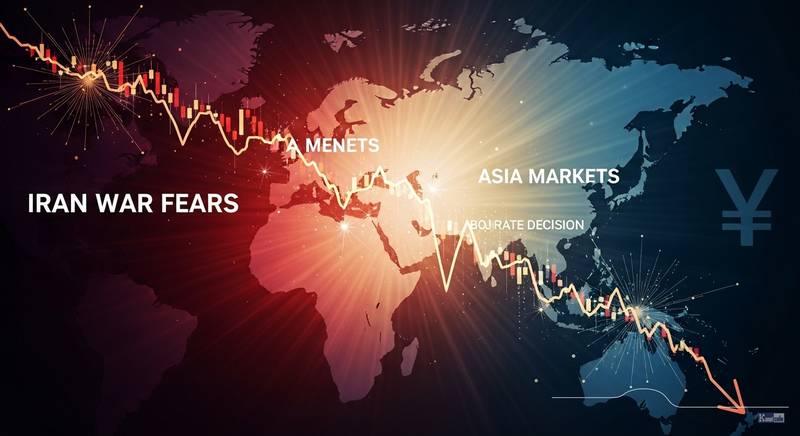
Asia-Pacific markets fell sharply on Thursday, tracking Wall Street’s steepest session loss of 2026, as Iran’s retaliatory strikes on Gulf energy infrastructure sent crude prices surging past $107 per barrel and pushed the crypto Fear & Greed Index into “Extreme Fear” territory at 23.
TLDR Keypoints
- Wall Street posted its worst day of 2026: The Dow fell 1.63% to a new year-to-date low of 46,225.15, dragging Asia-Pacific futures lower across the board.
- Iran war escalation is driving an energy shock: Brent crude jumped 3.83% to $107.38/barrel after Iranian strikes hit Qatar’s Ras Laffan LNG facility, disrupting both oil and liquefied natural gas supply lines.
- BOJ rate decision looms: The Bank of Japan is expected to hold rates at 0.75%, but the energy-driven inflation shock complicates its policy outlook and adds pressure on global risk assets including Bitcoin.
Wall Street Losses Send Shockwaves Through Asian Markets as Iran Tensions Spike Oil
U.S. equities sold off hard on March 18. The Dow Jones Industrial Average dropped 1.63% to close at 46,225.15, a new closing low for 2026 that also pushed the index below its 200-day moving average. The S&P 500 fell 1.36% and the Nasdaq Composite lost 1.46%, according to CNBC.
The selloff deepened after the Federal Reserve held rates steady at 3.5% to 3.75%, with Chair Jerome Powell stating that inflation “was not coming down as much as hoped.” February’s Producer Price Index came in at 0.7%, more than double the 0.3% economist estimate, reinforcing the hawkish signal.
Asia followed Wall Street lower. South Korea’s KOSPI led regional losses, falling 2.56%, with Samsung Electronics and SK Hynix each dropping over 3%. Japan’s Nikkei 225 declined 2.47%, the Topix fell 1.82%, and Australia’s ASX 200 opened down 1.55% at 8,506.30.
Hang Seng futures pointed to 25,479, well below the prior close of 26,025.42, signaling further downside when Hong Kong opens.
The catalyst behind the energy panic: Iran conducted retaliatory strikes on Qatar’s Ras Laffan LNG facility, one of the world’s largest liquefied natural gas export terminals, causing what reports described as “extensive damage.” The Strait of Hormuz closure disrupted an estimated 20% of global oil supplies along with significant LNG volumes, though that figure remains single-source and unconfirmed.
Brent crude futures surged 3.83% to $107.38 per barrel, while WTI crude closed at $96.32 per barrel. For energy-importing economies across Asia, particularly Japan and South Korea, the supply disruption translates directly into higher import costs and inflationary pressure at the worst possible time.
BOJ Rate Decision Adds a Second Layer of Pressure on Global Liquidity
The Bank of Japan’s March 19 rate decision is expected to hold its benchmark rate at 0.75%, a level it reached in December 2025, the highest in 30 years. Every surveyed economist expects no change this meeting.
But a hold does not mean calm. The Iran-driven energy shock pushes Japanese import inflation higher, narrowing the BOJ’s room to cut rates even if domestic growth slows. Japan imports nearly all of its energy; an LNG supply disruption at Ras Laffan directly hits Japanese utility costs and consumer prices.
For crypto markets, the BOJ’s rate path matters because of the yen carry trade. When BOJ tightens or signals further hikes, borrowed yen gets repatriated and leveraged positions in risk assets, including Bitcoin and tech equities, face unwinding pressure. The July 2024 BOJ rate hike triggered a sharp carry trade unwind that briefly sent Bitcoin below key support levels alongside a broad equity selloff.
Governor Ueda’s post-decision press conference, still pending at time of publication, will be closely watched for any shift in forward guidance. A hawkish tone in the face of rising energy costs would compound the risk-off pressure already building across Asian markets.
How Iran Tensions and Hawkish Central Banks Are Hitting Crypto
Bitcoin fell 3.97% to $71,016 in the same risk-off wave, with 24-hour trading volume at $46.87 billion and total market capitalization at $1.42 trillion. The Fear & Greed Index dropped to 23, deep in “Extreme Fear” territory.
The selloff aligns with a pattern seen in previous geopolitical shocks. When the Israel-Hamas conflict broke out in October 2023, Bitcoin initially dipped alongside equities before recovering within weeks as risk appetite returned. The key difference now is that the Iran conflict is directly disrupting energy supply infrastructure, not just generating geopolitical headlines, and the Iran war timeline has shifted in ways that make a quick resolution less likely.
Rising energy prices also hit Bitcoin through mining economics. Higher oil and natural gas costs increase electricity prices for miners, compressing margins and potentially forcing less efficient operations to sell treasury holdings to cover costs. This miner sell pressure can amplify downward price moves during already fragile sentiment.
The Fed’s dot plot still projects one rate cut in 2026 and another in 2027, but with February PPI running more than double expectations and crude above $107, the timeline for rate relief keeps getting pushed back. That means tighter financial conditions for longer, which historically weighs on speculative assets.
For investors watching this dual macro shock, the next concrete data points are the BOJ press conference later on March 19 and any further developments in the broader Iran conflict’s humanitarian and strategic fallout. The Fed’s next policy meeting in May will incorporate the energy price spike into its inflation outlook, setting the stage for what could be a pivotal decision on the 2026 rate cut timeline.
Disclaimer: This article is for informational purposes only and does not constitute financial or investment advice. Cryptocurrency and digital asset markets carry significant risk. Always do your own research before making decisions.