


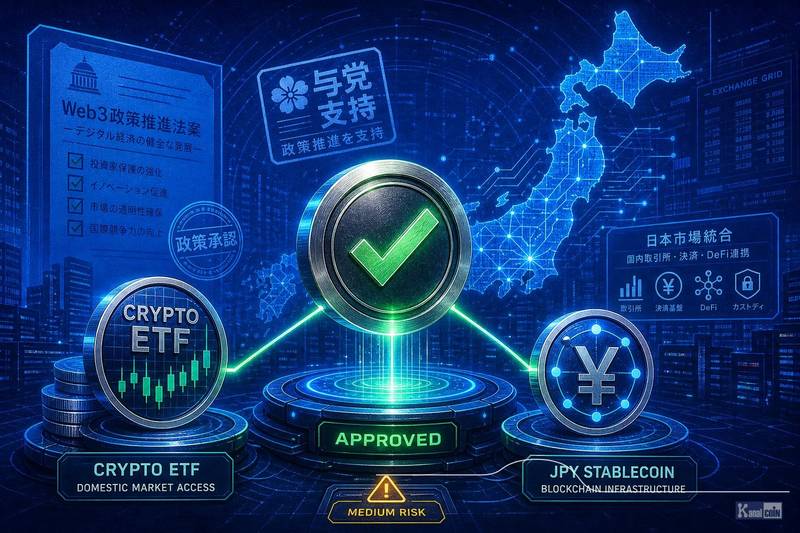
Japan’s ruling Liberal Democratic Party (LDP) has signaled support for crypto ETF trading and yen-based stablecoins, a policy shift that could open new channels for digital asset investment and settlement in one of Asia’s largest economies.
What Japan’s ruling party is backing on crypto ETFs and yen stablecoins
The LDP’s web3 project team published proposals covering two distinct areas of crypto market development. The first backs the introduction of crypto ETF trading, which would allow Japanese investors to gain exposure to digital assets through regulated, exchange-traded products rather than holding tokens directly. The second supports the promotion of yen-denominated stablecoins, according to details shared on the party’s official website.
Crypto ETFs have already gained traction in other markets, where spot Bitcoin and Ethereum ETFs attracted significant institutional capital after regulatory approval. Japan has not yet approved similar products, making the ruling party’s backing a notable step for local market access.
Yen-based stablecoins would provide a fiat-pegged digital token for on-chain settlement denominated in Japan’s national currency. A ruling party panel has argued that Japan should promote yen stablecoins across Asia to maintain the currency’s relevance in digital finance.
Why the move matters for Japan’s crypto market and investors
Crypto ETFs lower the barrier to entry for both retail and institutional participants. Instead of navigating wallet security and exchange accounts, investors could trade crypto exposure through existing brokerage accounts. This is particularly relevant in Japan, where traditional finance infrastructure is well-developed but direct crypto participation remains limited by regulatory friction.
Yen stablecoins could strengthen domestic crypto infrastructure by reducing reliance on dollar-denominated tokens like USDT and USDC for on-chain transactions. For exchanges and financial institutions operating in Japan, a regulated yen stablecoin would simplify compliance and settlement, similar to how Coinbase recently added direct local currency rails in India to streamline fiat-crypto conversion.
The combined push on both fronts suggests the LDP sees digital assets as an area where traditional finance and crypto markets should integrate more deeply. If approved, ETF products could also channel fresh liquidity into the broader digital asset ecosystem, including actively traded tokens and derivatives markets.
What comes next for regulation, approvals, and industry response
Political backing from the ruling party is a necessary but insufficient step. Regulatory follow-through from the Financial Services Agency (FSA) will determine whether these proposals become actionable reform. The FSA would need to establish compliance standards for ETF issuers, approve specific products, and define the legal framework for yen stablecoin issuance.
Exchanges, banks, and stablecoin issuers will be watching for specifics on licensing requirements and timelines. The broader crypto derivatives market, including developments like new perpetual contract listings on major exchanges, could also be influenced by Japan’s regulatory direction if it encourages more institutional-grade product offerings in Asia.
Japan’s move positions it alongside Hong Kong, Singapore, and South Korea in a competitive push to define Asia’s crypto regulatory landscape. Whether the policy support translates into approved products will depend on implementation details that have yet to be announced.
Disclaimer: This article is for informational purposes only and does not constitute financial or investment advice. Cryptocurrency and digital asset markets carry significant risk. Always do your own research before making decisions.