

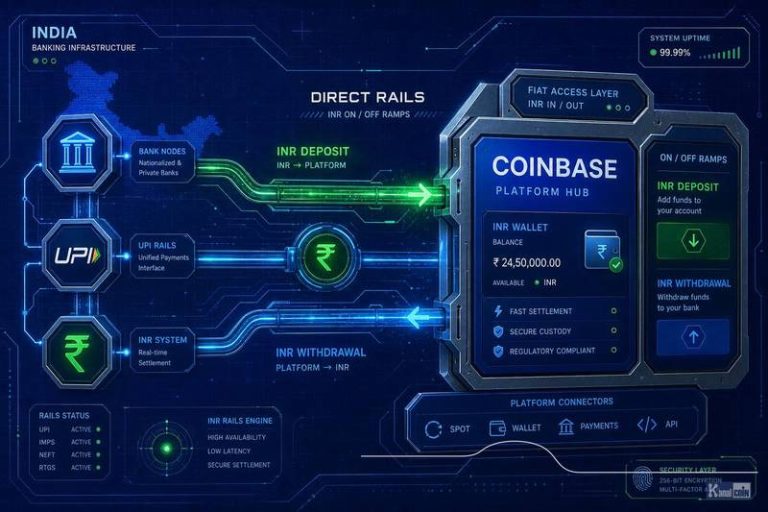
Coinbase has announced the launch of direct INR rails in India, enabling local users to deposit and withdraw funds in Indian rupees directly on the platform. The move represents a key infrastructure step in the exchange’s broader push into the Indian market.
What Coinbase Announced With Direct INR Rails in India
TLDR
- Coinbase is rolling out direct INR deposit and withdrawal rails for Indian users
- The move follows Coinbase securing regulatory registration in India
- Indian users will be able to fund accounts and cash out in their local currency
Direct INR rails mean that Indian users can send rupees to and from Coinbase without relying on third-party payment intermediaries or converting through foreign currencies first. The feature covers both the deposit side, funding an account to buy crypto, and the withdrawal side, cashing out holdings into INR.
Coinbase detailed the launch in a blog post announcing direct INR rails, positioning the update as a core part of its India market entry.
Registration as a Foundation
The INR rails launch builds on Coinbase securing registration in India as a compliant virtual digital asset service provider. Without that regulatory step, offering local currency payment channels would not have been possible.
How Direct INR Deposits and Withdrawals Could Change the User Experience
Deposit-Side Convenience
Before direct INR rails, Indian users on global exchanges typically faced friction when trying to fund accounts. Options often involved international wire transfers, peer-to-peer workarounds, or stablecoin on-ramps, each adding cost and delay.
With native INR deposits, users can fund their Coinbase accounts using domestic payment methods. This mirrors how Coinbase handles fiat purchases in other supported markets, reducing the steps between holding rupees in a bank account and placing a trade.
Withdrawal-Side Convenience
The withdrawal component is equally significant. Cashing out crypto holdings into local currency has historically been a pain point on exchanges without domestic banking integration.
Direct INR withdrawals let users move funds back to their Indian bank accounts without routing through foreign intermediaries. Specific details on eligibility, transaction limits, and processing times have not yet been confirmed by Coinbase.
Why This Launch Matters for Coinbase’s India Strategy
Fiat Access as an Exchange Differentiator
For any exchange entering a new market, local fiat rails are the baseline infrastructure that makes the platform usable for everyday traders. Without them, an exchange remains limited to crypto-native users who already hold digital assets.
By pairing its India registration with INR deposit and withdrawal support, Coinbase is signaling a commitment to building a full-service local presence. This approach mirrors how domestic exchanges have operated, with platforms navigating India’s evolving regulatory landscape while maintaining local currency support. Separately, regulatory discussions around stablecoins, including Jamie Dimon’s warnings on the CLARITY Act, highlight the global policy environment exchanges must navigate when expanding into new jurisdictions.
The announcement also comes as institutional interest in crypto continues to build globally. Figures like Michael Saylor have continued to signal confidence in Bitcoin, reinforcing demand-side tailwinds that could benefit exchanges expanding their geographic reach.
Meanwhile, infrastructure reliability remains a key concern across the industry, as seen when Sui attributed recent mainnet halts to upgrade bugs, underscoring why robust operational rollouts matter for platforms serving new markets.
Indian crypto users should watch for Coinbase’s operational details on supported payment methods, fee structures, and any phased rollout plans as the INR rails go live.
Disclaimer: This article is for informational purposes only and does not constitute financial or investment advice. Cryptocurrency and digital asset markets carry significant risk. Always do your own research before making decisions.