

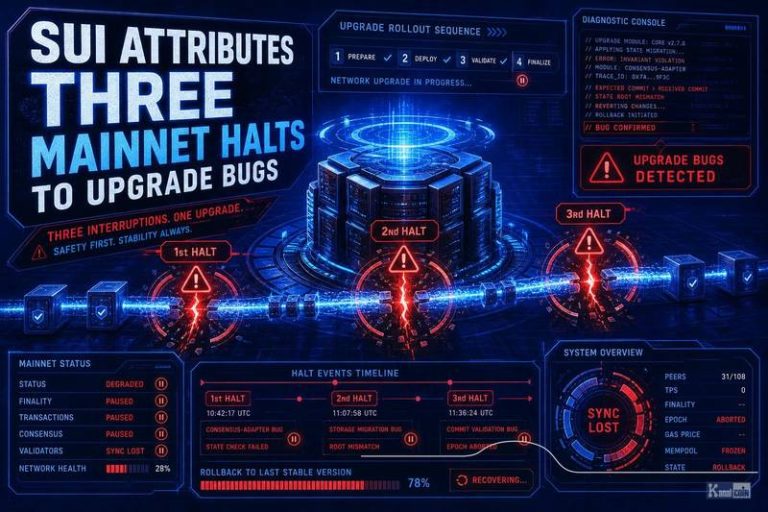
Sui’s mainnet went down three times in roughly 36 hours last week after upgrade bugs crashed validators, the Sui Foundation said in a postmortem that blamed two distinct software defects introduced during the network’s 1.72 release.
The three outages hit on May 28 and May 29, 2026. The Sui Foundation said in its postmortem that no user funds were at risk and no committed transactions were reverted during any of the incidents.
How three halts unfolded in 36 hours
TLDR: Key Takeaways
- Sui mainnet halted three times on May 28-29 due to two distinct upgrade bugs in the 1.72 release.
- The first two crashes involved gas charging logic; the third was a latent randomness-state bug exposed during the fix rollout.
- Sui said no user funds were lost and no committed transactions were reverted.
The first outage ran from about 7:00 a.m. PT to 1:30 p.m. PT on May 28. A crash bug in gas charging logic, triggered by the 1.72 release’s new address balances feature, caused validators to halt.
The second outage followed the next morning, lasting from roughly 5:00 a.m. PT to 8:30 a.m. PT on May 29. It stemmed from the same category of bug, again involving gas charging logic interacting with the address balances addition.
The third halt was different. It ran from about 1:30 p.m. PT to 7:20 p.m. PT on May 29 and came from a separate latent bug in how validators preserved DKG/randomness state across restarts. That bug was exposed during the rollout of the Friday morning fix, surfacing at the next epoch change.
Sui’s status page logged the incident as first being investigated at 07:15 PDT on May 28 and reported the network online with more than two-thirds of stake upgraded at 08:43 PDT on May 29. Epoch 1143 came online with degraded participation at 19:32 PDT on May 29, with final resolution on May 30.
Why Sui says upgrade bugs caused the outages
According to Sui, the first two outages traced to crash bugs in how gas charging logic interacted with the address balances feature shipped in version 1.72. The feature was new, and the bug manifested under specific transaction conditions that testing had not caught.
The third outage had a different root cause. Sui said that when engineers deployed the fix for the gas logic crashes on Friday morning, validators needed to restart. A latent bug in how validators preserved randomness state across restarts, which had not previously been triggered, surfaced at the next epoch boundary.
Sui acknowledged it had knowingly deployed an interim fix with a low-probability halt risk in order to restore service faster. Rather than waiting for a comprehensive patch, the team prioritized getting the network back online, accepting a small chance of a third disruption, which materialized hours later. That risk-acceptance detail, absent from competitor coverage of the halts, sets this postmortem apart.
What repeated halts mean for Sui’s reliability positioning
Three mainnet halts in two days is a significant operational event for any layer-1 blockchain, particularly one that markets itself on high throughput. Independent reporting noted the repeated downtime cuts against Sui’s pitch as a high-speed network and revived reliability comparisons to Solana’s earlier outage history.
Network halt incidents are not unique to Sui; the Cosmos-based Gravity Bridge halted after a reported exploit earlier this year, and chains like XRPL have emphasized architectural features designed to prevent such disruptions. The pattern across the industry underscores how upgrade processes remain a persistent risk vector.
SUI traded near $0.88 at the time of research, down roughly 3.0% over 24 hours.
The incident also matters because of the scale of capital on the network. Sui’s total value locked stood near $743.9 million at the time, meaning hundreds of millions in DeFi positions depended on network availability during the outage window.
For validators, developers, and users, the episode raises practical questions about upgrade testing and rollout procedures. The fact that a latent bug in randomness-state persistence went undetected until a production restart suggests gaps in pre-deployment simulation of validator lifecycle events. As regulators and institutions increasingly scrutinize blockchain infrastructure, as seen in discussions around stablecoin legislation and financial system resilience, operational reliability becomes a harder metric to ignore.
Sui’s postmortem committed to concrete code-path fixes for both the gas logic and randomness-state bugs. Whether those changes and improved upgrade testing processes prevent a repeat will shape how much lasting reputational damage these 36 hours cause.
Disclaimer: This article is for informational purposes only and does not constitute financial or investment advice. Cryptocurrency and digital asset markets carry significant risk. Always do your own research before making decisions.