


Bedrock, the multi-asset liquid staking protocol, is positioning its BR token at the center of a growing movement to unlock yield for Bitcoin holders. With over 5,000 BTC staked across more than 15 chains and a protocol that recently expanded to Aptos, Bedrock is making a case that idle Bitcoin capital belongs in DeFi.
What Bedrock Is and What the BR Token Does
Bedrock is a liquid staking protocol that lets Bitcoin holders deposit BTC and receive uniBTC, a yield-bearing liquid receipt token. Unlike traditional staking where assets are locked, uniBTC holders retain liquidity and can deploy their tokens across DeFi while earning staking rewards.
The BR token serves as the governance and utility layer of the Bedrock ecosystem. Through a vote-escrowed model (veBR), token holders direct protocol incentives and participate in fee-sharing, similar to the veTokenomics model popularized by Curve Finance.
For Bitcoin holders who have historically earned no native yield on their holdings, this represents a meaningful shift. Bitcoin’s $1.55 trillion market cap dwarfs the amount of BTC actively deployed in DeFi, leaving an enormous pool of dormant capital that protocols like Bedrock aim to activate.
Bedrock also operates beyond Bitcoin alone, supporting multi-asset staking. But its BTCFi products, uniBTC and brBTC, form the core value proposition as the protocol competes for a share of Bitcoin’s capital base.
Bedrock’s Aptos Expansion Marks the Latest Milestone
On September 4, 2025, Bedrock launched uniBTC and brBTC on the Aptos blockchain, bringing its liquid-staked Bitcoin products to a high-throughput Layer 1 network. The assets are bridgeable to Aptos via Interport, secured by Chainlink CCIP, and can be deployed into Hyperion liquidity pools for yield generation.
At the time of the Aptos launch, Bedrock’s protocol TVL stood at approximately $700 million with more than 5,000 BTC staked across 15+ supported chains. The Aptos ecosystem itself hosts over $400 million in BTC-backed assets and $1.17 billion in stablecoin liquidity, making it a natural destination for BTCFi expansion.
Bedrock’s current TVL tracked by DeFiLlama sits at approximately $382 million across 18 chains, with Bitcoin ($131M) and Ethereum ($122M) as the largest allocations. The protocol hit an all-time high of $686.54 million on January 31, 2025, representing 1,685% year-on-year growth at the time.
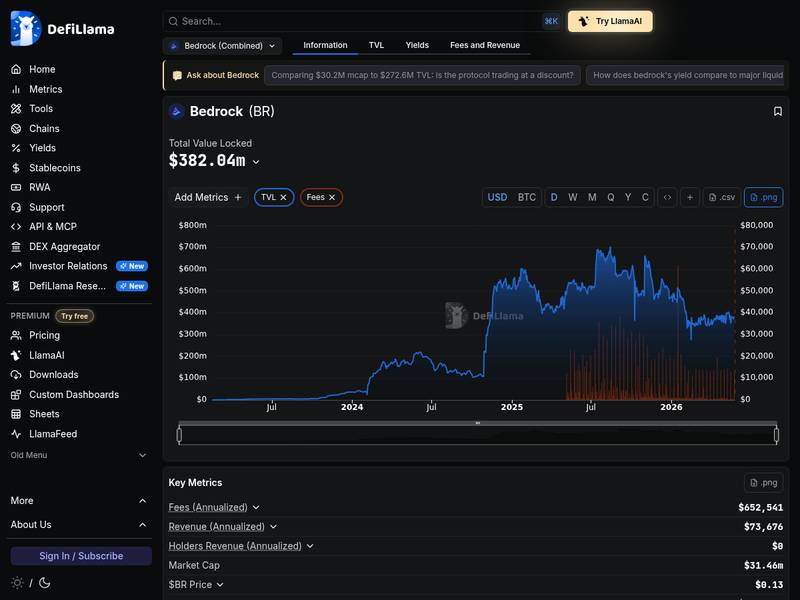
The decline from $700M to $382M mirrors broader market conditions; the Fear & Greed Index currently reads 30 (Fear), reflecting cautious sentiment across crypto markets. Similar dynamics have affected other DeFi protocols, as capital rotates during periods of uncertainty, a pattern also visible in how regulatory crackdowns on crypto platforms have dampened risk appetite in certain regions.
Zhuling Chen, Core Contributor at Bedrock, described the expansion as “bringing secure, yield-bearing Bitcoin to a high-performance DeFi network.”
“Bitcoin remains the most important asset in crypto, and enabling it on Aptos is central to our mission of building an open, accessible financial system.”
— Ash Pampati, SVP and Head of Ecosystem at Aptos
A future integration with Aries Markets for lending and borrowing on Aptos has been announced but is not yet live, according to the press release.
Where Bedrock Fits in the BTCFi Race
Bedrock competes in an increasingly crowded BTCFi landscape alongside protocols like Babylon, Lombard, SolvBTC, and pSTAKE. Each takes a different approach to the same problem: making Bitcoin productive without forcing holders to sell or wrap into centralized custody solutions.
What differentiates Bedrock is its multi-chain footprint. With 15+ supported chains and cross-chain bridging secured by Chainlink CCIP, the protocol offers deployment flexibility that single-chain competitors cannot match. The Aptos integration exemplifies this, giving users access to Hyperion pools and, eventually, Aries Markets lending, all while holding yield-bearing BTC derivatives.
The opportunity remains enormous. Bitcoin at $77,572 commands a $1.55 trillion market cap, yet only a fraction is deployed in DeFi. As institutional interest in Bitcoin-native yield grows, protocols that can offer secure staking with maintained liquidity stand to capture significant inflows, a trend that parallels broader moves toward tokenized financial infrastructure across the industry.
For Bedrock, the catalysts ahead include further chain integrations, the maturation of its BR/veBR governance model, and whether the protocol can reverse its TVL decline as market sentiment recovers. The gap between its announced $700M peak and current $382M figure will be the metric to watch, particularly as regulatory clarity in key markets either accelerates or constrains DeFi adoption.
Disclaimer: This article is for informational purposes only and does not constitute financial or investment advice. Cryptocurrency and digital asset markets carry significant risk. Always do your own research before making decisions.