


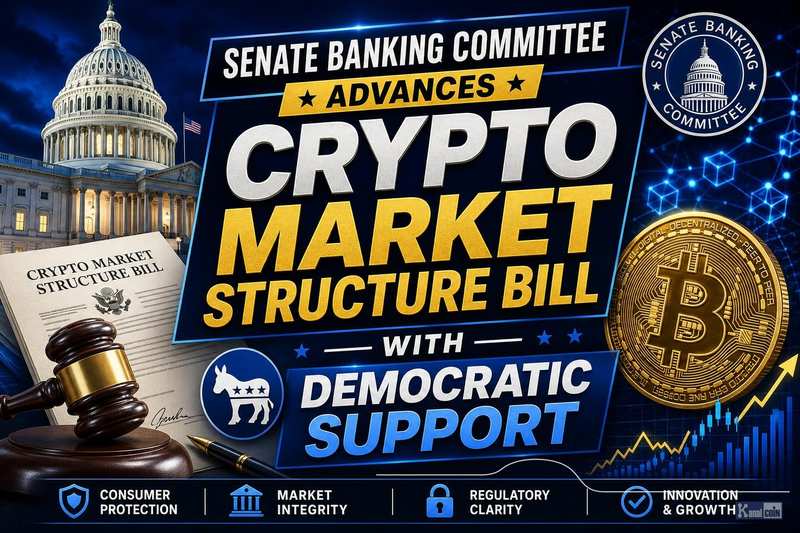
The Senate Banking Committee has advanced a crypto market structure bill with some Democratic support, marking a procedural step forward for legislation that would establish a clearer regulatory framework for digital assets in the United States.
The committee-level advancement is not the same as full Senate approval. The bill, which focuses on crypto market structure, must still navigate further Senate debate, potential amendments, and a full floor vote before it could reach the president’s desk.
Chairman Tim Scott, along with Senators Cynthia Lummis and Thom Tillis, released the bill text ahead of the Banking Committee markup. The legislation targets the regulatory framework and oversight structure governing cryptocurrency markets.
Why Democratic support signals broader momentum
The headline development is not just the bill’s advancement but that it drew support from some Democratic members. Crypto regulation has largely followed partisan lines in recent congressional sessions, making any cross-party backing a notable shift.
Democratic support suggests the proposal may carry broader traction than a purely partisan measure. That signal could influence how the bill is received when it reaches the full Senate, where bipartisan backing often determines whether legislation survives procedural hurdles.
However, “some Democratic support” should be read as a signal of momentum, not a guarantee of passage. The bill could still face opposition or significant amendments as it moves through later stages of the legislative process, as reporting on the committee’s deliberations has indicated.
The broader politics of crypto regulation remain fluid. Previous attempts at comprehensive market structure legislation have stalled at various stages, and the path from committee approval to enacted law involves multiple opportunities for delay or revision. Recent regulatory actions, including developments like the scrutiny surrounding major crypto-linked political contributions, underscore how politically charged the digital asset space remains.
What comes next for the bill
Committee advancement typically leads to scheduling for broader Senate consideration. The timeline depends on the legislative calendar and competing priorities, neither of which is certain.
Market structure legislation raises unresolved questions about jurisdiction between the SEC and CFTC, oversight of decentralized protocols, and implementation timelines. These details will likely drive the next round of debate. Industry participants tracking regulatory developments, including those watching how institutional products like Bitcoin ETFs respond to policy shifts, will be monitoring the bill’s progression closely.
The key signals to watch are whether the bill gets scheduled for a full Senate vote, whether additional Democratic co-sponsors emerge, and how the crypto industry’s lobbying efforts shape any amendments. Developments in related areas, such as new product launches on major exchanges, may also factor into how urgently legislators approach the framework.
Disclaimer: This article is for informational purposes only and does not constitute financial or investment advice. Cryptocurrency and digital asset markets carry significant risk. Always do your own research before making decisions.