


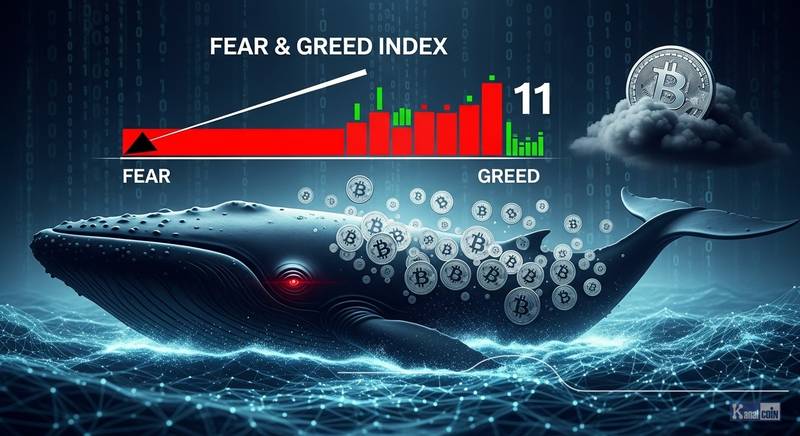
Bitcoin whales have accumulated 270,000 BTC over the past 30 days, marking the largest whale absorption event since 2013, even as the Crypto Fear & Greed Index plunged to 11, deep into “extreme fear” territory.
The contrast between retail panic and large-holder conviction is the defining feature of the current Bitcoin market. While smaller participants appear to be selling under pressure, wallets classified as whales have been absorbing supply at a historically unusual pace.
What a Fear & Greed Reading of 11 Says About the BTC Backdrop
The Crypto Fear & Greed Index sitting at 11 places sentiment firmly in “extreme fear.” On the index’s 0-to-100 scale, anything below 25 reflects widespread risk aversion, and a reading this low has historically been rare.
Retail Sentiment vs. Large-Holder Behavior
Extreme fear readings typically coincide with elevated selling from shorter-term holders and retail participants. Prices drop, social media sentiment turns negative, and trading volumes shift toward panic selling.
Yet the on-chain picture tells a different story. While retail sentiment has collapsed, whale wallets have moved in the opposite direction, steadily accumulating Bitcoin rather than distributing it. This divergence is what makes the current setup notable.
Sentiment indicators like Fear & Greed are not guaranteed trading signals. A reading of 11 can precede a reversal, but it can also persist or worsen if macro conditions deteriorate further.
Why 270,000 BTC in Whale Buying Stands Out
The Raw Figure
According to CoinCentral reporting, whales have purchased 270,000 BTC within a 30-day window. “Whale absorption” refers to large wallets taking coins off the market faster than new supply enters circulation, effectively reducing the available float.
At recent price levels, that volume represents a substantial portion of Bitcoin’s circulating supply being moved into wallets with a history of long holding periods. The scale of this accumulation has coincided with a broader trend of sustained ETF inflows into spot Bitcoin products, suggesting institutional appetite remains strong even during periods of retail fear.
The Since-2013 Context
The last time 30-day whale accumulation reached this scale was in 2013, when Bitcoin was a fraction of its current market capitalization. The capital required for this kind of absorption at today’s prices is orders of magnitude larger than the previous record.
This pattern has historically aligned with periods where long-term holders were building positions during market stress. Bitfinex analysts have documented similar structural dynamics behind recent Bitcoin moves, noting how quiet accumulation by patient capital can precede significant price shifts.
What This Combination Could Mean Next for Bitcoin
Extreme fear paired with aggressive whale accumulation creates a tension that has historically resolved in one of several ways.
Bullish Scenario
If whale demand continues absorbing sell pressure, the available supply on exchanges shrinks. Any catalyst, such as renewed institutional interest through vehicles like Goldman Sachs’ planned Bitcoin Premium Income ETF, could trigger a supply squeeze and sharp price recovery.
Neutral Scenario
Whale accumulation stabilizes at current levels, and Bitcoin enters a prolonged consolidation range. Fear dissipates slowly as neither buyers nor sellers gain control, and the market grinds sideways for weeks.
Downside Scenario
Macro headwinds, regulatory shocks, or broader risk-asset selloffs can overwhelm on-chain accumulation signals. Whales buying does not guarantee price floors if forced selling from leveraged positions or external economic pressure accelerates. Activity in the broader DeFi ecosystem also illustrates how protocol-level risks can ripple across crypto markets independently of spot accumulation trends.
On-chain signals like whale absorption are one input among many. Broader macro conditions, exchange flows, and derivatives positioning all shape where Bitcoin heads from here.
Disclaimer: This article is for informational purposes only and does not constitute financial or investment advice. Cryptocurrency and digital asset markets carry significant risk. Always do your own research before making decisions.