



Blockstream co-founder Adam Back is pushing for optional quantum-proof Bitcoin upgrades, arguing that a phased, step-up sequence with a long migration window is a more realistic path than a forced protocol-wide change. The pitch keeps Bitcoin’s conservative governance intact while giving security-conscious users a way to harden their coins against future quantum attacks.
What Adam Back is proposing for quantum-proof Bitcoin
On April 4, 2026, Back wrote that Bitcoin users should get a step-up sequence of post-quantum readiness paired with a long migration time, which he said would make it more plausible to deprecate unmigrated ECDSA and Schnorr signatures over time, according to his post on X.
The proposal frames quantum hardening as opt-in first, not as a mandatory fork. Users who want the protection can migrate early; the rest would follow on an extended timeline before legacy signature schemes are phased out.
In a follow-up the next day, Back said support for change tends to scale with its defensive value, and argued that even people who consider the quantum timeline grossly exaggerated can back defensively long migration windows.
the appetite for change is proportional to the defensive value for change. so i think there should be reasonable support for it. even people who think quantum timeline is grossly exaggerated are sick of the FUD, and/or understand the value from defensively long migration windows.
— Adam Back (@adam3us) April 5, 2026
Why quantum resistance is now part of the Bitcoin roadmap
Back’s argument lands against a backdrop of concrete engineering work. BIP 360 is a draft consensus soft fork that proposes Pay-to-Merkle-Root (P2MR) as a quantum-resistant script-tree output type, described in the spec as a conservative first step for users who want that protection, according to the BIP text.
The same document is explicit about scope: P2MR protects against long-exposure attacks only, and short-exposure protection may require separate post-quantum signature proposals later. That narrow framing is what makes the upgrade optional rather than a wholesale cryptography swap.
The regulatory calendar is also tightening. BIP 360 cites U.S. CNSA 2.0 migration deadlines of 2030 for software and networking equipment and 2033 for browsers and operating systems, and notes that NIST IR 8547 plans to disallow ECC in the U.S. federal government after 2035 except for hybrid use.
Independent research points the same direction. A May 2025 Chaincode report argued for a dual-track Bitcoin response of roughly two years for contingency work and about seven years for a comprehensive path, and estimated around 6.26 million BTC, or roughly $650 billion, sit in address types that could be exposed to a sufficiently powerful quantum adversary.
What optional upgrades could mean for Bitcoin users and the network
The opt-in model is not purely theoretical. Blockstream said on March 3, 2026, that it broadcast what it believes are the first post-quantum-signed transactions on a production Bitcoin sidechain, Liquid, according to Blockstream Research. Liquid users can opt into quantum protection today by locking assets to a Simplicity contract that requires post-quantum signatures, with no consensus-rule changes needed.
For wallet holders and custodians, that template hints at how a Bitcoin mainnet rollout could work: new address types coexist with legacy ones, and users self-select when to migrate. Developers would carry the heavier load, wiring P2MR and any successor signature scheme into wallet software, hardware devices, and exchange withdrawal flows.
Not everyone agrees the pace is sufficient. Quantum-native network QRL has argued that Bitcoin’s migration is slower and harder than optional-upgrade advocates suggest, warning that throughput bottlenecks and dormant-coin exposure could stretch a full migration into a 2033-2034 window. That critique does not address Blockstream’s already-live Liquid deployment, but it frames the stakes if optional adoption stalls.
Markets are not treating the debate as an immediate catalyst. Bitcoin changed hands at $74,357 with a 0.44% move over 24 hours and a market cap near $1.49 trillion, while 24-hour volume came in around $39.3 billion.
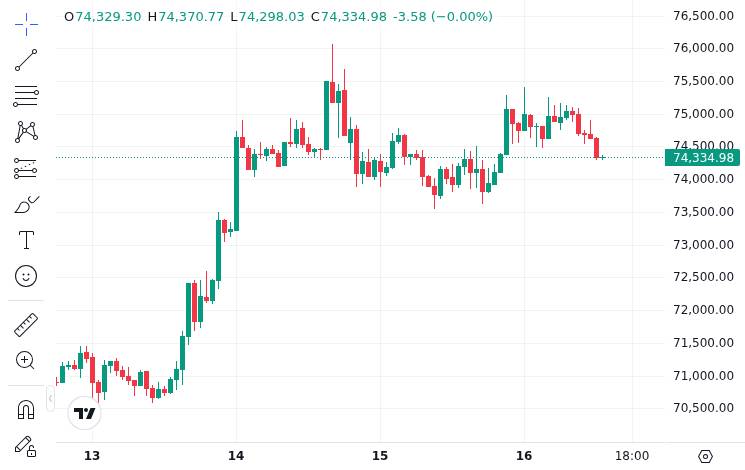
Sentiment, however, is defensive: the Crypto Fear and Greed Index read 23, classified as Extreme Fear. That cautious tape mirrors the broader pause seen when Bitcoin’s rally near $75,000 stalled on softening on-chain demand, and it sits alongside macro cross-currents like Kraken’s scenarios for a Warsh-led Fed and ongoing policy signals around dollar and yuan stablecoin competition.
Separately, Back has suggested that Taproot and Schnorr were designed in 2018-2019 with a quantum transition in mind, according to unconfirmed reports from CoinEdition; no primary technical statement corroborating that specific design intent was available at publication.
The next markers to watch are whether BIP 360 attracts additional review from Bitcoin Core contributors, and whether more wallets and custodians follow Liquid’s template by offering optional post-quantum address types before the 2030-2033 compliance cliffs arrive.
Disclaimer: This article is for informational purposes only and does not constitute financial or investment advice. Cryptocurrency and digital asset markets carry significant risk. Always do your own research before making decisions.