



The Bank of Korea on April 13 called for crypto exchanges to adopt circuit-breaker mechanisms similar to those used on the Korea Exchange, citing the recent Bithumb payout error as evidence that digital asset venues lack adequate internal controls.
Why the Bank of Korea wants crypto circuit breakers now
The central bank’s report said crypto exchanges need safeguards modeled on the trading halts that the Korea Exchange triggers during extreme volatility in stocks and derivatives. The BOK argued that weaker internal controls and lower regulatory standards at crypto venues, compared with traditional finance, amplified the Bithumb incident.
The report also called for real-time IT systems that verify internal ledgers against on-chain blockchain balances, a measure designed to catch discrepancies before mispayments leave the platform. The proposal frames the problem as a market-structure gap, not a one-off accident.
South Korean regulators have moved quickly on crypto oversight this year. The BOK’s circuit-breaker push follows a broader pattern of tightening regulatory frameworks for digital asset exchanges across major markets.
What the Bithumb payout error revealed about exchange controls
Bithumb said the incident originated from an input mistake during an event reward payout, not a hack or external exploit. A staff member was able to distribute bitcoin without supervisor approval or internal monitoring verification, according to the BOK’s findings.
The exchange blocked trading and withdrawals for affected users within 35 minutes of detecting the error. Bithumb reported that 620,000 BTC was mispaid and 618,212 BTC was recovered, a reclamation rate above 99%. No externally transferred bitcoin was found.
The speed of recovery limited the fallout, but the BOK’s report used the incident to illustrate how a single human error, absent proper controls, could trigger massive unintended payouts. The episode underscored a gap between the operational safeguards at traditional financial institutions and those at crypto exchanges.
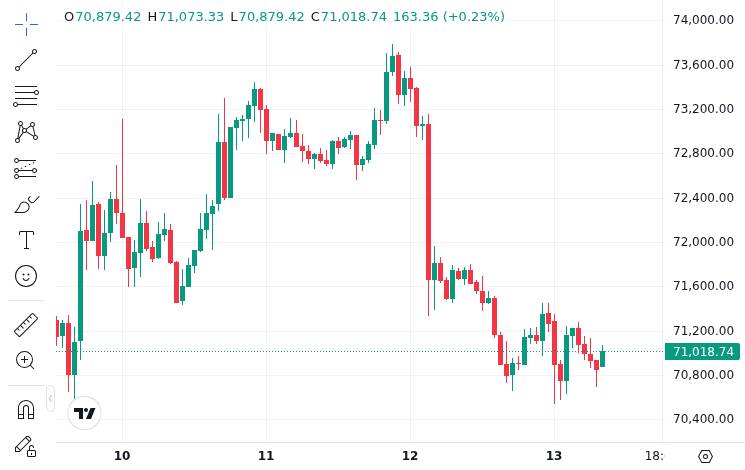
Bitcoin traded at $71,019 at press time, with a market cap of roughly $1.42 trillion. The Fear & Greed Index sat at 12, deep in “Extreme Fear” territory, reflecting broader market unease beyond the Bithumb story alone.
How regulators tightened oversight after the incident
The Financial Services Commission responded separately by requiring all Korean crypto exchanges to implement asset-matching systems by the end of May 2026. Exchanges must also disclose balances daily and undergo monthly external checks, creating a layered verification regime that did not exist before the Bithumb error.
Officials assessed in February that the Bithumb-triggered crypto volatility was unlikely to spill over directly into broader financial markets. That containment judgment gave regulators room to design measured rules rather than emergency interventions.
The combination of the BOK’s circuit-breaker proposal and the FSC’s asset-matching deadline marks the most significant set of exchange-level controls South Korea has introduced since its virtual asset legislation took effect. The end-of-May deadline will test whether exchanges can deploy real-time reconciliation infrastructure on a compressed timeline.
For crypto markets globally, the Korean approach offers a case study in how a single operational failure can accelerate regulatory timelines. Whether the circuit-breaker model gains traction beyond South Korea may depend on how effectively the new rules prevent repeat incidents, a question regulators in other jurisdictions with growing exchange activity are likely watching closely.
Disclaimer: This article is for informational purposes only and does not constitute financial or investment advice. Cryptocurrency and digital asset markets carry significant risk. Always do your own research before making decisions.