



Circle Internet Group (NYSE: CRCL) launched CPN Managed Payments on April 8, 2026, a fully managed platform that allows banks, payment service providers, fintechs, and enterprises to settle transactions in USDC without directly holding or managing digital assets.
The product sits on top of Circle’s existing Payments Network (CPN) and handles the entire digital asset lifecycle, including USDC minting and burning, payment orchestration, compliance controls, and blockchain infrastructure. Partners transact solely in fiat while Circle manages all crypto operations behind the scenes.
Launch partners for CPN Managed Payments include Thunes, a global payments network connecting 12 billion mobile wallets and bank accounts across 140+ countries; Veem, a cross-border payments provider; and Worldline, a financial services processor.
What CPN Managed Payments Solves for Regulated Institutions
TLDR KEY POINTS
- Banks and PSPs can now settle in USDC without obtaining digital asset custody licenses or managing crypto wallets
- Circle handles 100% of USDC minting/burning, multi-chain orchestration, and compliance monitoring under its own regulatory licenses
- The platform supports 20+ blockchains, 90+ fiat currencies, and 24/7 real-time settlement
CPN Managed Payments is designed as a service layer between traditional financial institutions and blockchain settlement rails. Banks and PSPs connect through a fiat API, while Circle manages all underlying crypto operations, including wallet infrastructure, blockchain routing across 20+ blockchain networks, and USDC conversion.
The critical distinction is regulatory. Financial institutions can operate under Circle’s existing money transmitter licenses and regulatory approvals rather than obtaining separate digital asset custody licenses. This removes one of the largest barriers to institutional stablecoin adoption, the compliance overhead of directly handling crypto assets.
Nikhil Chandhok, Circle’s Chief Product and Technology Officer, framed the product as an enterprise integration play:
“By combining issuance, liquidity, compliance, and programmable infrastructure into a unified solution, we are enabling financial institutions to embed stablecoin settlement into their existing payment stacks with enterprise-grade reliability and operational readiness.”
— Nikhil Chandhok, Circle CPTO, via Circle Pressroom
How Settlement Works Without Direct Crypto Custody
The operational flow separates fiat handling from blockchain execution. A sending institution (Originating Financial Institution, or OFI) initiates a payment in local fiat currency through CPN’s API. Circle converts the fiat to USDC, routes it across the optimal blockchain, and delivers fiat to the receiving institution (Beneficiary Financial Institution, or BFI).
At no point does the bank or PSP hold USDC on its balance sheet. Circle mints USDC upon receiving fiat from the sender, executes the cross-border transfer on-chain, and burns the USDC when converting back to the recipient’s local currency. The entire round-trip happens 24/7 with real-time settlement.
Built-in compliance architecture includes Travel Rule enforcement for cross-border transactions, a requirement that has historically forced institutions to build or license expensive compliance tooling when handling digital assets directly. CPN Managed Payments bundles this into the platform, similar to how traditional payment processors like those involved in Polymarket’s recent acquisition of Brahma for DeFi infrastructure are consolidating operational complexity.
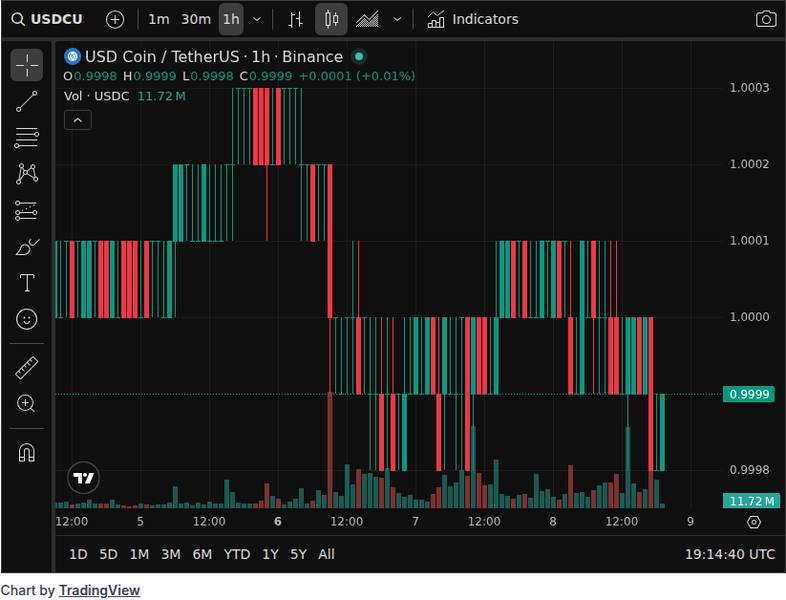
USDC currently maintains a $78.27 billion market cap with $17.43 billion in 24-hour trading volume, ranking sixth among all cryptocurrencies. The stablecoin trades at $0.999864, holding its dollar peg.
Why This Matters for Stablecoin Payment Adoption
CPN Managed Payments targets the institutional adoption bottleneck directly. Banks and PSPs that want faster cross-border settlement have historically faced a choice: build internal crypto custody infrastructure or avoid blockchain rails entirely. Circle’s managed model offers a third path.
Thunes’ participation is particularly notable. The network’s reach across 140+ countries and connection to 12 billion mobile wallets positions CPN Managed Payments as a potential corridor for remittances and emerging market payments where traditional SWIFT transfers are slow and expensive. Chloé Mayenobe, Thunes Deputy CEO, said the partnership “allows us to seamlessly bridge traditional banks, mobile wallets, and digital assets.”
The timing is notable given broader market conditions. The Fear & Greed Index sits at 17, deep in Extreme Fear territory, yet institutional infrastructure investment continues. This pattern, where infrastructure buildout accelerates during risk-off periods, mirrors what happened during previous cycles when major players repositioned during downturns.
Practical limitations remain. The platform depends on Circle’s own liquidity and regulatory standing. Any disruption to Circle’s licenses or USDC reserves would directly impact every institution relying on the managed service. Partners also trade operational simplicity for vendor concentration risk.
Early adopters are most likely to be mid-size PSPs and fintechs serving cross-border corridors where SWIFT settlement times create real business friction. Large banks with existing correspondent banking relationships may move slower, given internal compliance review cycles and the novelty of delegating settlement infrastructure to a crypto-native company.
CPN Managed Payments supports 90+ fiat currencies at launch. Whether this fully managed approach accelerates institutional stablecoin adoption will depend on Circle’s ability to demonstrate reliable uptime, consistent regulatory standing, and competitive pricing against established cross-border rails.
Disclaimer: This article is for informational purposes only and does not constitute financial or investment advice. Cryptocurrency and digital asset markets carry significant risk. Always do your own research before making decisions.