



U.S. spot Bitcoin ETFs hemorrhaged nearly $300 million in net outflows last week as institutional investors pulled back from crypto exposure amid deepening risk-off sentiment, geopolitical uncertainty, and end-of-quarter portfolio rebalancing.
$290M Exits U.S. Spot Bitcoin ETFs in Single Session
Weekly net outflows across all U.S. spot Bitcoin ETFs totaled $296.18 million for the week ending March 28, reversing a strong four-week stretch that had delivered $2.2 billion in cumulative inflows.
The heaviest selling hit on Friday, March 28, when total single-day redemptions reached $225.62 million. BlackRock’s iShares Bitcoin Trust (IBIT) accounted for $201.67 million of that Friday exodus alone, dwarfing outflows from Bitwise ($18.60 million) and Ark Invest ($5.35 million).
Total net assets across all U.S. spot Bitcoin ETFs dropped to $84.77 billion, down from over $90 billion the prior week. The scale of IBIT’s single-day redemption is notable given BlackRock’s fund has historically been the most consistent inflow magnet among the spot ETF cohort.
The retreat was not limited to Bitcoin. Ethereum ETFs recorded $206.58 million in weekly outflows, marking a second consecutive week of losses. That breadth suggests an institutional-level rotation out of crypto assets broadly, not a Bitcoin-specific loss of conviction. Investors tracking recent whale movements on Ethereum will note the contrast between large holders accumulating and institutions heading for the exits.
Risk-Off Sentiment and Quarter-End Rebalancing Collide
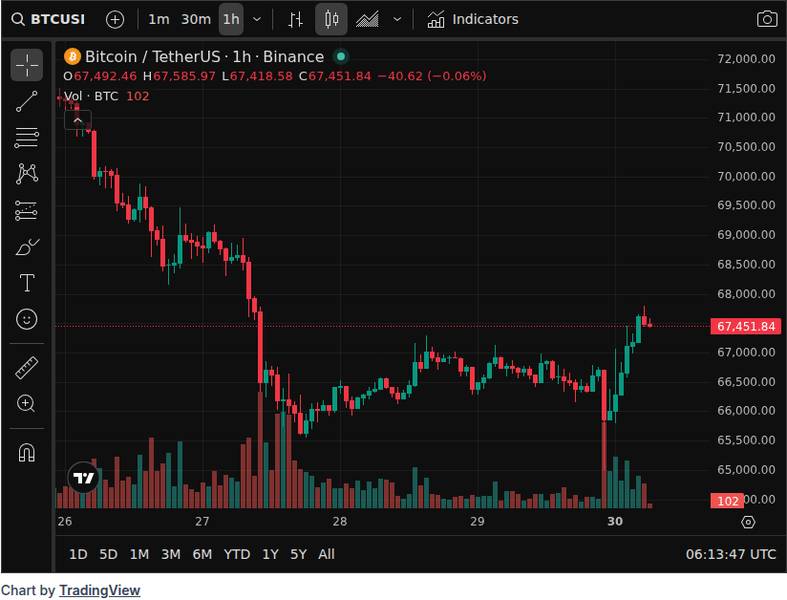
Bitcoin traded at approximately $67,428 as of March 30, up 1.0% over 24 hours but down 2.1% on the week. Market capitalization held at $1.35 trillion with 24-hour trading volume near $29.98 billion.
Pratik Kala, head of research at Apollo Crypto, attributed the selling to “risk-off sentiment and end of quarter rebalancing,” a combination that compressed demand from institutional allocators who typically adjust positions ahead of quarterly reporting windows.
“Bitcoin is behaving less like a breakout asset and more like a reflection of liquidity conditions, indicating capital is avoiding directional bets during range-bound trading.”
Bitunix Analyst, via Yellow
The Crypto Fear & Greed Index sat at 8 out of 100, deep in “Extreme Fear” territory, on March 30. That reading corroborates the risk-off characterization and marks one of the lowest sentiment prints since the index’s inception.
Adding to the demand vacuum, MicroStrategy ended its 13-week streak of weekly Bitcoin purchases, removing what had been a consistent buy-side floor throughout Q1. With institutional ETF flows turning negative and a major corporate buyer stepping back simultaneously, the near-term demand picture has narrowed considerably. The broader trend of evolving regulatory frameworks around crypto-backed financial products adds another layer of complexity for institutional positioning.
Fading ceasefire hopes tied to geopolitical tensions were cited as an additional driver in initial reports, though that catalyst has not been independently confirmed beyond a single source.
$290M in Context: Retreat, Not Capitulation
The $296.18 million weekly outflow, while significant, represents roughly 0.35% of the $84.77 billion in total net assets still held across U.S. spot Bitcoin ETFs. That ratio suggests institutional repositioning rather than a wholesale abandonment of the asset class.
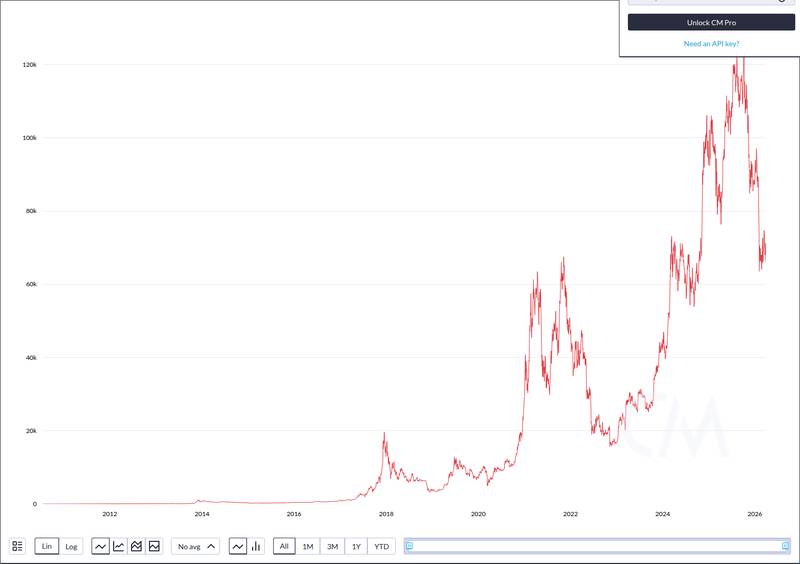
Bitcoin has traded in a range between roughly $65,000 and $72,000 in recent weeks, a consolidation band that aligns with institutional range-bound positioning. The dip below $65,200 earlier in the week before recovering to $67,400 reflects the kind of liquidity-driven volatility that typically accompanies quarter-end rebalancing cycles.
The divergence between institutional and retail sentiment is striking. Despite ETF outflows and Extreme Fear readings, community sentiment on CoinGecko showed 72% bullish positioning, suggesting retail investors view the pullback as a buying opportunity rather than a trend reversal. This split between institutional caution and retail conviction has historically preceded periods of increased volatility, as seen during similar dynamics in compressed yield environments across DeFi.
Investors watching for a flow reversal should track two concrete signals: whether IBIT returns to net positive daily flows in the first full week of Q2 (beginning March 30), and whether MicroStrategy resumes its weekly purchase cadence. The previous four-week inflow streak that brought $2.2 billion into Bitcoin ETFs began after a similarly sharp but short-lived outflow episode, suggesting the current bleed may prove cyclical rather than structural.
Q2 opens with Bitcoin sitting at $67,428, ETF assets at $84.77 billion, and sentiment at multi-month lows. The gap between that fear reading and the $1.35 trillion market cap holding steady will resolve in one direction or the other as quarter-end rebalancing flows settle and fresh institutional allocation decisions take shape in April.
Disclaimer: This article is for informational purposes only and does not constitute financial or investment advice. Cryptocurrency and digital asset markets carry significant risk. Always do your own research before making decisions.