


A single compromised signing key allowed an attacker to mint 80 million unbacked USR stablecoin tokens on March 22, 2026, draining roughly $25 million from Resolv Labs and sending shockwaves through at least six DeFi lending protocols. Sentora’s weekly DeFi metrics report, published March 27 by analyst Juan Pellicer, quantified the damage and traced the ripple effects across the broader market.
How a $200,000 Deposit Became a $25 Million Exploit
The attacker deposited just $200,000 in USDC into Resolv, a delta-neutral stablecoin protocol that issues USR tokens. From that modest position, the attacker exploited a flaw in the minting infrastructure to generate approximately 80 million unbacked USR tokens, then extracted an estimated $25 million before the system caught up.
The root cause was not a smart contract bug. Chainalysis confirmed the attack vector was a compromised AWS-hosted signing key with no on-chain mint cap and no multisig safeguard. It was an infrastructure failure, the kind that audits of Solidity code alone cannot catch.
USR collapsed over 70% from its $1 peg within minutes, trading as low as $0.025 on Curve and $0.14 on other venues before partially recovering to the $0.27 to $0.42 range. The speed of the depeg left little time for holders or automated liquidation systems to react.
Resolv Labs stated that the collateral pool “remains fully intact,” with the exploit “isolated to USR issuance mechanics.” Reserve assets were protected, but USR token holders absorbed the losses directly.
Sentora’s Data Maps the Contagion Across Six Protocols
What distinguishes the Sentora report from standard exploit recaps is the granular breakdown of cascading damage. The exploit rippled into six lending protocols: Morpho vaults, Euler, Venus, Lista DAO, and Fluid all paused markets or isolated vaults as a precaution. Aave reported zero direct USR exposure.
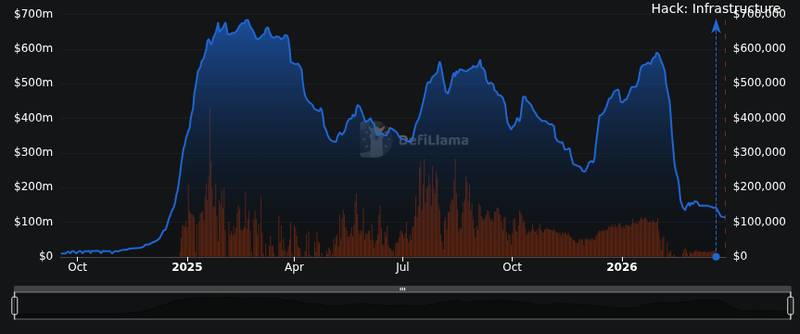
Resolv’s total value locked collapsed from a peak of approximately $687 million in February 2025 to roughly $114 million after the exploit, an 83% decline. DeFiLlama’s tracking adjusts for the 80 million fraudulently minted tokens, meaning the real capital flight was even steeper than the headline number suggests.
The broader DeFi market absorbed the shock unevenly. The Crypto.com Research DeFi weekly report for the week of March 25 recorded a 5.23% decline in the DeFi market cap index, a 7.57% drop in volume, and a 53.28% surge in the DeFi volatility index. The Crypto Fear & Greed Index fell to 12, deep in “Extreme Fear” territory.
Security analyst Michael Pearl characterized the fallout as “concentrated with localized spillover, rather than widespread contagion.” That framing fits the data: protocols with direct USR exposure scrambled, while the rest of DeFi experienced elevated caution rather than panic.
Resolv was not an isolated incident. Q1 2026 DeFi losses totaled $137 million across 15 incidents, with Resolv ($25 million), Step Finance ($27.3 million), and Truebit ($26.2 million) among the largest. The quarter’s pattern suggests infrastructure-level vulnerabilities, not just smart contract exploits, are becoming a more prominent attack surface. This trend comes at a time when broader crypto markets are also under pressure, with U.S. Bitcoin spot ETFs recording $225 million in net outflows on March 27 alone.
What Protocols and Investors Should Watch Next
The immediate question is whether Resolv can chart a credible recovery path. The team’s claim that reserve assets are intact gives them a starting point, but the protocol must address the fundamental key management failure that enabled the exploit. Any remediation plan without multisig controls and on-chain mint caps will face skepticism.
For the affected lending protocols, the priority is quantifying bad debt. Sentora’s report broke down losses per protocol and per curator, a level of detail no other public analysis has matched. Morpho vault depositors, Euler lenders, and Venus participants should monitor governance proposals for any compensation or loss-socialization mechanisms in the coming weeks.
The broader DeFi ecosystem faces a harder question about infrastructure security standards. The Resolv exploit demonstrated that a single compromised cloud-hosted key can bypass every on-chain safeguard. As post-quantum cryptography migration discussions gain urgency across the industry, the Resolv case adds another dimension: even current-generation key management practices are failing at basic operational security.
Meanwhile, crypto companies face growing legal scrutiny over transparency and disclosure practices, as highlighted by the ongoing Nvidia crypto revenue lawsuit that recently gained class certification. The Resolv incident may further fuel regulatory calls for stricter oversight of yield-bearing stablecoin protocols, particularly around minting controls and key management standards.
Investors tracking recovery signals should watch Resolv’s TVL trend on DeFiLlama, USR’s peg stability on decentralized exchanges, and any formal audit or post-mortem publication from Resolv Labs.
The Sentora report’s value is in putting numbers on what social media captured only as panic. Six protocols affected, $25 million extracted, 83% TVL decline, and a volatility spike of 53% in a single week. The data confirms the exploit was severe but contained. Whether it stays contained depends on what Resolv and its counterparties do next.
Disclaimer: This article is for informational purposes only and does not constitute financial or investment advice. Cryptocurrency and digital asset markets carry significant risk. Always do your own research before making decisions.