


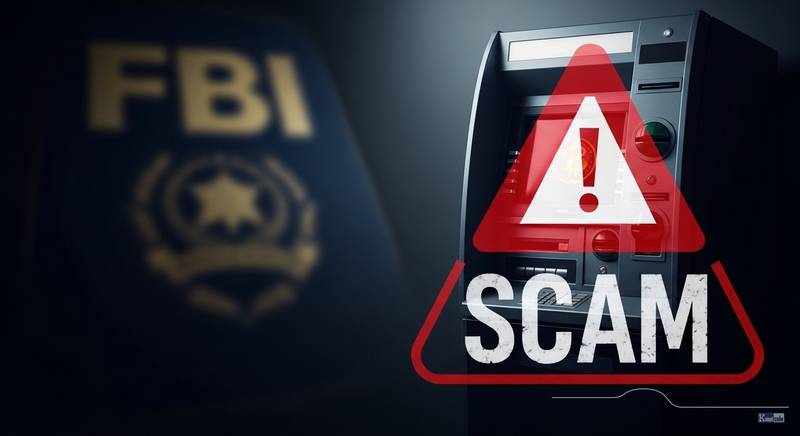
The FBI has issued a warning about an organized criminal network that impersonates law enforcement officers to pressure victims into sending money through cryptocurrency ATMs. The scheme relies on fake threats of arrest and asset seizure to create panic, exploiting the speed and irreversibility of crypto transactions to siphon funds before victims realize they have been defrauded.
TLDR KEYPOINTS
- The FBI flagged a criminal network specifically targeting victims through crypto ATMs by posing as federal and local law enforcement.
- Scammers use phone calls and messages claiming victims face imminent arrest or legal action unless they comply with payment demands.
- Victims are directed to withdraw cash and deposit it at cryptocurrency ATMs to wallet addresses controlled by the criminals.
How the Crypto ATM Impersonation Scam Works
The fraud follows a consistent pattern. Criminals contact potential victims by phone or electronic message, claiming to be FBI agents, local police officers, or representatives of other government agencies. They tell the target they are under investigation or face pending charges.
The caller then escalates urgency, warning the victim that failure to act immediately will result in arrest, asset freezing, or criminal prosecution. Under this pressure, victims are instructed to withdraw cash from their bank accounts and deposit it at a nearby cryptocurrency ATM.
At the ATM, victims are told to send funds to a specific wallet address, often described as a “secure government account” or a way to “protect” their assets during the supposed investigation. Once the crypto transaction is confirmed, the funds are effectively gone.
Crypto ATMs are the preferred vehicle for this scam because transactions settle quickly and are largely irreversible. Unlike traditional wire transfers, which banks can sometimes freeze or recall, cryptocurrency sent to an external wallet offers victims almost no recourse for recovery.
The FBI’s Internet Crime Complaint Center (IC3) has published advisories warning that no legitimate law enforcement agency will ever demand payment via cryptocurrency. Any such request is a clear indicator of fraud.
Scale of the Threat and FBI’s Response
Cryptocurrency fraud has become one of the fastest-growing categories of financial crime reported to federal agencies. The FBI’s 2023 cryptocurrency fraud report documented billions of dollars in losses across various crypto-related scam types, with ATM-based schemes representing a notable and rising share.
The bureau has responded with both consumer awareness campaigns and active investigations. Its Operation Level Up initiative focuses on identifying and contacting potential victims of cryptocurrency fraud before they lose more money, a proactive approach that marks a shift from purely reactive enforcement.
The FBI’s guidance for anyone who receives such a call is straightforward: hang up, do not send any funds, and file a complaint directly with IC3. Real law enforcement officers will never demand immediate cryptocurrency payments over the phone.
The warning applies nationally, not to any specific region. Criminals operating these schemes have targeted victims across the United States, with elderly individuals representing a disproportionately affected demographic. The broader crypto ecosystem has also felt the effects of rising fraud, with large-scale Bitcoin movements drawing increased scrutiny from both regulators and on-chain analysts.
Crypto ATM Fraud Draws Regulatory Attention
The FBI’s warning comes amid growing legislative and regulatory focus on crypto ATM operators. Senator Dick Durbin has proposed amendments to the GENIUS Act that would impose stricter requirements on crypto ATM operators, specifically targeting the vulnerability of elderly users to ATM-based scams.
The Financial Crimes Enforcement Network (FinCEN) has also weighed in, issuing guidance on convertible virtual currency kiosk operators that reinforces know-your-customer and anti-money-laundering obligations for businesses operating crypto ATMs.
These moves signal that crypto ATMs, once seen as a convenient on-ramp for retail users, are increasingly viewed by regulators as a high-risk channel for illicit finance. Operators that fail to implement adequate fraud prevention measures face growing compliance pressure.
The regulatory tightening around crypto ATMs parallels broader enforcement trends. As Bitcoin price volatility continues to attract new users to the market, the intersection of consumer protection and crypto infrastructure is becoming a central policy battleground. Macroeconomic uncertainty has only amplified the urgency, as financially stressed individuals may be more susceptible to high-pressure scam tactics.
For crypto users, the safeguard remains simple: no government agency will ever ask for payment in cryptocurrency, and any caller making such a demand is a criminal.
Disclaimer: This article is for informational purposes only and does not constitute financial or investment advice. Cryptocurrency and digital asset markets carry significant risk. Always do your own research before making decisions.