


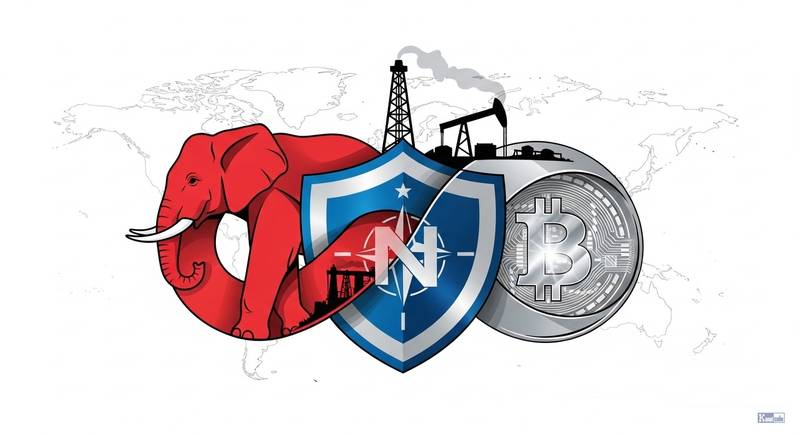
Trump NATO Iran war crypto risk moved from rhetoric to market signal on March 17, after President Donald Trump publicly blasted allied governments for staying out of the U.S. campaign against Iran, deepening geopolitical uncertainty that traders in Asia and beyond are already reading as a fresh risk-off cue.
CNBC reported that Trump used Truth Social to say the United States no longer needed NATO support because of its military success, adding that it never needed that help in the first place and did not need anyone’s help at all. He framed the standoff as a test for the alliance after several partners declined to join the war effort or commit naval assets to secure the Strait of Hormuz. CNBC
For crypto markets in Southeast Asia, the immediate issue is not alliance diplomacy on its own. It is the combination of war risk, oil shipping disruption, and a renewed fight over sanctions, all of which can hit regional currencies, imported energy costs, and short-term appetite for volatile assets.
Trump’s NATO attack adds another layer of uncertainty to an already fragile war backdrop
Trump’s post was directed at NATO countries and also mentioned partners such as Japan, Australia, and South Korea, according to CNBC’s account of the statement. He also warned that it would be very bad for NATO’s future if countries failed to help police the Strait of Hormuz, a critical energy chokepoint for global trade. CNBC
The resistance from allies has been unusually explicit. NBC News reported that Germany’s defense minister said, “This is not our war, we have not started it,” while UK Prime Minister Keir Starmer said any British role was not envisioned as a NATO mission and that the UK would not be drawn into a wider war. NBC News
That matters for markets because alliance fragmentation can prolong uncertainty even when the White House claims operational momentum. The brief also notes that no NATO country has firmly committed to helping secure Hormuz, while Australia, Japan, Poland, Sweden, Spain, the UK, and Germany have all signaled reluctance or outright refusal.
Trump further claimed that Iran’s navy, air force, anti-aircraft systems, and radar were gone, but that battlefield assessment has not been independently confirmed in the material provided for this article. The more defensible takeaway for investors is narrower: the war is entering its third week, shipping security remains unresolved, and the politics around escalation are hardening.
Crypto traders are likely to read this as risk-off first, then reassess the safe-haven narrative
The research brief did not include a verified live Bitcoin price snapshot, so a precise market print should not be inserted here without fresh sourcing. What can be said with confidence is that the broader sentiment backdrop is weak, with the Crypto Fear & Greed Index at 28, labeled “Fear,” as of March 17.
That lines up with the pattern seen during prior U.S.-Iran flashpoints: the first reaction tends to be defensive, especially when headlines also threaten oil transport and broader trade flows. Only after the initial shock do traders revisit the argument that Bitcoin can behave as a hedge against state conflict, sanctions pressure, or fiat instability.
For ASEAN readers, that split matters. Exchanges and traders across Indonesia, the Philippines, Thailand, Singapore, and South Korea often see fast shifts in stablecoin demand and speculative positioning when macro stress collides with commodity inflation, a theme that also sits behind Kanalcoin’s recent look at how equities, fixed income, crypto and commodities are converging in ETFs.
If the Strait of Hormuz stays constrained, energy-linked inflation can re-enter the conversation quickly for import-dependent Asian economies. That can pressure local currencies and household spending even before crypto finds a clearer directional narrative.
The Iran conflict also revives the sanctions and compliance debate around blockchain networks
This story has a second crypto angle that goes beyond price action. Iran has a documented history of using crypto activity, including mining and wallet flows, to ease the pressure of U.S. sanctions, and U.S. regulators have previously treated Iran-linked crypto exposure as a serious enforcement issue.
That means any deeper war footing can sharpen scrutiny on exchanges, brokers, OTC desks, and stablecoin rails that touch sanctioned jurisdictions. For platforms serving global users, including those with meaningful Asian customer bases, the compliance question is not theoretical: screening, wallet monitoring, and sanctions controls become front-line operational issues during conflicts like this.
The article is also part of a broader market chain reaction already visible in energy and security coverage. Readers tracking the knock-on effects may also want to compare this with Kanalcoin’s reporting on the oil shock from diesel prices hitting $5 per gallon as the Iran war disrupts supply and the political fallout after a senior U.S. counterterrorism official resigned over the war.
For now, the strongest market signal is not that Bitcoin has definitively become a wartime safe haven. It is that geopolitical fragmentation, sanctions risk, and energy disruption are all back on the board at the same time, which usually keeps volatility elevated across crypto and traditional assets alike.
From a Southeast Asian perspective, that combination deserves close attention because the region feels external commodity shocks quickly, while its crypto markets often react faster than local policymakers. Until there is a verified reopening path for Hormuz or a credible de-escalation track, traders are likely to stay headline-sensitive.
Disclaimer: This article is for informational purposes only and does not constitute financial or investment advice.
Disclaimer: This article is for informational purposes only and does not constitute financial or investment advice. Cryptocurrency and digital asset markets carry significant risk. Always do your own research before making decisions.