


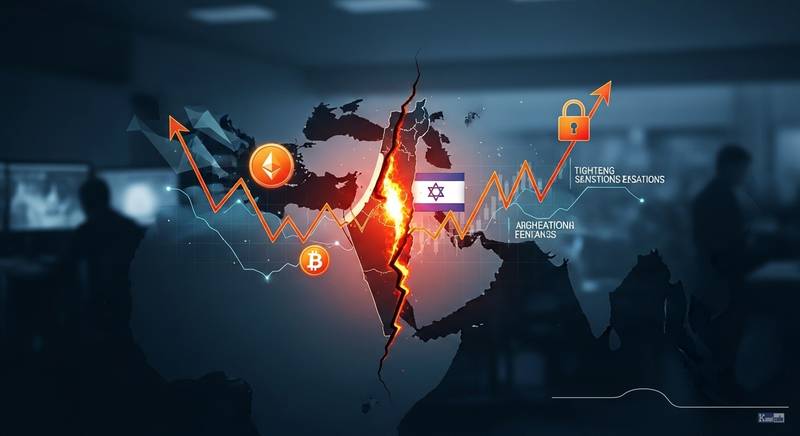
The U.S.-Israel military campaign against Iran, now in its 17th day, is fracturing the American right along a fault line that runs directly through the MAGA coalition, pitting isolationist nationalists against traditional pro-Israel hawks in a dispute with direct implications for crypto markets, sanctions enforcement, and the future of digital asset legislation in Congress.
MAGA Isolationists vs. Pro-Israel Hawks: The Rift the Iran War Forced Into the Open
The fracture is not subtle. Rep. Marjorie Taylor Greene has accused the U.S. of “murdering Iranian children.” Candace Owens has published more than a dozen posts framing the conflict as Israel-led. Megyn Kelly, Matt Walsh, and the Hodge Twins have all cast the war as a betrayal of the “America First” doctrine, according to reporting by The New York Times.
The tensions have reached into the administration itself. Secretary of State Marco Rubio publicly blamed Israel for dragging U.S. forces into the conflict. Trump subsequently walked back those remarks, but the damage was visible: a sitting Secretary of State and the President were publicly misaligned on the war’s origins.
“Secretary Rubio’s remarks indicate that Israel put U.S. forces in harm’s way by insisting on attacking Iran,” Rep. Joaquin Castro said, amplifying the internal contradiction.
Sen. Ruben Gallego framed it more bluntly: “So Netanyahu now decides when we go to war? So much for America First.”
The strategic disagreement runs deeper than rhetoric. The Wall Street Journal reported on March 10 that Trump is seeking a negotiated settlement before the November 2026 midterms, while Israeli Prime Minister Netanyahu wants regime change in Iran. Those are incompatible objectives, and the gap is widening.
The rift is not confined to the U.S. In Europe, far-right movements that once marched in lockstep are splitting along the same line. Nigel Farage and Spain’s Vox back the war. AfD co-chair Tino Chrupalla called Trump a “president of war.” Paul Golding of Britain First said, “Not our fight, not our war. Put Britain First.” A YouGov poll from March 2026 found only 28% of Reform UK voters strongly support U.S. military actions against Iran.
What Middle East Escalation Means for Crypto Markets
Geopolitical shocks involving Iran have historically triggered Bitcoin price spikes. In January 2020, the U.S. killing of Iranian General Qasem Soleimani correlated with a notable BTC rally as investors treated digital assets as a hedge against geopolitical instability.
The current conflict introduces a more complex dynamic. Strait of Hormuz disruption risk, elevated oil prices, and uncertainty about U.S. foreign policy direction all feed into macro volatility. For crypto, the question is whether Bitcoin is behaving as a risk-on asset, selling off alongside equities, or as a safe-haven alternative.
The answer matters for positioning. When political consensus breaks down in Washington, monetary and fiscal policy signals become harder to read. That unpredictability tends to increase volatility across all asset classes, including digital assets. Bitcoin has seen sharp derivatives-driven rallies in recent months, and geopolitical uncertainty adds another variable to an already complex market structure.
Iran, Sanctions, and the Crypto Enforcement Equation
Iran is not a peripheral player in the crypto ecosystem. The country has historically accounted for an estimated 4-7% of global Bitcoin hash rate, using mining as a mechanism to generate revenue outside the reach of traditional financial sanctions.
The U.S. Treasury’s Office of Foreign Assets Control (OFAC) has repeatedly designated Iran-linked crypto addresses. Chainalysis and Elliptic have documented Iranian entities using cryptocurrency to circumvent international sanctions, a pattern that predates the current war but is now under sharper scrutiny.
Escalation changes the enforcement calculus. As military operations intensify, so does political pressure on centralized exchanges to demonstrate Iran-related compliance. Any exchange serving U.S. users faces heightened risk of regulatory action if Iranian-linked flows are detected on their platforms.
Congress has already held hearings on the war’s authorization. If those hearings expand to cover sanctions evasion through digital assets, the compliance burden on the crypto industry could increase significantly, independent of any broader legislative agenda.
A Divided GOP and the Fate of Crypto Legislation
The Republican Party has been the primary legislative driver of pro-crypto bills in the current Congress. Stablecoin regulation, market structure bills, and broader digital asset frameworks all depend on unified Republican support to move through committee and reach the floor.
The Iran-Israel rift threatens that unity. When a party fractures on a high-profile foreign policy question, the breakdown in discipline rarely stays contained. Legislative horse-trading, vote-counting, and coalition management all become harder when members are publicly attacking each other’s positions on the war.
The political math is compounding. A pro-Palestine advocacy group, the IMEU Policy Project, is spending $2 million on midterm ads targeting pro-Israel Republicans. In early 2026 Democratic primaries, pro-Palestine candidates have gained ground: Texas reverend Frederick Haynes III won decisively on a Palestine justice platform, and North Carolina’s Nida Allam came within one percentage point of incumbent Valerie Foushee.
“The perception that President Trump launched this war against Iran for Israel’s benefit is dividing his base and will benefit Democrats in 2026,” an IMEU Policy Project spokesperson told The Intercept.
For crypto markets, the downstream risk is legislative delay. If Republican leadership is consumed by an internal war over the actual war, the bandwidth for advancing crypto-friendly policy shifts shrinks. Bills that were considered likely to advance in 2026 may stall if the party cannot maintain cohesion on its domestic agenda while fighting over foreign policy.
The November 2026 midterms are the hard deadline. If the Iran conflict is still unresolved by then, the political environment for any legislation, including crypto regulation, becomes significantly more unpredictable.
Disclaimer: This article is for informational purposes only and does not constitute financial or investment advice. Cryptocurrency and digital asset markets carry significant risk. Always do your own research before making decisions.