



Investors have slashed Federal Reserve rate-cut bets as surging oil prices from the Iran war threaten to reignite inflation, with Southeast Asian nations bearing the heaviest burden from the Strait of Hormuz blockade that has disrupted 20% of global crude supply.
TLDR KEY POINTS
- Goldman Sachs has pushed the first expected Fed rate cut to September 2026, down from two cuts priced in just weeks ago, as oil tops $100 per barrel.
- The Philippines, Vietnam, and Thailand source 74-96% of their crude from the Persian Gulf; the Philippines has moved to a four-day government work week to conserve fuel.
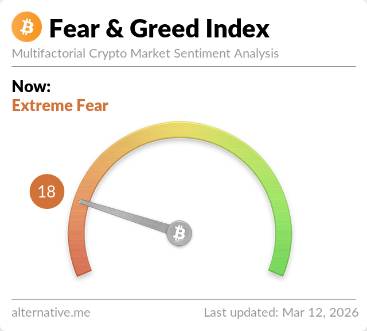
- Bitcoin holds near $70,259, up 7% since the conflict began, outperforming stocks, gold, and silver despite Extreme Fear sentiment at 18.
Strait of Hormuz Blockade Triggers Biggest Oil Supply Shock in History
Brent crude surged back above $100 per barrel on March 12 as Iran’s new Ayatollah Mojtaba Khamenei vowed to keep the Strait of Hormuz blocked. The waterway, which handles roughly 20 million barrels per day, has been effectively shut since the US-Israeli airstrikes on Iran began on February 28.
The International Energy Agency slashed its 2026 global oil supply forecast by 50%, calling the disruption the largest in the history of the global oil market. Global supply has dropped by an estimated 8 million barrels per day in March.
Bond traders responded by pricing in just one quarter-point rate cut for 2026, down from more than two as recently as late February. Goldman Sachs now expects the first Fed rate cut in September 2026, with a second in December, citing rising inflation risks from energy costs.
The Federal Open Market Committee meets March 17-18 and is widely expected to hold rates steady. Ellen Zentner, chief economic strategist at Morgan Stanley Wealth Management, said the Fed “may feel compelled to remain on the sidelines” given the risk that “higher-for-longer oil prices could trigger another inflation surge.”
ASEAN Nations Deploy Emergency Fuel Measures as Reserves Run Low
Southeast Asia faces the sharpest impact of any region. The Philippines sources 96% of its oil from the Persian Gulf, Vietnam 87%, and Thailand 74%. Even oil-producing Indonesia imports over one-third of its crude needs.
Governments across the region have moved into crisis mode. The Philippines shifted government offices to a four-day work week to conserve fuel. Thailand imposed temporary diesel price caps while Vietnam tapped its fuel price stabilization fund. Myanmar enacted alternating driving days.
Fuel reserves tell a concerning story. Indonesia, Southeast Asia’s largest economy, holds just 21-23 days of reserves. Vietnam sits at roughly 20 days. The Philippines has 50-60 days, but those inventories are privately held commercial stocks, not government-controlled strategic reserves.
Petrochemical companies across the region, including Singapore’s Aster Chemicals, Indonesia’s PT Chandra Asri, and Thailand’s Rayong Olefins, have declared force majeure. Sam Reynolds of the Institute for Energy Economics warned that Vietnam faces “high risk of fuel shortages without more crude inflows.”
Bitcoin Holds $70K in Extreme Fear, Outperforms Traditional Assets
Despite the macro turmoil, Bitcoin has shown surprising resilience. The cryptocurrency traded at $70,259 on March 12, up approximately 7% since the conflict escalated on February 28. That performance outpaced the S&P 500 (down ~1%), Nasdaq 100 (flat), gold (down ~3%), and silver (down ~9%).
Market sentiment, however, tells a different story. The Crypto Fear & Greed Index sits at 18, deep in “Extreme Fear” territory. Bitcoin perpetual futures have carried negative funding rates since early March, the longest stretch since April 2025 when BTC bottomed around $76,000.
Institutional buyers appear to be accumulating during the volatility. CoinDesk reported that large traders are “snapping up coins in privately negotiated transactions,” supporting price resilience even as retail sentiment collapses.
Analysts Split on Whether War Spending Helps or Hurts Crypto
The debate over Bitcoin’s role as an inflation hedge has resurfaced. A Kaiko research analyst stated bluntly: “The inflation hedge narrative has been disproven for quite a while now.” Gold, not Bitcoin, attracted the initial flight to safety when strikes on Iran began, surging to over $5,000 an ounce.
BitMEX co-founder Arthur Hayes offered the contrarian case. He argued that a prolonged US military engagement in Iran increases the probability the Fed will be forced to cut rates or expand the money supply to fund war spending. Historically, monetary expansion has been rocket fuel for Bitcoin and risk assets broadly.
Goldman Sachs estimates that a 10% increase in oil prices pushes headline inflation up by about 0.2 percentage points, further complicating the Fed’s path to easing. Higher-for-longer rates typically weigh on risk assets, including crypto, by tightening liquidity.
What This Means for Southeast Asian Crypto Traders
For the region’s growing crypto user base, the outlook hinges on two competing forces. Delayed rate cuts mean tighter global liquidity, which historically pressures digital asset prices. But weakening local currencies, as the Philippine peso dropped to 59.5 PHP per US dollar on February 28, could drive demand for dollar-denominated crypto assets like USDT as a hedge.
The FOMC decision on March 17-18 will set the tone. If the Fed signals prolonged patience on cuts, expect pressure on risk assets. If war spending forces the Fed’s hand toward accommodation later this year, Bitcoin’s resilience near $70,000 could mark a floor rather than a ceiling.
Indonesia’s 9.6 million crypto exchange users on platforms like Indodax and Tokocrypto face a dual squeeze: rising energy costs eroding purchasing power, and a global liquidity environment that may not loosen until the second half of 2026 at the earliest.
Disclaimer: This article is for informational purposes only and does not constitute financial advice. Cryptocurrency investments carry significant risk. Always conduct your own research before making investment decisions.