


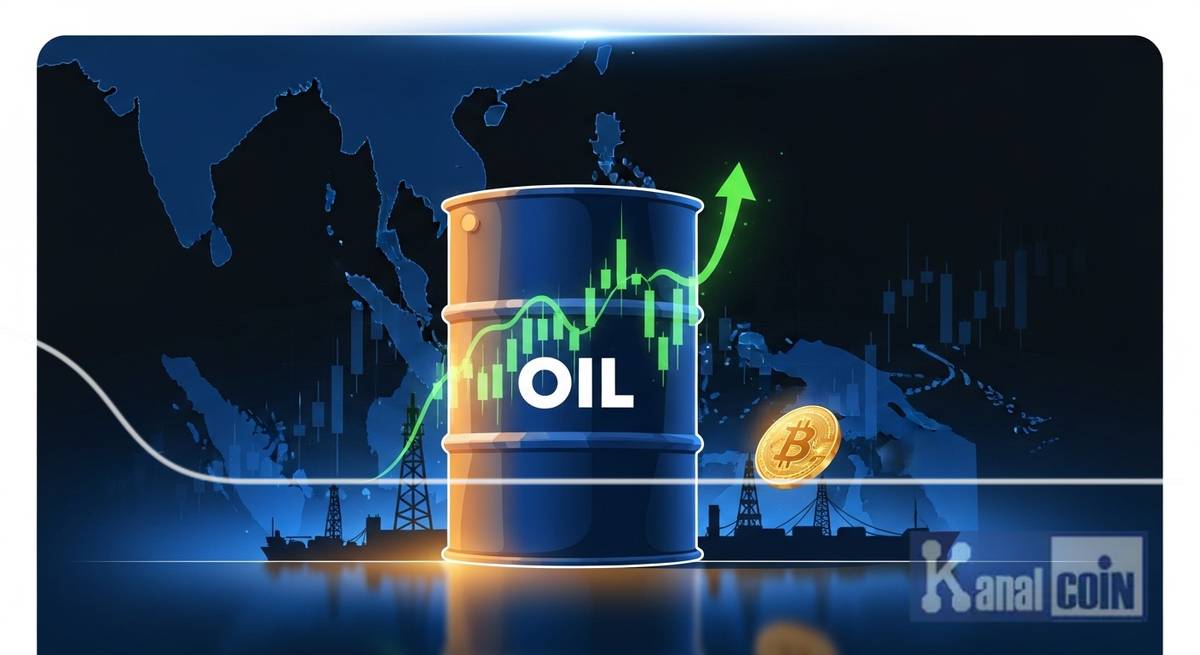
US oil and gas giants Exxon Mobil, Chevron, and a wave of American energy producers hit all-time-high stock valuations on March 12 as crude oil surged past $100 a barrel, fueled by the Iran war and the Strait of Hormuz disruption. While Wall Street energy stocks soar, Southeast Asian economies scramble with emergency fuel rationing, and Bitcoin holds near $70,000 in a market gripped by extreme fear.
TLDR KEY POINTS
- Exxon’s market cap surged 30% to $643 billion and Chevron climbed past $400 billion as oil topped $100 per barrel for the first time since 2022.
- Indonesia allocated $22.6 billion in energy subsidies while Thailand and the Philippines imposed four-day work weeks and fuel rationing to manage the crisis.
- Bitcoin held near $70,000, outperforming the S&P 500, gold, and silver since the conflict began on February 28, even as the Fear & Greed Index sat at 18 (Extreme Fear).
Exxon Hits $643 Billion as Oil Tops $100 for First Time Since 2022
Exxon Mobil’s market cap climbed nearly 30% year-to-date to a record $643 billion. Chevron rose more than 30% to almost $400 billion, while Occidental Petroleum jumped 43% since January.
The rally extends well beyond the majors. Venture Global, the fastest-growing US LNG exporter, saw its stock surge 92% since January 1. Natural gas pipeline leader Williams hit a new high of $92 billion in market cap, and refiners Valero, Marathon, and Phillips 66 all reached record valuations above $70 billion.
Global crude oil crossed $100 a barrel for the first time since Russia’s 2022 invasion of Ukraine. US benchmark WTI surged as high as $115 before settling above $90, while Brent briefly spiked past $118. US gasoline prices now sit above $3.60 per gallon, up 32% from January lows.
The catalyst is the escalating conflict between the United States, Israel, and Iran, which has disrupted shipping through the Strait of Hormuz. Roughly 20% of daily global oil and LNG supply flows through the narrow waterway bordering Iran, the UAE, and Oman.
ASEAN Nations Deploy Emergency Fuel Measures as Costs Spiral
While US energy companies celebrate record profits, the crisis is hitting Southeast Asia’s 700 million people hard. The region’s heavy dependence on Middle Eastern oil imports has triggered emergency responses across multiple governments.
Indonesia’s finance minister announced 381.3 trillion rupiah ($22.6 billion) in energy subsidies from the state budget, directing Pertamina to keep fuel and electricity prices affordable for its 280 million residents. The allocation is the largest energy subsidy package in the country’s history.
Thailand ordered civil servants to work from home, banned elevator use in government buildings, raised air-conditioning minimums to 27°C, and froze cooking gas prices until May. The country has also banned oil exports except to neighboring Cambodia and Laos.
The Philippines implemented a four-day government work week and restricted official travel to essential functions only. Local diesel prices surged by up to 24.25 pesos per liter in a single week. Singapore and the Philippines raised pump prices 10-13% since March 2.
Venture Global CEO Mike Sabel highlighted the regional impact: “There are markets in Asia that are heavily reliant on Qatar supply. Every day that ships can’t flow through, that creates a lot of backup and incremental demand.”
Bitcoin Outperforms Equities at $70,000 Despite Extreme Fear
Against this backdrop of surging oil and crumbling equity markets, Bitcoin has shown unexpected resilience. BTC traded at $70,492 at press time, up approximately 7% since the conflict escalated on February 28.
That performance outpaces every major traditional asset class over the same period. The S&P 500 fell roughly 1%, the Dow dropped 5% for the month, gold declined about 3%, and silver lost 9%. The Nasdaq 100 traded largely flat.
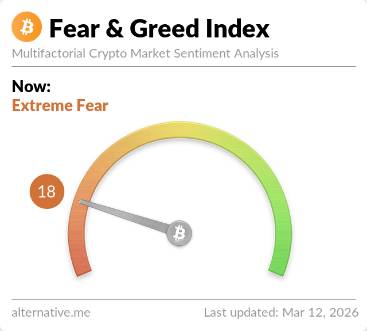
Yet market sentiment remains deeply pessimistic. The Crypto Fear & Greed Index sits at 18, firmly in “Extreme Fear” territory. Last month the reading dropped as low as 9. Bitcoin funding rates have stayed negative since early March, the longest such stretch since the April 2025 bottom at $76,000.
Institutional buyers appear to be driving the price floor. Large traders have been “snapping up coins in privately negotiated transactions,” CoinDesk reported, providing steady demand even as retail sentiment collapses.
Mark Connors, head of research at 3iQ and former Credit Suisse executive, pointed to a structural tailwind: “Liquidity drives bitcoin. If the war runs longer, that means more spending.” US federal debt has been growing at roughly 14% annualized since mid-2025, a dynamic that historically supports hard-asset valuations.
Crypto’s 24/7 Markets Proved Their Edge When Stocks Were Closed
When President Trump announced strikes on Iran on Saturday, February 28, all traditional financial markets were closed. Crypto exchanges captured the real-time price discovery. Decentralized exchange Hyperliquid hit $1.2 billion in open interest, with oil-linked perpetual contracts generating $1.62 billion in 24-hour volume, exceeding crypto pairs.
Bitwise’s Chief Investment Officer called it “the weekend that changed finance.” NYSE and Nasdaq have since announced plans for extended-hours trading with tokenized assets and blockchain settlement by mid-2026.
Chainalysis data reveals how geopolitical stress drives crypto adoption in conflict zones. Iran’s crypto ecosystem surpassed $7.78 billion in 2025, with on-chain activity closely correlated with domestic tensions.
New analysis reveals Iran's crypto ecosystem surpassed $7.78B in 2025, with on-chain activity closely correlated with geopolitical and domestic tensions.
Our data show:
– IRGC-linked addresses now represent 50% of Iran's crypto economy
– Iranians increasingly withdraw Bitcoin…— Chainalysis (@chainalysis) January 15, 2026
Source: @chainalysis on X
What the Oil Surge Means for Southeast Asia’s 16 Million Crypto Investors
Indonesia alone has 16 million registered crypto investors and recorded IDR 482 trillion in crypto transactions in 2025. Indodax, the country’s largest exchange with over 40% market share, saw transaction volume surge 51.65% year-over-year to IDR 201.2 trillion in 2025.
CoinShares’ head of research identified the core dynamic: “The dominant variable in global asset pricing is no longer the labour market. It is oil, and the geopolitical crisis underpinning it.”
For energy-importing ASEAN nations now spending billions on fuel subsidies, the pressure compounds existing inflation risks. The IEA has confirmed a record 400 million barrel emergency oil release to stabilize supply, but analysts at J.P. Morgan and Goldman Sachs warn the relief may be temporary if the Strait of Hormuz remains contested.
Bitcoin’s resilience during this crisis, outperforming equities and precious metals while Southeast Asian currencies face devaluation pressure, is testing the “digital gold” thesis in real time. For the region’s growing crypto investor base, the question is whether BTC can maintain its role as a hedge when the oil shock deepens.
Disclaimer: This article is for informational purposes only and does not constitute financial advice. Cryptocurrency investments carry significant risk. Always conduct your own research before making investment decisions.