


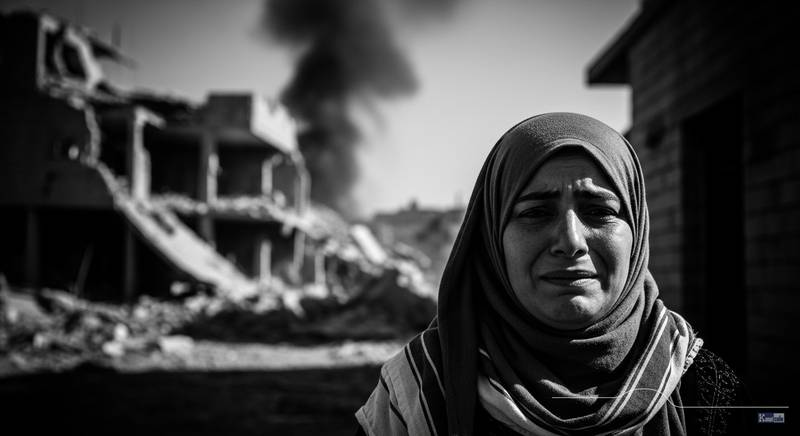
Three Palestinian women were killed in the West Bank village of Beit Awwa on March 18, 2026, after missile fragments from an Iranian attack struck a hair salon housed in a metal caravan, marking the first Palestinian fatalities from Iranian missile fire since the US-Israel-Iran conflict began in late February.
The strike, which occurred late Wednesday during a wave of Iranian missile launches, also wounded 13 people, at least one seriously. The Palestinian Red Crescent confirmed the casualties, and WAFA, the Palestinian Authority’s official news agency, confirmed the incident.
The Israeli military identified the weapon as a cluster munition warhead that split into bomblets upon impact. Beit Awwa is located southwest of Hebron. Unlike most Israeli communities, Palestinian areas in the West Bank have virtually no bomb shelters.
Initial reports cited three fatalities, though updated reporting from Times of Israel and Ynet News later put the toll at four. No official statements from the Iranian government or Palestinian Authority leadership specifically addressing the West Bank deaths have been confirmed.
Iranian Missile Barrage Expands Conflict Beyond Israeli Borders
Iran’s Revolutionary Guards stated the missile launches were retaliation for Israeli strikes on Iranian energy infrastructure, part of an escalation cycle that began when US-Israeli military operations against Iran commenced on February 28, 2026.
At least 15 people have been killed in Israel since the conflict began. The Beit Awwa strike represents a significant development: Iranian missiles, directed at Israeli targets, are now producing civilian casualties in Palestinian territory, an unintended consequence that complicates the conflict’s dynamics.
The incident underscores the unpredictable reach of the ongoing missile exchanges. With no direct acknowledgment from Tehran regarding Palestinian civilian deaths, the diplomatic fallout remains uncertain. The escalation has drawn comparisons to previous Iran-Israel confrontations that shifted regional stability assessments for global markets.
Crypto Markets Hold in ‘Extreme Fear’ as Conflict Widens
Bitcoin traded at $71,244 at press time, down 3.58% over 24 hours, with a market cap of $1.426 trillion and 24-hour trading volume of $47.39 billion. The Fear & Greed Index sat at 23 out of 100, deep in “Extreme Fear” territory.
Crypto markets have been locked in this fearful posture since the war began on February 28. BTC initially crashed to roughly $63,000 that weekend, triggering over $300 million in leveraged liquidations. It briefly recovered above $74,000 by March 16 before retreating again as the conflict continued to deepen.
The February 28 weekend was notable because crypto platforms were the only major markets open when the geopolitical shock hit. As Bitwise’s Chief Investment Officer observed, “This was the weekend that changed finance, for the first time crypto markets were effectively ‘the market’ during the weekend geopolitical shock.”
The widening civilian toll from Iranian missiles, now extending to Palestinian noncombatants, reinforces the view that a quick resolution to the conflict is unlikely. That assessment weighs against any near-term recovery in risk appetite. The Federal Reserve’s recent decision to hold rates steady amid geopolitical uncertainty has added another layer of caution for investors navigating both traditional and digital asset markets.
For crypto markets, the key question remains whether Bitcoin functions as a safe-haven asset during prolonged geopolitical crises or continues trading as a risk asset that sells off alongside equities. The data since February 28, a sharp initial drop followed by a partial recovery and renewed weakness, suggests the risk-asset pattern is dominant for now.
Disclaimer: This article is for informational purposes only and does not constitute financial or investment advice. Cryptocurrency and digital asset markets carry significant risk. Always do your own research before making decisions.