

Last updated: November 16, 2026. Independent editorial review. We have no commercial relationship with Symbiotic.
Who This Guide Is For
This guide is for readers who keep hearing the word "restaking" or "collateral markets" and want a plain explanation before they put any money near it. You do not need to know what a slasher, a curator or an adapter is. We explain each term when it first appears.
We cover the whole product: the marketing website, the Symbiotic app (vaults, dashboard, network discovery), the Liquid Lane redemption page, the Relay developer framework, the documentation, the audit list and the public numbers. For every part we say what we opened ourselves and what we only read about in the docs.
How We Tested Symbiotic
We opened every page below on three screen sizes. The app was also used with a connected wallet.
| Device | Screen size used | What we opened |
|---|---|---|
| Desktop | 1440 x 900 | Website, app, Liquid Lane page, docs |
| Tablet | 1024 x 1366 in the app, about 820 px wide on the marketing site | Website, app vault list, vault page |
| Phone | 430 x 932 in the app, about 390 px wide on the marketing site | Website, app vault list, vault page, swap page |
The Wallet We Used
We connected a throwaway MetaMask wallet that holds no funds. It was created only for testing. We connected it to the app and to the Liquid Lane page, opened vaults and typed an amount into the swap box. We did not deposit, did not sign any transaction and did not approve any token spending. The wallet address shown in some screenshots belongs to that empty test wallet.
What this means for you: everything we describe about depositing, withdrawing, claiming rewards and redeeming comes from the docs and from what the interface displayed. We did not run a real deposit or withdrawal, so we cannot tell you how fast or smooth those steps are in practice.
Quick Verdict
Symbiotic is a serious, well-audited piece of infrastructure, but it is not a simple "stake and earn" product. It has been rebuilt as "Core V2" in 2026 and now focuses on collateral markets: vaults that lend capital to real-world finance applications such as RWA redemptions, credit and insurance. The audit list is long and no hack is recorded. The weak points are a sharp fall in locked value over the last month, small balances in the new V2 vaults, very low yield in the biggest older vault, and a product that is hard for a beginner to judge. Our editorial score is 3.5 out of 5.
| Item | Detail |
|---|---|
| Category | Collateral markets, formerly marketed as restaking |
| Main chain | Ethereum |
| Website | symbiotic.fi |
| App | app.symbiotic.fi (vaults, dashboard, discover) |
| Liquid Lane | swap.symbiotic.fi |
| Docs | docs.symbiotic.fi |
| Native token | None found (see the Token section) |
| Points program | Yes, Symbiotic Points |
| Bug bounty | Cantina, up to $500,000 (docs say) |
| Hack record | None in the DefiLlama hacks database (checked November 16, 2026) |
| Our editorial score | 3.5 / 5 |

What Is Symbiotic (Plain English)
Imagine a pool of money that has a rule attached: "this money is promised to back something, and it cannot leave until the promise ends." Now imagine many different financial apps can borrow the strength of that promise. A lender can say "if the borrower defaults, the pool pays." An insurer can say "if a claim is valid, the pool pays." That is the idea behind Symbiotic.
The docs describe Symbiotic as a platform that brings enforceable economic guarantees onchain through programmable collateral markets. Capital is committed to back obligations for a defined period, and code, not good behaviour, stops it from leaving early. While it is committed, the capital can still earn yield.
In plain terms: you put a coin such as USDC into a vault. A professional manager (a "curator") decides which apps and lending markets the vault supports. Those apps pay for the safety your money provides, and you receive a share of the result. The risk is that if something goes wrong in a supported app, part of the pool can be taken to cover the loss.
Symbiotic first became known in 2024 as a "restaking" protocol, a way to reuse staked ETH and similar assets to secure other networks. In July 2026 it launched Core V2 (the Points page says so), and the homepage now talks about "collateral markets" instead. When you read older articles, remember that they describe the earlier product.
The Four Roles
| Role | What they do | Everyday comparison |
|---|---|---|
| Allocator | Deposits assets into a vault | The investor |
| Curator | Designs the vault strategy, picks risk limits, sets fees | The fund manager |
| Application | Uses vault capital for security, liquidity or guarantees and pays rewards | The business that borrows trust |
| Operator | Performs tasks for an application, backed by vault collateral | The contractor who posts a bond |
Who Built It
The About page names three leaders. Misha Putiatin is co-founder and CEO and is also co-founder and CEO of the security firm Statemind. Algys Ievlev is co-founder and CTO and previously co-founded Statemind and MixBytes. Jillian Friedman is COO and was previously COO and CFO of Ether Capital. We could not verify these biographies independently, so treat them as the company's own statements.

One point worth noticing: Statemind appears in the audit list as an auditor of Symbiotic code, and its CEO is also a Symbiotic co-founder. Other firms (Bailsec, OpenZeppelin, Cyfrin and more) have also reviewed the code, so Statemind is not the only reviewer, but readers should know the link exists.
According to DefiLlama's funding data, Symbiotic raised a $5.8M seed round in June 2024 led by Paradigm and Cyber Fund, and a $29M Series A in April 2025 led by Pantera Capital with Coinbase Ventures participating.
Key Facts and Sources
| Fact | Value | Source and date |
|---|---|---|
| Total value locked (TVL) | $238.69M | DefiLlama, November 16, 2026 |
| 7 day change | -13.17% | DefiLlama, November 16, 2026 |
| TVL 30 days earlier | $453.7M | DefiLlama history |
| Peak TVL | $2.70B around December 2024 | DefiLlama history |
| Chain | Ethereum | DefiLlama |
| Core V2 launch | July 2026 | Symbiotic docs, Points Program page |
| Largest collateral by value | uniBTC $65.9M, wstETH $63.6M, LBTC $37.7M | DefiLlama |
| Vault count | "100+" on the homepage, "80+" in the DefiLlama description | Two sources, see the note below |
| Funding | $5.8M seed and $29M Series A | DefiLlama funding data |
| Audit entries in the docs | More than 30 reports | Symbiotic docs audit table |
Why the numbers differ. The homepage says "100+ vaults" while the DefiLlama description says "80+ vaults, 74,000+ active stakers, 111 operators." These are likely written at different dates, and the older vault version (V1) and newer (V2) are counted differently. We could not confirm which is right. We used neither number as a fact in our calculations.
A drop to look at. TVL on DefiLlama fell from $453.7M thirty days earlier to $238.69M, which is a fall of about 47% (our calculation). Over a longer period it is down about 91% from the $2.70B peak (our calculation). A fall this size can have several causes, such as depositors leaving, price moves or a change in how assets are counted, and DefiLlama does not tell us which. It is a sign of caution, not proof of a problem.
How Symbiotic Looks on Your Device
Symbiotic runs three separate sites, and they look quite different. The marketing site (symbiotic.fi) is white with green accents and large 3D-style illustrations. The app (app.symbiotic.fi) is black with green text and a terminal feel. The Liquid Lane page (swap.symbiotic.fi) is light grey and looks like a normal swap box.
Desktop (1440 px)
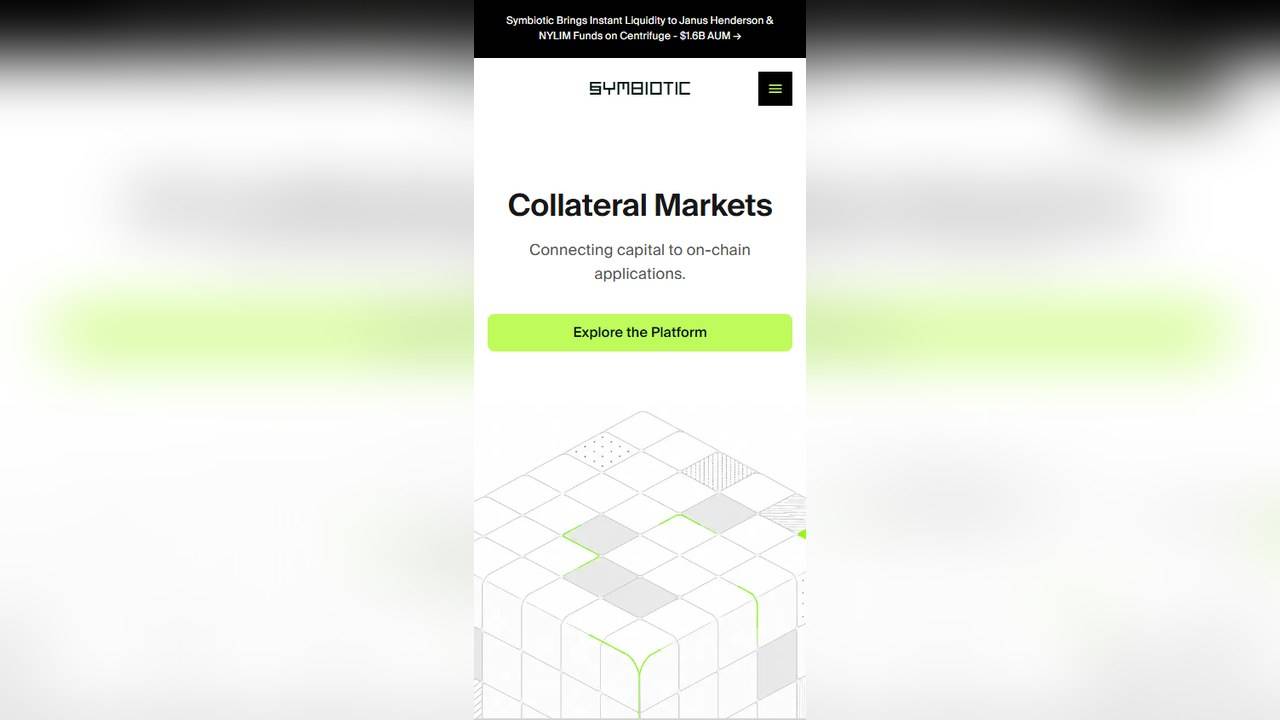
The homepage opens with a black banner about instant liquidity for Janus Henderson and NYLIM funds on Centrifuge ($1.6B AUM, as stated on the banner). The headline reads "Collateral Markets," with the line "Connecting capital to on-chain applications." The top menu has Platform, Applications, Company, a Redeem RWAs button and a Launch App button.

Tablet (about 820 to 1024 px)
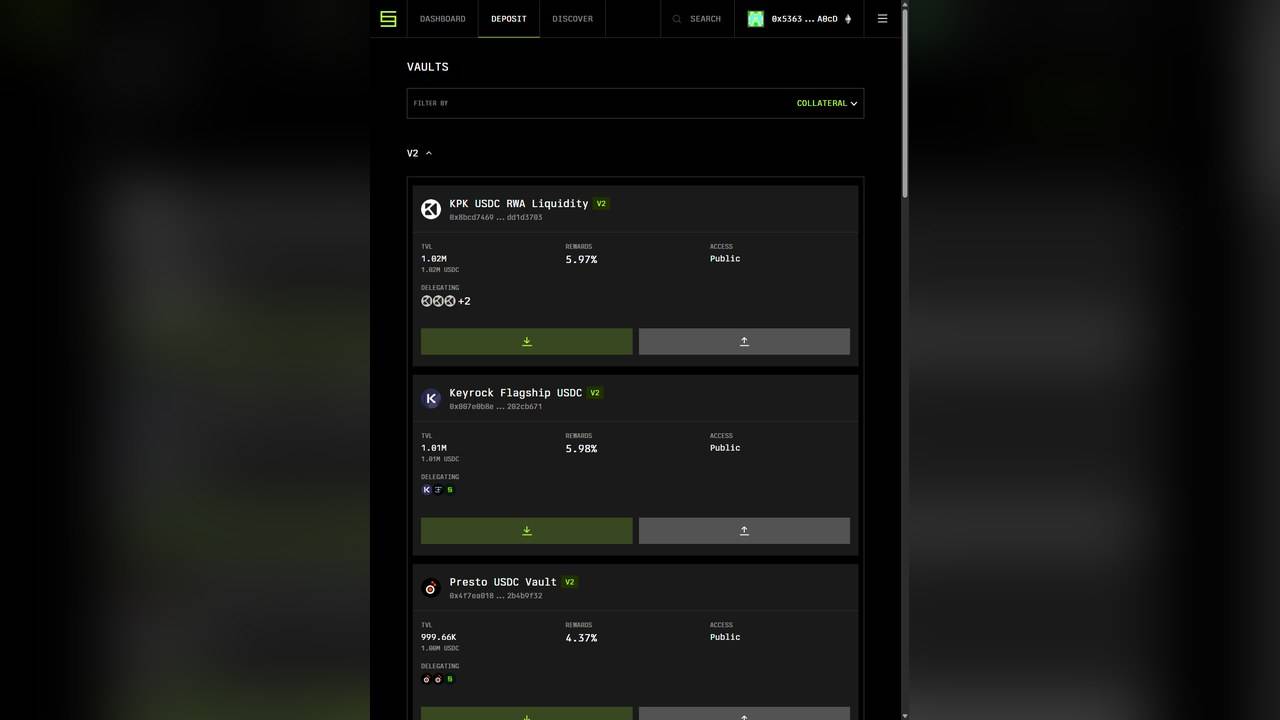
On tablet, the homepage stacks into a single column and the menu collapses into a green hamburger button. The app keeps its top menu (Dashboard, Deposit, Discover) and turns each vault row into a card showing TVL, rewards, access and two large buttons for deposit and withdraw.

Phone (390 to 430 px)
On a phone the homepage is clean and readable. The app vault page puts the vault name, collateral, access and curator first, then TVL, allocated amount and net APY in three small boxes, then the deposit form. We found it usable, but the long vault history chart and the adapter list are tall and need a lot of scrolling.

The documentation site also works well on a phone. It opens with a short summary, a search button and a Learn card.

One bug we hit. When we typed the address app.symbiotic.fi/discover directly into the browser, the app showed a "Page not found" screen on both tablet and phone sizes. Clicking the Discover tab inside the app worked on desktop. This is a small issue, but if you bookmark the page you may land on an error.
Connecting Your Wallet
You do not need a wallet to browse. The app lists vaults, TVL and rewards for everyone. You only connect when you want to see your own positions or deposit.
- Open app.symbiotic.fi. It forwards you to the Deposit page.
- A cookie notice appears at the bottom. We chose "Only required."
- Click Connect Wallet in the top right.
- Choose your wallet. We used MetaMask.
- MetaMask shows a request that says the site will see addresses, balances and activity, and that it cannot move funds without your permission. Click Connect.
- Your shortened address appears in the top bar.
The Liquid Lane page works the same way, with a wallet list that includes MetaMask, Coinbase Wallet, Rainbow, Phantom, Zerion, Safe and others.
Beginner safety tip. Connecting only shares your public address. It is the later "approve" and "sign" steps that move money. Never approve a request you do not understand, and use a separate wallet with a small balance when you try a new protocol. Check that the web address is exactly app.symbiotic.fi before you connect.
Core Features at a Glance
| Feature | What it is | Tested by us |
|---|---|---|
| Vaults (V2 and V1) | Pools that hold one asset each | Opened, deposit not tested |
| Dashboard | Your positions, rewards, points, withdrawals | Opened, empty for our test wallet |
| Discover | Lists of networks, operators, curators | Networks tab opened |
| Liquid Lane | Instant redemption of tokenized funds | Quote screen opened, trade not tested |
| Credit and Guarantees | Collateral backing loans | Marketing page only |
| Insurance and Underwriting | Collateral backing cover | Marketing page only |
| Relay | Developer framework for stake-backed attestations | Marketing page only |
| Points Program | Rewards for depositors | Docs only |
| Documentation and audits | Technical guide and reports | Read |
Feature 1: Vaults
A vault is the basic building block. Each one holds a single asset (for example USDC or uniBTC) and gives you vault shares in return. The docs say vaults are permissionless ERC-4626 containers, which is a standard format for yield-bearing vaults, so the share token can be transferred like any other token. As the vault earns, each share becomes worth more.
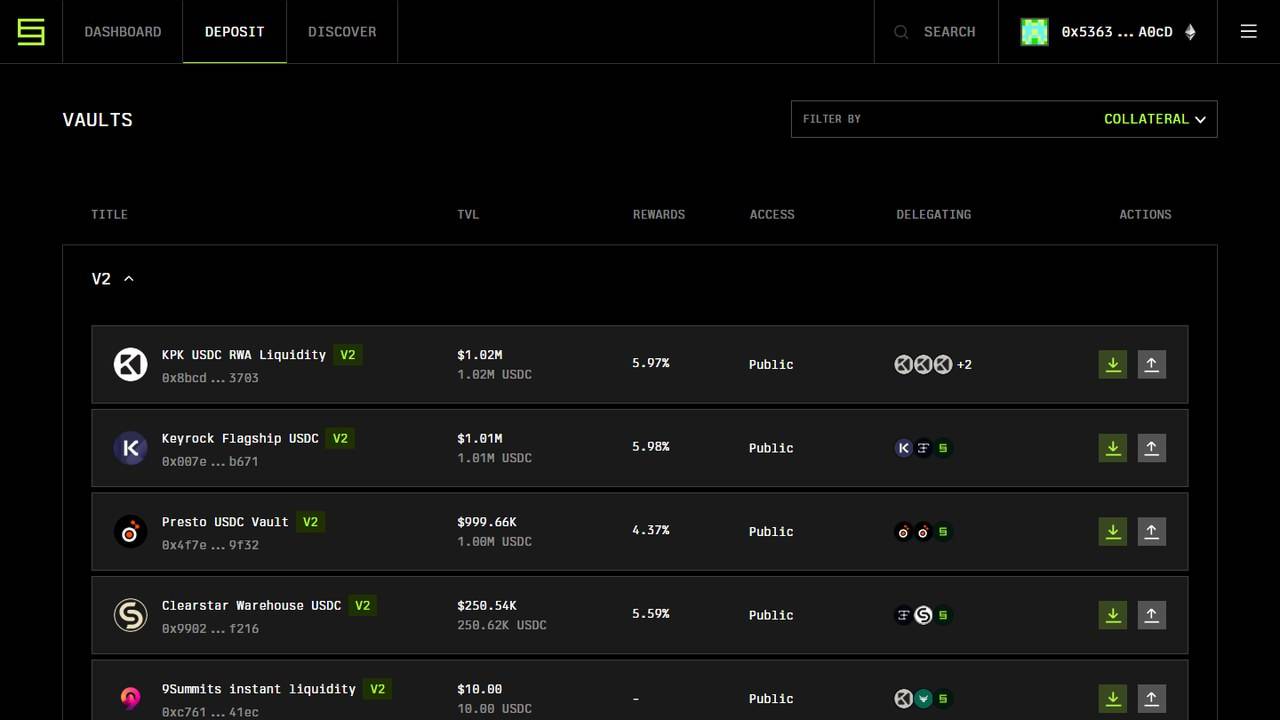
What we saw. The Deposit page splits vaults into "V2" (new) and "V1" (old). On November 16, 2026 the V2 section showed these vaults:
| V2 vault | TVL shown | Rewards shown | Access |
|---|---|---|---|
| KPK USDC RWA Liquidity | $1.02M | 5.97% | Public |
| Keyrock Flagship USDC | $1.01M | 5.98% | Public |
| Presto USDC Vault | $999.66K | 4.37% | Public |
| Clearstar Warehouse USDC | $250.54K | 5.59% | Public |
| 9Summits instant liquidity | $10.00 | none shown | Public |
| Amber Group USDC Vault | $0.00 | none shown | Public |
Two things stand out. First, the V2 vaults are small: the four with money hold about $3.3M together (our calculation from the table), against a total TVL of $238.69M on DefiLlama. Most of the locked value is still in older V1 vaults. Second, two V2 vaults are essentially empty, which tells us V2 is still in its early rollout.
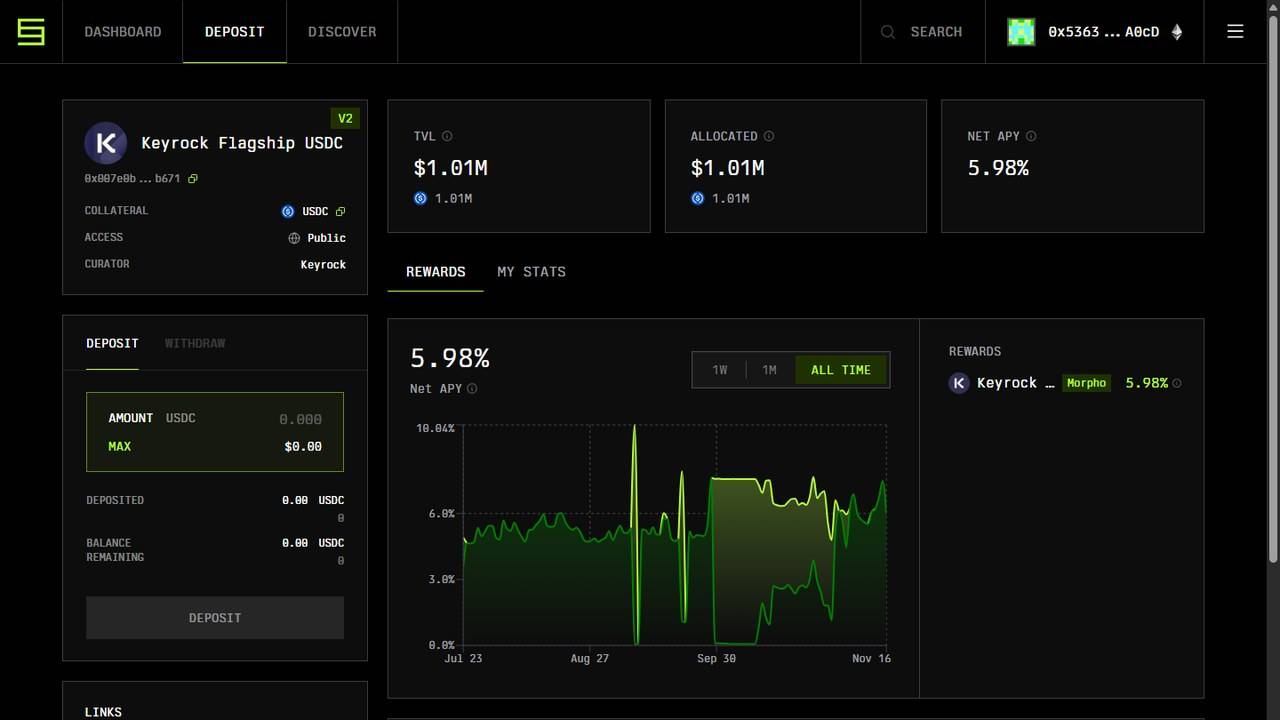
Opening one vault. We opened Keyrock Flagship USDC. The page shows the collateral (USDC), access (Public), curator (Keyrock), TVL $1.01M, allocated $1.01M and net APY 5.98%. A chart shows how the yield moved since July. It ranged between 0% and roughly 10% with sharp spikes and a flat stretch near zero, so the rate you see today is a snapshot, not a promise.
The page also lists three adapters, which are the places the vault sends money: a Keyrock USDC position on Morpho holding 99.99% of TVL, a "3F Adapter" with $144.32 (0.01%) and a "Liquid Lane Adapter" with $0.00. In plain words, almost all of this vault's yield today comes from ordinary lending on Morpho, not from the more unusual Symbiotic applications.
Deposit form. The deposit button stayed greyed out because our wallet held no USDC. We did not deposit. The form has Deposit and Withdraw tabs, a Max button and a "balance remaining" line, which we assume relates to the deposit limits mentioned in the docs.
Docs say vaults can hold idle capital (waiting in the vault) and allocated capital (sent to adapters), and that when you redeem, the vault uses idle money first and then pulls money back from adapters. Not tested.
The Older V1 Vault We Opened
We also opened the biggest V1 vault, Bedrock-Susquehanna Crypto-uniBTC, with $54.45M (846.87 uniBTC). Its page shows details that V2 pages do not:
| Setting | What the page showed |
|---|---|
| Slasher | Instant |
| Withdrawal delay | 7 days to 14 days |
| Curator | Bedrock |
| Delegator | Operator network specific |
| Total APY | 0.11% |
| Network | Cap (1 network) |
| Operator | Susquehanna Crypto (1 operator) |
The description says the vault delegates uniBTC to the Susquehanna Crypto operator for Cap. The headline is the yield: 0.11% is very low for a product that locks Bitcoin for up to two weeks on exit and carries slashing risk. The chart shows it was near 0.2% from March to April and then dropped. A beginner should read this as "the main reward may be points, not interest." Symbiotic Points are not money, and the docs do not promise they convert to anything.


Feature 2: Dashboard
The Dashboard shows total deposited, Symbiotic Points, and tabs for Positions, Rewards, Points and Withdrawals. With our empty wallet every box said "No data," which is the correct result. The docs add that if you use a wrapper such as a liquid restaking token (LRT), some of your points may appear in that provider's own site instead.

Feature 3: Discover
Discover has three tabs: Networks, Operators and Curators. The Networks tab lists the apps that use vault collateral and how much stake backs each one. On November 16, 2026 it showed:
| Network | Stake shown |
|---|---|
| Cap | $140.08M |
| Spark | $9.29M |
| Ditto Network | $7.99M |
| Cycle Network | $6.94M |
| Kalypso | $3.74M |
| 0G | $1.65M |
| Capx Cloud | $1.59M |
Cap alone accounts for more than half of the $238.69M DefiLlama TVL figure (our calculation, and the two numbers come from different sources and times, so it is only a rough guide). This matters because a single dependency is a concentration risk. The Liquid Lane docs describe Cap as a collaboration where Symbiotic powers more than $250M of collateral underwriting for borrowers such as Susquehanna and M11 Credit. We did not verify that number.

Feature 4: Liquid Lane (Instant Redemptions for Tokenized Funds)
Liquid Lane is the product Symbiotic promotes most today. The problem it targets: many tokenized funds (private credit, treasury funds, "real-world assets" or RWAs) can take days to redeem. Liquid Lane lets a holder sell the token now at a quoted price, while a market maker takes the waiting risk.
How it works (docs say). A holder asks for a quote. Market makers draw cash from curator-managed Symbiotic vaults to pay the holder immediately. The curator then starts the normal redemption with the fund issuer in the background and the cash returns to the vault. Vault depositors earn the spread, plus base yield from lending (for example on Morpho) while the cash waits. The docs say vaults average about a 14 day lockup, and that curators may serve redemptions that run longer.
Before connecting, the page already shows a sample quote of 100 mF-ONE for 112.63 USDC.

What we tested. We opened the Redeem RWAs page (swap.symbiotic.fi), connected the test wallet and typed 2,500 of the asset mF-ONE. The page quoted about 2,815.9 USDC from one solver, KPK, with 200,000 capacity, a discount of 0.90% against the asset's displayed value, and a "Gasless" tag. The button read "Insufficient mF-ONE" because the wallet is empty, so we could not trade. This confirms the quote screen works. It does not confirm that a real trade settles on time or at that price.
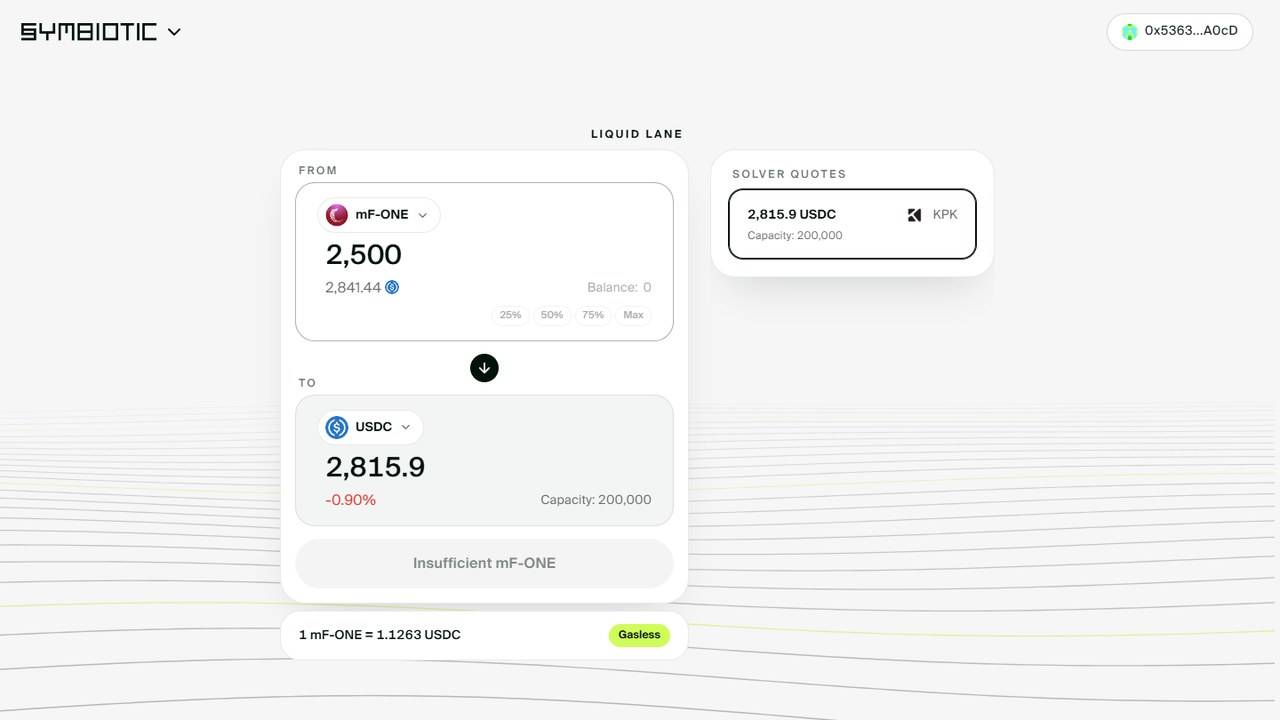
Supported assets (docs say). Midas products (mF-ONE, mGLOBAL, mGLO, mROX, mTBILL, mRe7YIELD, mAPOLLO, mEDGE, mHYPER, mM1), Centrifuge funds (JAAA, JTRSY from Janus Henderson, and HYB from New York Life Investment Management), OpenEden (HYBOND), Hastra (PRIME) and Pareto (AA_FalconXUSDC). Accepted cash is USDC.
Risks the docs list. Product risks (duration, liquidity, operations) and infrastructure risks (smart contracts, front end and API, oracle). Our reading: if many holders want out at once, the cash in the vaults is finite, and the quote capacity of 200,000 shown on the page is small compared with the $1.6B AUM figure in the homepage banner.


Feature 5: Credit and Guarantees
The Credit page pitches "capital-efficient borrowing": a borrower receives a facility and can use the full amount as working capital without posting their own collateral, because the vault collateral backs the risk. Underwriters (people with BTC or other assets in a vault) earn premiums from real borrowing demand. The docs add that credit apps can use vault collateral to back obligations, transfer default risk and create programmable guarantees.
Not tested. This is a marketing page and docs only. We found no public screen where an ordinary user can join a credit facility, so today it looks aimed at institutions and curators. The Cap network on the Discover page is the live example behind it.

Feature 6: Insurance and Underwriting
The Insurance page describes capital providers backing insurance policies and earning premiums, with collateral isolated by pool, product or risk type, and with tranches and loss waterfalls. The docs say a valid claim can be paid through slashing.
Not tested. Same as Credit: page and docs only. The DefiLlama description names Nexus Mutual as a live integration, but we did not open it.

Feature 7: Relay (For Developers)
Relay is a separate framework with its own dark site. In simple terms, it lets developers turn a computation or event into an "attestation" signed by many operators who have staked money behind it, then verify it on many chains. The page claims support for more than 1M operators, verification gas of 400k or less, and about 40 ms proof time. These are the project's own claims. We did not run Relay and cannot confirm them.
A regular depositor does not need Relay. It matters for judging whether the team is building real infrastructure. The docs include a developer quickstart called "Super Sum" and use cases such as bridges, oracles and decentralized compute.

Feature 8: Adapters and the Universal Delegator
An adapter is a connector. Vault money goes through adapters either to applications (to give them security) or to outside yield sources such as lending markets. The Universal Delegator is the traffic controller: it decides where capital goes and pulls it back when users withdraw. Each adapter has an absolute limit and the curator sets a maximum, and money moves only when both rules allow it. (Docs say. We could see the adapter list on a vault page but could not test the controller.)

Feature 9: Symbiotic Points
Symbiotic runs a points program instead of (so far) a token. Points are a score kept by the project. The docs state the rule for Core V2 vaults: points per hour equal the vault TVL allocated to adapters multiplied by 0.001. As an example (our calculation), $1,000 allocated for one day would earn about 24 points. The docs do not say what points are worth, so do not treat them as money.
The older V1 rules were split by season. Season 1 (from June 2024) rewarded plain deposits, and the docs say pre-deposit vaults gathered roughly $2B of TVL. Season 2 rewarded stake that was delegated to networks. Networks could take up to 5% of points, operators up to 5% more, and curators could charge up to 5% admin fee on the vault share.

Token and Governance
Token. We searched CoinGecko for "symbiotic" and "symbiotic-fi" on November 16, 2026 and found no matching coin. DefiLlama lists no token symbol or market cap for the protocol, and the docs we read (the full text file) do not describe a launched token, an airdrop or a token generation event. So there is no price table here. The SPK asset that appears among the TVL tokens on DefiLlama belongs to Spark and is not a Symbiotic token.
Why this matters. Points programs often come before a token, but the docs make no promise. If you deposit mainly for points, you are betting on something the team has not announced.
Governance. The docs talk about vault-level governance (each vault's curator sets its rules) but do not describe a protocol-wide vote. We found no timelock or DAO described. Admin rights are discussed as a risk: the Risks page tells curators to use multisigs.
Fees and Costs
| Fee | Detail | Source |
|---|---|---|
| Management fee | Set by the vault curator, capped at about 5% per year | Docs, Manage Fees page |
| Performance fee | Set by the curator, capped at 20% of positive performance | Docs, Manage Fees page |
| How fees are paid | New vault shares are minted to the fee receiver, which dilutes other depositors | Docs |
| Liquid Lane swap | Shown as a discount in the quote (0.90% in our test) and tagged "Gasless" | Our test |
| Network gas | You pay normal Ethereum gas to deposit or withdraw | General Ethereum behaviour, not tested |
| Withdrawal wait | V1 vault showed 7 to 14 days | App, V1 vault page |
Read the fee settings of each vault before depositing. The caps are maximums, so a vault can charge less. We did not find a fee display on the vault pages we opened, so ask the curator or read the vault contract if you need exact numbers.
Security
How Slashing and Withdrawals Work (Docs Say)
Slashing means part of a vault can be taken to punish an operator who broke an application's rules. The docs say a vault is deployed with one of three modes: no slashing, instant slashing, or a veto slasher with a short window in which a decision can be challenged. The mode cannot be changed afterward. Our V1 vault showed "Instant."
Withdrawals take two steps. After you request, the money becomes claimable after the end of the next vault epoch, so the delay is between one and two epoch lengths. Until then it can still be slashed. That is why exits are not instant.
Audits
The docs list more than 30 reports. Recent and notable entries:
| Auditor | Scope | Date |
|---|---|---|
| Bailsec | Euler and Liquid Lane (Pareto) | 08-2026 |
| Bailsec | Liquid Lane (Centrifuge, Figure, OpenEden, mGLOBAL) | 07-2026 |
| Statemind | 3F adapter | 07-2026 |
| OpenZeppelin | Liquid Lane | 06-2026 |
| Bailsec and Statemind | Core V2 | 06-2026 |
| Cyfrin and Sigma Prime | Relay contracts | 09-2025 and 12-2025 |
| Sherlock contest | Relay and Network | 07-2025 |
| Certora, OtterSec, ChainSecurity, Zellic, Cantina contest | Core (V1) | 2024 |
The bug bounty on Cantina is listed as $500,000 for Core and Rewards. Audits lower risk, but they do not remove it.

Track Record
The DefiLlama hacks database has no entry for Symbiotic as of November 16, 2026. That is good, but the product is relatively young and Core V2 is only a few months old. A clean record on the older version says little about new code.
Risk Table
| Risk | What it means | Our view |
|---|---|---|
| Slashing | Collateral can be taken if an application or operator fails | Real. Read each vault's slasher setting |
| Curator choice | Curators pick the apps and loan markets | Central. The Risks page says same-asset vaults can hold very different risks |
| New code | Core V2 and Liquid Lane launched in mid 2026 | Many audits, but little time in production |
| Concentration | Cap holds a large part of stake | High, see Discover table |
| RWA and issuer risk | Tokenized funds can have legal and liquidity issues | Specific to Liquid Lane |
| Value falling | TVL down about 47% in 30 days | A warning sign worth watching |
| Docs vs interface | Vault count and APY differ between sources | Always check live pages |

Symbiotic vs Competitors
Symbiotic sits in the restaking and collateral category on DefiLlama. The figures below were captured on November 16, 2026.
| Protocol | TVL (DefiLlama) | Main idea | Notes |
|---|---|---|---|
| EigenCloud | $4,611.1M | Restaking on Ethereum with a large operator base | About 19 times the TVL of Symbiotic (our calculation). Not tested by us |
| Babylon | $2,673.7M | Bitcoin staking for other chains | Reviewed by us. BTC staking yield was very low and the product blocks some countries |
| Lombard (LBTC) | $423M | Liquid Bitcoin token | LBTC is also a collateral asset inside Symbiotic ($37.7M) |
| Mellow Core | $206M | Curated vaults | Similar curator model. Not tested by us |
| Symbiotic | $238.7M | Collateral markets, Liquid Lane, credit, insurance | This review |
| b14g | $158.1M | Restaking | Not tested by us |
| Jito Restaking | $12.2M | Solana restaking | Not tested by us |
| Solayer | $7.0M | Solana restaking | Not tested by us |
What stands out. Symbiotic is the third largest in its DefiLlama category after EigenCloud and Babylon, but far smaller than both. Its difference is the shift away from plain restaking toward real-world finance use cases, with Liquid Lane as the lead product. That is a sharper focus and a harder sell to beginners. If you want to understand how lending markets and institutions use on-chain collateral, Symbiotic is more interesting to study.
Pros and Cons
Pros
- Long audit list from many firms, plus a $500,000 bug bounty (docs say).
- No recorded hack on DefiLlama.
- Clear product direction (Liquid Lane, credit, insurance) with named partners such as Midas, Centrifuge and Morpho.
- App is easy to browse without a wallet, and the connected wallet showed only a standard permission request.
- Vault pages show adapters and TVL breakdown, which helps you see where money goes.
Cons
- TVL fell about 47% in 30 days and about 91% from its peak.
- V2 vaults are tiny; the biggest V1 vault showed only 0.11% APY.
- Heavy dependence on one network (Cap).
- Withdrawals can take days (V1 vault showed 7 to 14 days) and remain slashable until the delay ends.
- No token, and no stated value for points.
- Direct link to the Discover page returned "Page not found" in our test.
- Vault count and other numbers differ between the website and DefiLlama.
Who Should Use Symbiotic
- Curious readers and researchers: yes. Browse the app and docs freely, no wallet required.
- Experienced DeFi users who understand slashing: possible, with small amounts, after reading each vault's strategy and slasher mode.
- Holders of tokenized funds (RWAs): worth watching Liquid Lane, but check quote size and issuer risk first.
- Complete beginners looking for safe yield: probably not. The product has several layers of risk and low yields in the biggest vault we opened.
- Anyone who needs fast access to their money: no, because of withdrawal delays.
Verdict
Score: 3.5 out of 5.
Symbiotic earns points for transparency (audits, docs, vault pages that show adapters) and for a coherent plan around collateral markets. It loses points for the fall in TVL, the thin V2 balances, the low yield in the largest vault we saw, the Cap concentration and the difficulty a newcomer has in judging risk. We did not make a deposit or a withdrawal, so we cannot score the real money experience. Treat this as a well-built system to study first, and size any deposit as money you can afford to lose.
FAQ
Is Symbiotic safe?
It has many audits and no recorded hack, but safe is not guaranteed. Slashing, curator mistakes, new code and issuer risk are real.
Does Symbiotic have a token?
We found none on CoinGecko, DefiLlama or in the docs on November 16, 2026. It runs a points program, and the docs do not say what points will be worth.
Do I need a wallet to look around?
No. The vault list, vault pages and network list were visible before we connected a wallet.
What is a curator?
The manager of a vault. They choose which apps and markets the money supports and may set fees.
What is slashing?
A penalty where part of locked collateral is taken when an operator or application breaks the rules. The docs say each vault has a fixed slashing mode.
How long does withdrawing take?
The docs say between one and two vault epochs. The V1 vault we opened showed 7 to 14 days. V2 vaults may differ, so check each page.
Is Liquid Lane available to everyone?
The page loaded and displayed quotes in our test before connecting. We could not verify regional eligibility, trading access or redemption access for all users. Regional, issuer, KYC, wallet, asset-holding and redemption restrictions were not verified.
Why did TVL fall so much?
We do not know. DefiLlama shows the numbers but not the reasons.
Quick Links
- Website: symbiotic.fi
- App: app.symbiotic.fi
- Liquid Lane: swap.symbiotic.fi
- Docs: docs.symbiotic.fi
- Audits: docs.symbiotic.fi/get-started/resources/audits
- Relay: symbiotic.fi/relay
- News: resources.symbiotic.fi
- DefiLlama: defillama.com/protocol/symbiotic
Disclaimer
This guide is for information only and is not financial advice. Depositing into vaults carries a risk of loss, including slashing, long withdrawal delays, smart contract failure and issuer risk on tokenized assets. Figures were captured on 16 November 2026 from Symbiotic's websites and docs and from DefiLlama, and they change constantly. Check the rules of your region before using any DeFi service.
Editorial credits
Checked by Kanalcoin QC Team before publishing on November 18, 2026 for headline accuracy, original value, factual consistency, metadata, commercial disclosure, authorship claims, review evidence and risk disclosure: our AI review system checks every article before it goes live, and our duty editor monitors it after publication. Report an error.
Kanalcoin uses AI for research, drafting and review. Our editorial team is responsible for every article and corrects or withdraws articles when needed. How we review.