


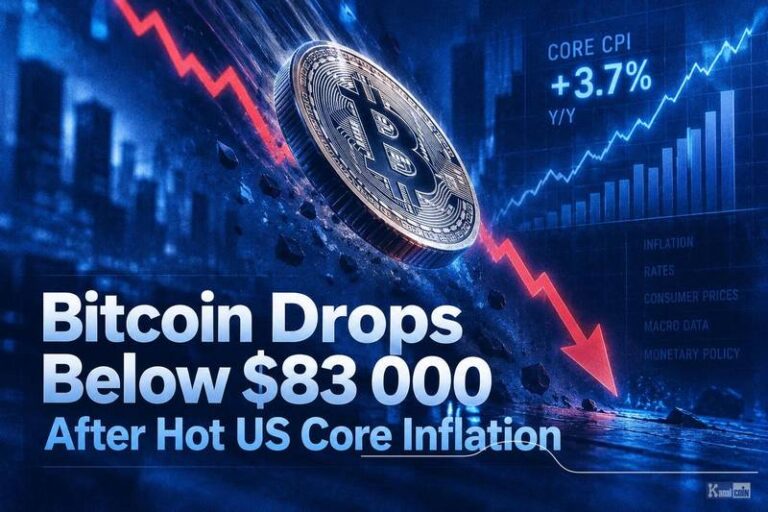
Bitcoin fell below $83,000 after hotter-than-expected US core inflation data rattled risk assets across global markets, triggering more than $100 million in crypto liquidations within a single hour. The swift move underscored how sensitive leveraged crypto positions remain to macroeconomic data releases, with Southeast Asian traders on platforms such as Indodax and Tokocrypto exposed to the rapid price swing during regional trading hours.
Bitcoin Drops Below $83,000 After US Core Inflation Surprise
The sell-off accelerated after the US Bureau of Labor Statistics released consumer price index figures showing core inflation running hotter than markets had anticipated. Bitcoin, which had been holding above the $83,000 level, broke below that threshold as traders repriced the likelihood of tighter monetary policy from the Federal Reserve.
The $83,000 level had drawn attention as a near-term support zone. A break below it compounded selling pressure as stop-loss orders and margin calls on derivatives exchanges fired in sequence. This pattern mirrors earlier episodes, including when Bitcoin fell below $75,000 on Fed rate hike fears before staging a partial recovery. For related coverage, see Bitcoin ETFs See $635 Million in Outflows as BTC Drops Below $80,000.
More Than $100 Million in Crypto Liquidations Hit Within an Hour
The derivatives market bore the sharpest impact. More than $100 million in crypto positions were liquidated within one hour of the price move, according to the headline data. That speed of forced unwinding points to concentrated leverage across perpetual futures markets rather than a gradual reduction in risk appetite. For related coverage, see Bitcoin Falls to $78.4K as Fed's Warsh Downplays Inflation.
When Bitcoin moves sharply on a macro catalyst, leveraged long positions face automatic liquidation if margin thresholds are breached. Each forced close adds fresh sell-side pressure, which can push prices further against remaining leveraged holders. The sequence echoes the dynamic seen when Bitcoin ETFs recorded $635 million in outflows as BTC dropped below $80,000, suggesting institutional and retail positioning had both been stretched heading into the inflation print. For related coverage, see American Bitcoin Drops 8.4% Ahead of Reverse Stock Split to Maintain Listing.
For Southeast Asian retail traders, the timing added difficulty. A rapid intraday drawdown of this scale on a macro trigger leaves little room to react, particularly on platforms where customer support and circuit-breaker mechanisms differ from major Western venues.
What Traders Will Watch After the Inflation-Driven Sell-Off
The immediate question is whether Bitcoin can stabilize around the $83,000 area or whether the break establishes a lower trading range. A sustained close below that level would shift short-term technical momentum, though any recovery in risk sentiment or softer subsequent inflation readings could reverse the move. Traders who watched Bitcoin fall to $78,400 before recovering when a Fed official downplayed soft inflation data will be alert to how quickly the narrative can shift.
Further liquidation activity remains a risk if Bitcoin fails to reclaim $83,000 quickly. Elevated open interest heading into the inflation release means residual leverage may still be present across the derivatives stack. Regional exchanges in Southeast Asia, where crypto adoption has expanded sharply over the past two years, will be monitoring whether the selling pressure attracts bargain buyers or deepens into a broader de-risking cycle tied to the global macro outlook.
Disclaimer: This article is for informational purposes only and does not constitute financial or investment advice. Cryptocurrency and digital asset markets carry significant risk. Always do your own research before making decisions.