Peter Schiff explains the gold surge as the result of a collapsing dollar, falling real yields, and an unavoidable Federal Reserve pivot.
In January 2026, gold moved above $5,000 as the DXY fell toward 97, signaling what Schiff calls a structural breakdown of dollar credibility. As the dollar loses purchasing power, gold, as a fixed supply monetary asset, is repricing higher to reflect real economic value.Peter Schiff says negative real yields and coming Fed cuts have eliminated the opportunity cost of holding gold. With inflation running hotter than interest rates and U.S. debt above $35 trillion, the Fed is trapped into easing to sustain the system.
Why Gold Is Moving Now: Peter Schiff–Carlson claims, real yields, and DXY
Gold is rising because real yields are falling, the U.S. dollar is weakening, and global capital is shifting into hard assets. Peter Schiff and Tucker Carlson both argue that gold’s move above $5,000 is not speculation but a monetary reset driven by dollar debasement and de-dollarization pressure.
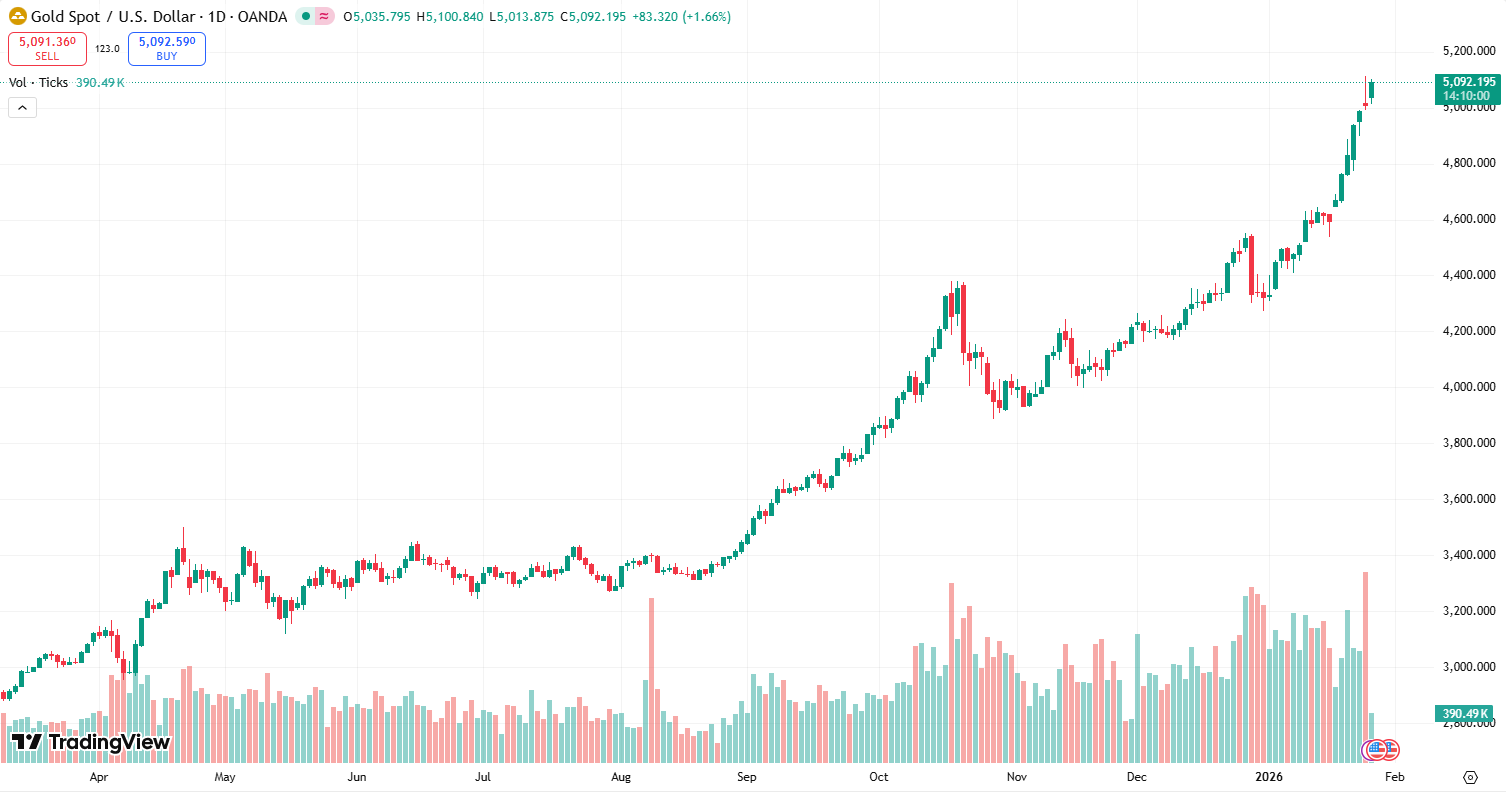
The key macro trigger is collapsing real yields. Markets now price multiple Federal Reserve rate cuts in 2026, which pushes inflation-adjusted yields toward zero or negative territory. When this happens, holding bonds becomes unattractive and capital moves into gold instead.
At the same time, the U.S. Dollar Index (DXY) has dropped near 99, reflecting a break in the dollar’s long-term super-cycle. A weaker dollar mechanically raises gold prices because gold is priced in dollars globally.
Central banks, especially in China, Russia, and emerging markets, are accelerating gold purchases to diversify away from dollar reserves. This structural shift is one of the main reasons analysts now project gold toward $6,000 rather than viewing this as a temporary rally
How inflation, real yields, Federal Reserve policy, and DXY drive gold
Gold moves inversely to real interest rates and the U.S. dollar. When inflation runs higher than interest rates, real yields fall, reducing the opportunity cost of holding gold. This is exactly what is happening in early 2026 as inflation remains above target while the Federal Reserve prepares to ease policy.
Federal Reserve policy drives gold through two channels. Rate cuts weaken the dollar and push real yields lower, which lifts gold. Rate hikes do the opposite by strengthening the dollar and raising bond yields, which pressures gold prices.
The DXY acts as a global transmission mechanism. A strong dollar makes gold expensive for foreign buyers, reducing demand. A weak DXY makes gold cheaper worldwide, increasing demand and pushing prices higher.
Despite these correlations, gold has recently decoupled upward due to geopolitical risk and massive central-bank buying, which now act as permanent structural supports for the metal rather than temporary spikes.
Silver’s slipstream: gold–silver ratio, volatility, and industrial demand
The gold–silver ratio has collapsed from 100:1 in 2025 to roughly 47:1 in January 2026, meaning silver is dramatically outperforming gold. This is its lowest level in over 15 years and signals a powerful silver bull phase.
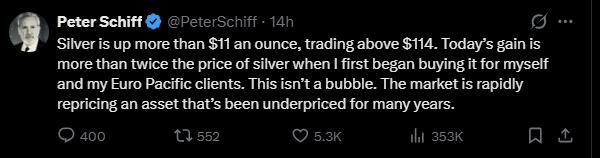
Silver is often described as “gold on steroids.” Its smaller market means capital inflows produce much larger price swings. Annualized volatility above 75% makes silver high-risk but extremely leveraged to gold’s trend
On the fundamental side, silver faces a structural supply deficit. Over 70% of silver is produced as a byproduct of copper and zinc mining, so supply cannot quickly respond to higher prices. At the same time, green energy, AI, and electronics are driving record industrial demand. This creates a liquidity trap for buyers and explains why silver surged past $100 much faster than gold.
ETF or bullion? GLD/SLV trade-offs, premiums, custody, tracking error
ETF flows, World Gold Council data, and GLD/SLV liquidity
Global physically-backed gold ETFs recorded $89 billion of inflows (801 metric tons) in 2025, the strongest year ever. Assets under management for gold ETFs have doubled to all-time highs.
GLD, the largest gold ETF, now holds around $172.75 billion in assets and is one of the most liquid financial instruments in the world, making it ideal for institutional trading. SLV, with over $50 billion in AUM, offers similar liquidity for silver but with higher volatility.
However, Peter Schiff warns that ETFs are paper claims. They depend on custodians, vault operators, clearing systems, and financial institutions that may not function normally during a monetary crisis.
Physical custody, taxes, spreads, and avoiding common retail pitfalls
Physical gold removes counterparty risk but adds storage and tax complexity. There are three main storage options.
- Home safes offer control but risk theft.
- Bank deposit boxes are secure but limited in access.
- Professional vaults provide full insurance and climate control but charge annual fees
In the U.S., physical metals are taxed as collectibles. Long-term gains are taxed up to 28%, higher than stocks. Dealer spreads also reduce returns, so buyers should avoid numismatic coins and stick to low-premium bullion. For Peter Schiff, physical metal is not a trade. It is financial insurance against currency failure.
Risks and signals: spot vs futures, CPI/FOMC/DXY, real yields
BLS CPI calendar, FOMC guidance, and liquidity-driven risk-off moves
Gold is being driven by CPI, Fed policy, and a weakening dollar. The FOMC meeting on January 27–28, 2026 is expected to signal a policy pause with rate cuts later in the year. The January CPI report on February 11, 2026 will determine whether inflation remains above target and keeps real yields low.
The DXY has fallen to around 97, a multi-month low, boosting gold and silver prices. Thin liquidity and geopolitical uncertainty are also pushing risk-off capital into precious metals.
Bitcoin correlation, government deficits, and U.S. dollar impulse
Gold is benefiting from U.S. deficits and dollar weakness while Bitcoin diverges. The U.S. ran a $1.8 trillion deficit in 2025 and is projected to run $1.7 trillion in 2026, reinforcing long-term currency debasement.
Gold gained over 65% in 2025, while Bitcoin underperformed, showing that markets currently prefer hard-asset safety over crypto speculation.
Peter Schiff maintains that Bitcoin is driven by liquidity and hype, while gold is driven by monetary reality. In a true currency crisis, he expects gold and silver to outperform all financial assets.
| Disclaimer: This website provides information only and is not financial advice. Cryptocurrency investments are risky. We do not guarantee accuracy and are not liable for losses. Conduct your own research before investing. |