

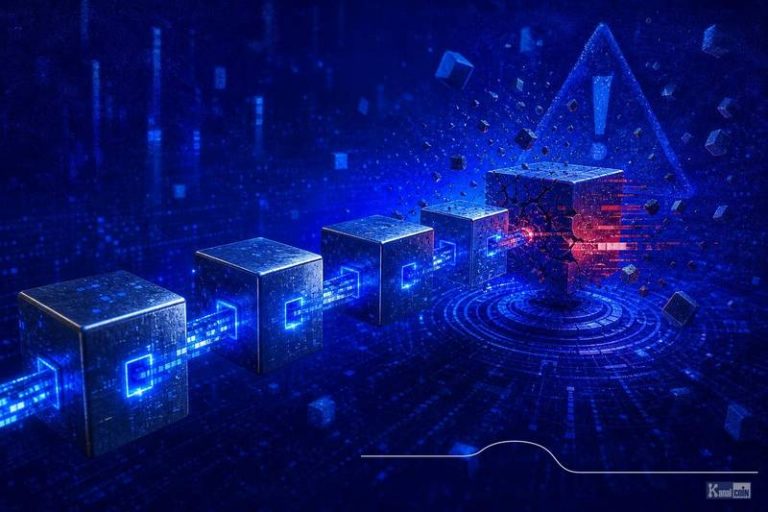
Base blockchain experienced an “Unsafe Head Stall” that interrupted block production on the Coinbase-backed Layer 2 network, forcing users and applications to contend with delayed transaction processing.
What happened during Base’s ‘Unsafe Head Stall’
TLDR KEYPOINTS
- Base suffered an “Unsafe Head Stall,” halting normal block production
- The interruption affected transaction confirmations across the network
- Users can track resolution progress through Base’s official status page
An Unsafe Head Stall occurs when the network’s sequencer stops advancing the chain tip that nodes consider safe for processing. In practical terms, new blocks either stop being produced or stop being finalized, leaving pending transactions in limbo. For related coverage, see FBI Seeks Forfeiture of Nearly $1M Tied to Adam Iza.
The incident was logged on Base’s incident history page, which records network disruptions and their resolution status. The exact duration and root cause have not been publicly detailed at the time of writing. For related coverage, see Circle and Nomura Partner to Target Japan's Foreign Exchange Market.
Why the Base disruption matters for users and the wider ecosystem
When block production stalls on a Layer 2 network, every on-chain action pauses. Token swaps, NFT mints, lending protocol interactions, and any other smart contract calls submitted during the interruption would have faced delays or failures.
Direct impact on users and applications
Pending transactions sent to Base during the stall would not have confirmed until block production resumed. Users bridging assets between Ethereum and Base may have experienced additional uncertainty, as bridge contracts rely on consistent block finality to process deposits and withdrawals.
Decentralized applications built on Base, spanning trading platforms to social protocols, would have been unable to process new state changes. For traders with time-sensitive positions, even a brief production halt can result in missed opportunities or unexpected exposure, similar to the volatility that drove nearly $500 million in Bitcoin and Ether ETF outflows during recent market stress.
Broader ecosystem considerations
Base has grown into one of the most active Ethereum Layer 2 networks. A block production interruption on a chain of this scale draws attention to the operational risks that still exist in rollup infrastructure, even when backed by a major institution like Coinbase.
Network reliability incidents can affect user confidence and developer sentiment. Projects evaluating which Layer 2 to build on weigh uptime records heavily, and events like the Unsafe Head Stall become part of that calculus. Infrastructure reliability is a growing focus across the sector, with efforts such as Cambrian’s seed round for a blockchain data oracle network aimed at improving on-chain data integrity.
What to watch after the block production interruption
The most immediate indicator of recovery is the resumption of consistent block production. Users can verify this by checking the Base status page, which tracks ongoing and resolved incidents.
Signals that indicate normalization
Normal operations are restored when new blocks appear at Base’s standard interval, pending transactions clear from the mempool, and the status page reflects a resolved state. Users should also watch for a post-incident report from the Base team on the official Base blog, which typically details root cause and prevention measures.
Until an official explanation is published, the specific trigger behind the Unsafe Head Stall remains unconfirmed. The broader crypto lending and infrastructure space continues to adapt to these operational challenges, as highlighted by developments like Galaxy’s backing of Tokenet to bring securities-lending standards to crypto.
Disclaimer: This article is for informational purposes only and does not constitute financial or investment advice. Cryptocurrency and digital asset markets carry significant risk. Always do your own research before making decisions.